Download the free toolbox talk
The one-page talk, editable Word version, and guidance below are open to everyone. No account required.
One-page toolbox talk
Download one-page toolbox talk (PDF, 1 page)Editable one-page toolbox talk (Word)Preview the one-page toolbox talk
Supporting documents
Included with free Safety & Systems membership.
Supervisor field check
A separate check to verify conditions and controls before work. Includes a one-page PDF and editable Word file.
Attendance sheet
A separate sign-in sheet to record the crew discussion. Includes a one-page PDF and editable Word file.
Need the crew records? Join free to use these supporting documents and the Safety & Systems Academy. No payment details. Email updates are optional.
Get supporting documents — free membershipAlready a member? Use the same link to sign in.
Hazard-based toolbox talk 12 of 52, with a practical HOP exercise.
Plan a 5–10 minute toolbox discussion, plus time to verify the actual controls. The one-page toolbox talk and editable Word version are public. Separate supervisor and attendance records are included with free Safety & Systems membership.
Why this matters
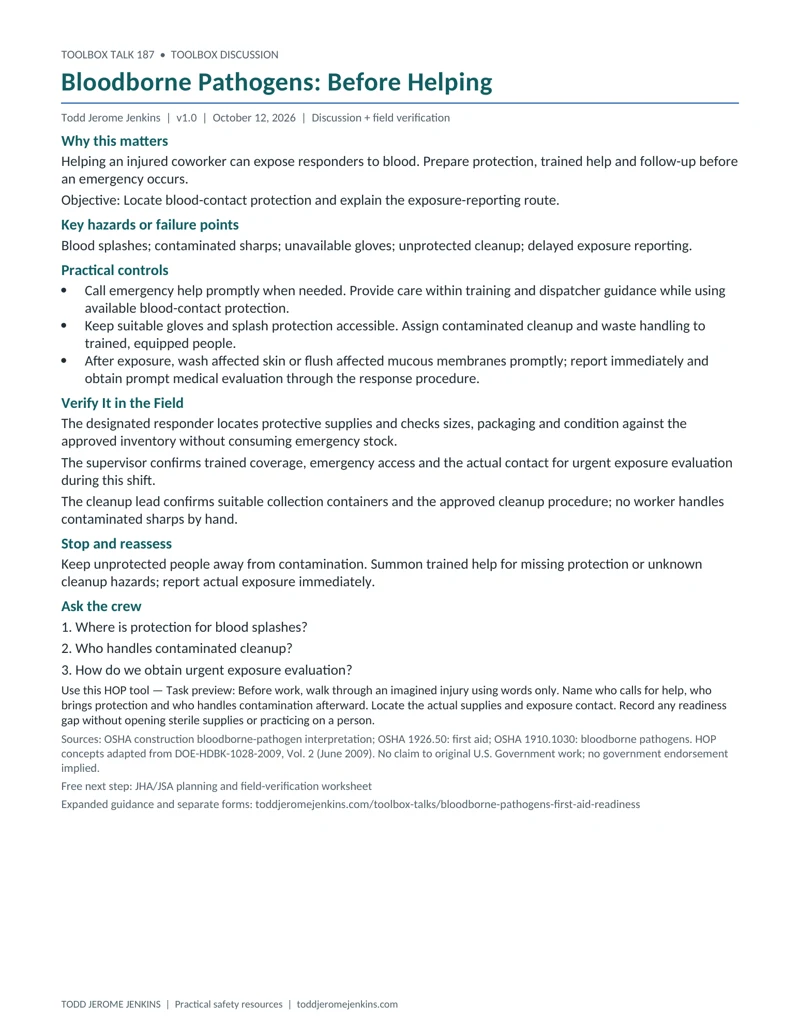
Helping an injured coworker can expose responders to blood. Prepare protection, trained help and follow-up before an emergency occurs.
Learning objective
Locate blood-contact protection and explain the exposure-reporting route.
Key hazards or failure points
Blood splashes; contaminated sharps; unavailable gloves; unprotected cleanup; delayed exposure reporting.
Practical controls
- Call emergency help promptly when needed. Provide care within training and dispatcher guidance while using available blood-contact protection.
- Keep suitable gloves and splash protection accessible. Assign contaminated cleanup and waste handling to trained, equipped people.
- After exposure, wash affected skin or flush affected mucous membranes promptly; report immediately and obtain prompt medical evaluation through the response procedure.
Verify It in the Field
- The designated responder locates protective supplies and checks sizes, packaging and condition against the approved inventory without consuming emergency stock.
- The supervisor confirms trained coverage, emergency access and the actual contact for urgent exposure evaluation during this shift.
- The cleanup lead confirms suitable collection containers and the approved cleanup procedure; no worker handles contaminated sharps by hand.
Stop and reassess
Keep unprotected people away from contamination. Summon trained help for missing protection or unknown cleanup hazards; report actual exposure immediately.
Crew discussion questions
- Where is protection for blood splashes?
- Who handles contaminated cleanup?
- How do we obtain urgent exposure evaluation?
For each required control, record its acceptance source and criterion, safe verification method, responsible verifier, actual result and time. Mark VERIFIED, HOLD/NOT VERIFIED, or N/A with a reason. Complete all required inspections; never enter danger or improvise a test to fill out a form.
Use this HOP tool
Task preview
Before work, walk through an imagined injury using words only. Name who calls for help, who brings protection and who handles contamination afterward. Locate the actual supplies and exposure contact. Record any readiness gap without opening sterile supplies or practicing on a person.
This exercise supports hazard identification or control verification. It does not replace safeguards, required training, specialist decisions or work authorization.
Leader preparation and practical detail
Preparation protects the response
Preview a possible injury before work. Identify who calls, who brings supplies and who assists emergency personnel. Keep protective supplies with usable access from the current work location. Do not use a briefing or form as proof of first-aid competence, and do not turn a readiness discussion into a reason to delay an emergency call.
Construction and maintenance differ
OSHA’s currently hosted January 26, 1993 interpretation distinguishes construction from maintenance: 1910.1030 does not directly apply to construction work as defined there. Construction training, PPE, waste provisions and the General Duty Clause still protect occupationally exposed responders. Employers must determine the applicable activity and exposure obligations; maintenance with occupational exposure can fall under 1910.1030.
Follow-up must be usable now
Identify how an exposed worker reaches medical evaluation after hours and how immediate washing or flushing is available. Do not put private medical information on the attendance or field-check sheet. The employer’s response arrangement should address contaminated materials and protective equipment removal as well as the initial assistance. This talk does not prescribe clinical treatment.
Short supervisor field check
- Responder coverage confirmed
- Protective supplies available
- Emergency contact usable
- Cleanup responsibility assigned
- Exposure follow-up ready
Use the separate sheet to document evidence, unresolved restrictions, correction owner, recheck and required release authority. Rebrief affected workers. This record does not replace specialist inspections, permits or engineering determinations.
Attendance and follow-through
Use the separate attendance record for participants, roles, questions, actions and late-arrival rebriefs. Attendance does not prove competence, functioning controls or authorization. Keep completed records private under employer procedures.
Source acknowledgment
HOP concepts are adapted from DOE-HDBK-1028-2009, Human Performance Improvement Handbook, Volume 2 (June 2009). Todd Jerome Jenkins makes no claim to authorship or copyright ownership of original U.S. Government work. The explanations and exercises are original adaptations; no endorsement by DOE or the U.S. Government is implied. Third-party material credited in the handbook retains its separate ownership.
HOP source: Volume 2/VOLUME 2 TASK PREVIEW.pdf; PDF1–2; printed6–7. The handbook supplies concepts; task-specific technical references are listed below.
Technical scope and references
Technical sources inspected October 9, 2026; resource edition October 12, 2026. Apply current jurisdictional requirements, the actual task procedure, manufacturer instructions, permits and required competent or qualified decisions. This resource supplies no equipment-specific acceptance criteria.
- OSHA construction bloodborne-pathogen interpretation — January 26, 1993; corrected 2004; scope distinction.
- OSHA 1926.50: first aid — Construction medical readiness.
- OSHA 1910.1030: bloodborne pathogens — Direct applicability depends on activity; reference for exposure response.
- DOE-HDBK-1028-2009 Volume 2 (June 2009) — PDF1–2; printed6–7; HOP concept basis, original exercise.
Connect this discussion to your JHA/JSA
Use the JHA/JSA planning and field-verification worksheet to connect this discussion to the actual task, controls and responsible people.
Related Todd Jerome Jenkins articles: How to Conduct a Job Safety Analysis and What Is Human and Organizational Performance?.
Related toolbox talks
- Severe Bleeding: Check Response Readiness
- CPR and AED Readiness: Can We Act Now?
- Emergency Readiness: Can We Reach Supplies and Call for Help?
Continue the hazard series
Put one verification into practice
Record today’s change and evidence using the free JHA/JSA planning and field-verification worksheet.