Download the free toolbox talk
The one-page talk, editable Word version, and guidance below are open to everyone. No account required.
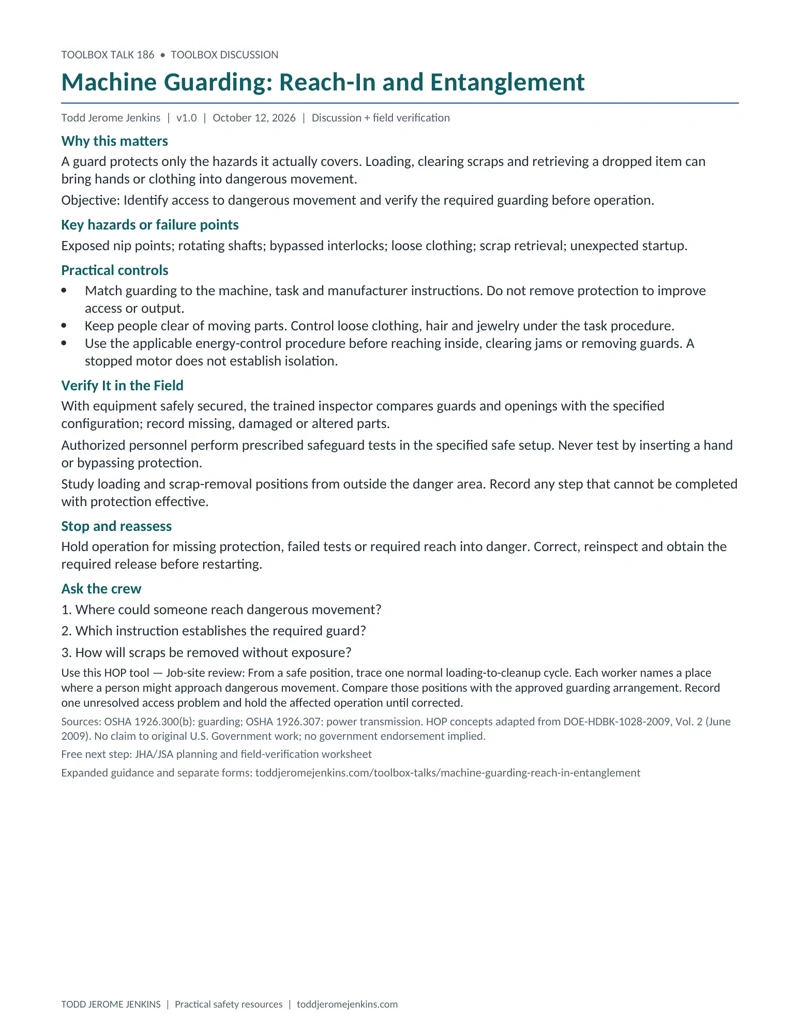
One-page toolbox talk
Download one-page toolbox talk (PDF, 1 page)Editable one-page toolbox talk (Word)Preview the one-page toolbox talk
Supporting documents
Included with free Safety & Systems membership.
Supervisor field check
A separate check to verify conditions and controls before work. Includes a one-page PDF and editable Word file.
Attendance sheet
A separate sign-in sheet to record the crew discussion. Includes a one-page PDF and editable Word file.
Need the crew records? Join free to use these supporting documents and the Safety & Systems Academy. No payment details. Email updates are optional.
Get supporting documents — free membershipAlready a member? Use the same link to sign in.
Hazard-based toolbox talk 11 of 52, with a practical HOP exercise.
Plan a 5–10 minute toolbox discussion, plus time to verify the actual controls. The one-page toolbox talk and editable Word version are public. Separate supervisor and attendance records are included with free Safety & Systems membership.
Why this matters
A guard protects only the hazards it actually covers. Loading, clearing scraps and retrieving a dropped item can bring hands or clothing into dangerous movement.
Learning objective
Identify access to dangerous movement and verify the required guarding before operation.
Key hazards or failure points
Exposed nip points; rotating shafts; bypassed interlocks; loose clothing; scrap retrieval; unexpected startup.
Practical controls
- Match guarding to the machine, task and manufacturer instructions. Do not remove protection to improve access or output.
- Keep people clear of moving parts. Control loose clothing, hair and jewelry under the task procedure.
- Use the applicable energy-control procedure before reaching inside, clearing jams or removing guards. A stopped motor does not establish isolation.
Verify It in the Field
- With equipment safely secured, the trained inspector compares guards and openings with the specified configuration; record missing, damaged or altered parts.
- Authorized personnel perform prescribed safeguard tests in the specified safe setup. Never test by inserting a hand or bypassing protection.
- Study loading and scrap-removal positions from outside the danger area. Record any step that cannot be completed with protection effective.
Stop and reassess
Hold operation for missing protection, failed tests or required reach into danger. Correct, reinspect and obtain the required release before restarting.
Crew discussion questions
- Where could someone reach dangerous movement?
- Which instruction establishes the required guard?
- How will scraps be removed without exposure?
For each required control, record its acceptance source and criterion, safe verification method, responsible verifier, actual result and time. Mark VERIFIED, HOLD/NOT VERIFIED, or N/A with a reason. Complete all required inspections; never enter danger or improvise a test to fill out a form.
Use this HOP tool
Job-site review
From a safe position, trace one normal loading-to-cleanup cycle. Each worker names a place where a person might approach dangerous movement. Compare those positions with the approved guarding arrangement. Record one unresolved access problem and hold the affected operation until corrected.
This exercise supports hazard identification or control verification. It does not replace safeguards, required training, specialist decisions or work authorization.
Leader preparation and practical detail
Study the whole work cycle
A guard assessment should include feeding, collecting finished work and removing scraps, not just the machine while producing. This is a practical application of job-site review: identify where actual work differs from the assumed operating position. Keep the review outside the hazardous area; discovering a difficult reach is a reason to redesign the method, not demonstrate that a hand fits.
Use construction requirements correctly
Construction 1926.300(b) addresses guarding exposed moving parts and points of operation. Section 1926.307 addresses mechanical power transmission. Identify additional rules for the particular machine. General-industry 1910.212 is not the sole construction reference, and this talk does not supply guard-opening dimensions or approve homemade guards.
Separate operation from servicing
Guarding normal operation and controlling energy during servicing serve different purposes. A person authorized under the employer procedure must establish the safe state before guards are removed or anyone enters the danger area. Document repair and required testing before return to operation; an out-of-service tag alone is not evidence of repair.
Short supervisor field check
- Machine and task identified
- Guard configuration confirmed
- Safe tests completed
- Loading and cleanup reviewed
- Defects held for correction
Use the separate sheet to document evidence, unresolved restrictions, correction owner, recheck and required release authority. Rebrief affected workers. This record does not replace specialist inspections, permits or engineering determinations.
Attendance and follow-through
Use the separate attendance record for participants, roles, questions, actions and late-arrival rebriefs. Attendance does not prove competence, functioning controls or authorization. Keep completed records private under employer procedures.
Source acknowledgment
HOP concepts are adapted from DOE-HDBK-1028-2009, Human Performance Improvement Handbook, Volume 2 (June 2009). Todd Jerome Jenkins makes no claim to authorship or copyright ownership of original U.S. Government work. The explanations and exercises are original adaptations; no endorsement by DOE or the U.S. Government is implied. Third-party material credited in the handbook retains its separate ownership.
HOP source: Volume 2/VOLUME 2 JOB-SITE REVIEW.pdf; PDF1–2; printed8–9. The handbook supplies concepts; task-specific technical references are listed below.
Technical scope and references
Technical sources inspected October 9, 2026; resource edition October 12, 2026. Apply current jurisdictional requirements, the actual task procedure, manufacturer instructions, permits and required competent or qualified decisions. This resource supplies no equipment-specific acceptance criteria.
- OSHA 1926.300(b): guarding — Construction tools and machinery.
- OSHA 1926.307: power transmission — Apply the relevant apparatus provisions.
- DOE-HDBK-1028-2009 Volume 2 (June 2009) — PDF1–2; printed8–9; HOP concept basis, original exercise.
Connect this discussion to your JHA/JSA
Use the JHA/JSA planning and field-verification worksheet to connect this discussion to the actual task, controls and responsible people.
Related Todd Jerome Jenkins articles: How to Conduct a Job Safety Analysis and What Is Human and Organizational Performance?.
Related toolbox talks
Continue the hazard series
Put one verification into practice
Record today’s change and evidence using the free JHA/JSA planning and field-verification worksheet.
Apply this to a specific situation
Conveyors: Hold the Restart After a Jam adds a focused toolbox exercise and field-verification guidance.