Download the talk and separate crew records
Free to download without an account. Each PDF is one page. Use the Word version to adapt the record to your task and approved procedures.
Supervisor field check
Download supervisor field check (PDF, 1 page)Editable supervisor field check (Word)Preview the one-page crew talk
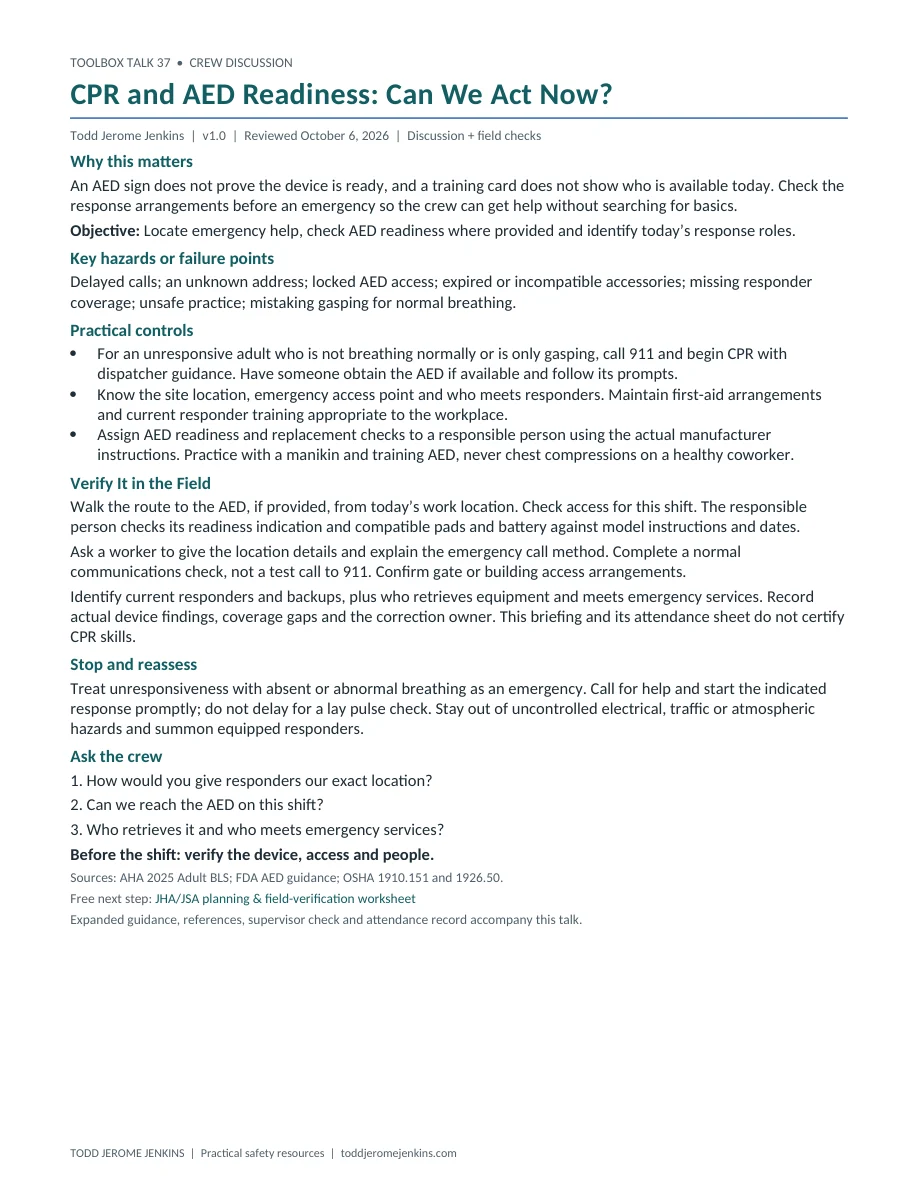
A 5–10 minute crew discussion, plus the time needed for field verification. All six downloads are free without a required signup.
Why this matters
An AED sign does not prove the device is ready, and a training card does not show who is available today. Check the response arrangements before an emergency so the crew can get help without searching for basics.
Learning objective: Locate emergency help, check AED readiness where provided and identify today’s response roles.
Key hazards or failure points
Delayed calls; an unknown address; locked AED access; expired or incompatible accessories; missing responder coverage; unsafe practice; mistaking gasping for normal breathing.
Practical controls
- For an unresponsive adult who is not breathing normally or is only gasping, call 911 and begin CPR with dispatcher guidance. Have someone obtain the AED if available and follow its prompts.
- Know the site location, emergency access point and who meets responders. Maintain first-aid arrangements and current responder training appropriate to the workplace.
- Assign AED readiness and replacement checks to a responsible person using the actual manufacturer instructions. Practice with a manikin and training AED, never chest compressions on a healthy coworker.
Verify It in the Field
Walk the route to the AED, if provided, from today’s work location. Check access for this shift. The responsible person checks its readiness indication and compatible pads and battery against model instructions and dates.
Ask a worker to give the location details and explain the emergency call method. Complete a normal communications check, not a test call to 911. Confirm gate or building access arrangements.
Identify current responders and backups, plus who retrieves equipment and meets emergency services. Record actual device findings, coverage gaps and the correction owner. This briefing and its attendance sheet do not certify CPR skills.
Use the separate field check to record the source and criterion, safe method, checker, actual result and time. Mark VERIFIED, HOLD/NOT VERIFIED, or N/A with a reason. Check every required control; the examples below do not clear the whole task.
| Control | Safe verification | Evidence to record |
|---|---|---|
| Ready AED | Responsible person follows the actual device inspection instructions. | Model, source, indicator/accessory findings and correction. |
| Reachable emergency help | Rehearse location information with a normal communication check. | Method, exact location and access arrangement. |
| Response roles | Confirm current coverage and backups for the shift. | Roles, training gap and follow-up owner. |
Stop and reassess
Treat unresponsiveness with absent or abnormal breathing as an emergency. Call for help and start the indicated response promptly; do not delay for a lay pulse check. Stay out of uncontrolled electrical, traffic or atmospheric hazards and summon equipped responders.
Crew discussion questions
- How would you give responders our exact location?
- Can we reach the AED on this shift?
- Who retrieves it and who meets emergency services?
Before the shift: verify the device, access and people.
A situation to discuss
Illustrative situation: the AED route is clear, but its readiness indicator needs attention under the manufacturer’s instructions. The responsible person follows the device procedure, arranges the program’s backup and assigns correction. Nobody marks the device ready simply because it is hanging in its usual place.
Leader preparation and practical detail
A brief response reminder has limits
AHA’s 2025 adult guidance supports immediate emergency activation and CPR for an unresponsive adult with absent or abnormal breathing. Compression-only CPR is appropriate for untrained or unwilling adult lay rescuers; trained rescuers should include breaths according to their training. Do not generalize hands-only messaging to children, drowning or overdose. Use current practical instruction and dispatcher help. [1], [5]
Check the actual AED system
Use the model’s current instructions to interpret its readiness indicator and inspect the specified accessories. A different brand or model may use different indicators and maintenance steps. Compatible pads and batteries, usable packaging and the applicable replacement dates matter. This resource does not supply a universal inspection interval or readiness color. [2]
Check coverage against the operation
First-aid requirements differ by industry and conditions. Review the applicable standard and the site’s medical arrangements rather than deriving a universal AED mandate from this talk. Consider changes in shifts, gates, remote work locations and emergency access. Rehearsal should use training equipment and leave emergency supplies ready for real use. [3], [4]
Prepare protection for designated responders
Where occupational exposure to blood or other potentially infectious material falls within 1910.1030, the employer’s exposure-control arrangements, training and appropriate protective equipment apply. Before an emergency, confirm that designated responders can access the equipment selected for their expected tasks, in suitable sizes and usable condition. Follow the program for exposure reporting and contaminated materials. This talk does not establish a universal glove material or authorize untrained cleanup.
Short supervisor field check
- Call method and exact location understood.
- AED route accessible when provided.
- Device and accessories checked using model instructions.
- Responder, equipment-retrieval and access roles covered.
- Readiness gaps corrected or program backup arranged.
Use the separate form to document evidence, restrictions, corrective-action owner, recheck and required restart approval. An unresolved required control means hold the affected work. Missing evidence is not a pass. Complete all task-specific inspections and permits.
Attendance and follow-through
The separate attendance sheet records participants, language support, questions, actions and late-arrival rebriefs. Attendance does not establish competence or prove controls function. Keep completed records private under the employer’s procedures.
Technical scope and references
This is adult response readiness and a brief reminder, not CPR/AED certification or a complete resuscitation course. Pediatric and other special circumstances need the appropriate current training. Apply the actual device instructions and industry-specific first-aid requirements. [1], [2], [3], [4], [5]
References checked October 6, 2026. Apply the jurisdiction, task, employer program and equipment instructions that govern the work. No site-specific manual, permit, engineering determination or product SDS has been approved by this general resource.
- 2025 AHA Guidelines, Part 7: Adult Basic Life Support — Lay rescuer recognizes unresponsiveness plus absent/abnormal breathing, including gasping, without requiring pulse check. Activate emergency response promptly and start CPR. Compression-only appropriate for untrained/unwilling adult lay rescuers; trained rescuers encouraged to include breaths. 100–120/min is published adult rate if included. Briefing is not certification.
- Automated External Defibrillators (AEDs) — AED systems depend on correct battery and pad accessories, and manufacturers resolve device compatibility/approval questions. Do not infer readiness from the wall sign alone.
- 29 CFR 1910.151 Medical services and first aid — General-industry medical advice, first-aid readiness and suitable quick drenching/flushing facilities where injurious corrosive exposure may occur. Scope actual operation before applying.
- 29 CFR 1926.50 Medical services and first aid — Construction-specific readiness requirements. No universal emergency response time or AED mandate derived here.
- Hands-Only CPR vs CPR With Breaths — CPR Guide — Hands-only adult/teen scope; CPR with breaths covers infants/children, drowning, drug overdose and respiratory causes. Link only; copyrighted graphic not copied.
Connect this discussion to your JHA/JSA
Use How to Conduct a Job Safety Analysis to connect today’s work steps, hazards and controls. Revisit Pre-Job JHA/JSA: What Changed Today? whenever conditions change.
Related published crew resources: Emergency Evacuation: Know the Route and Count the Crew; Working Alone: Check In and Get Help; Suspected Opioid Overdose: Get Help and Be Ready.
Put one check into practice
Download the free JHA/JSA planning and field-verification worksheet. For today’s task, record an important control, its source and the evidence needed before exposure. Complete the remaining required checks through your task plan.