Download the talk and separate crew records
Free to download without an account. Each PDF is one page. Use the Word version to adapt the record to your task and approved procedures.
Supervisor field check
Download supervisor field check (PDF, 1 page)Editable supervisor field check (Word)Preview the one-page crew talk
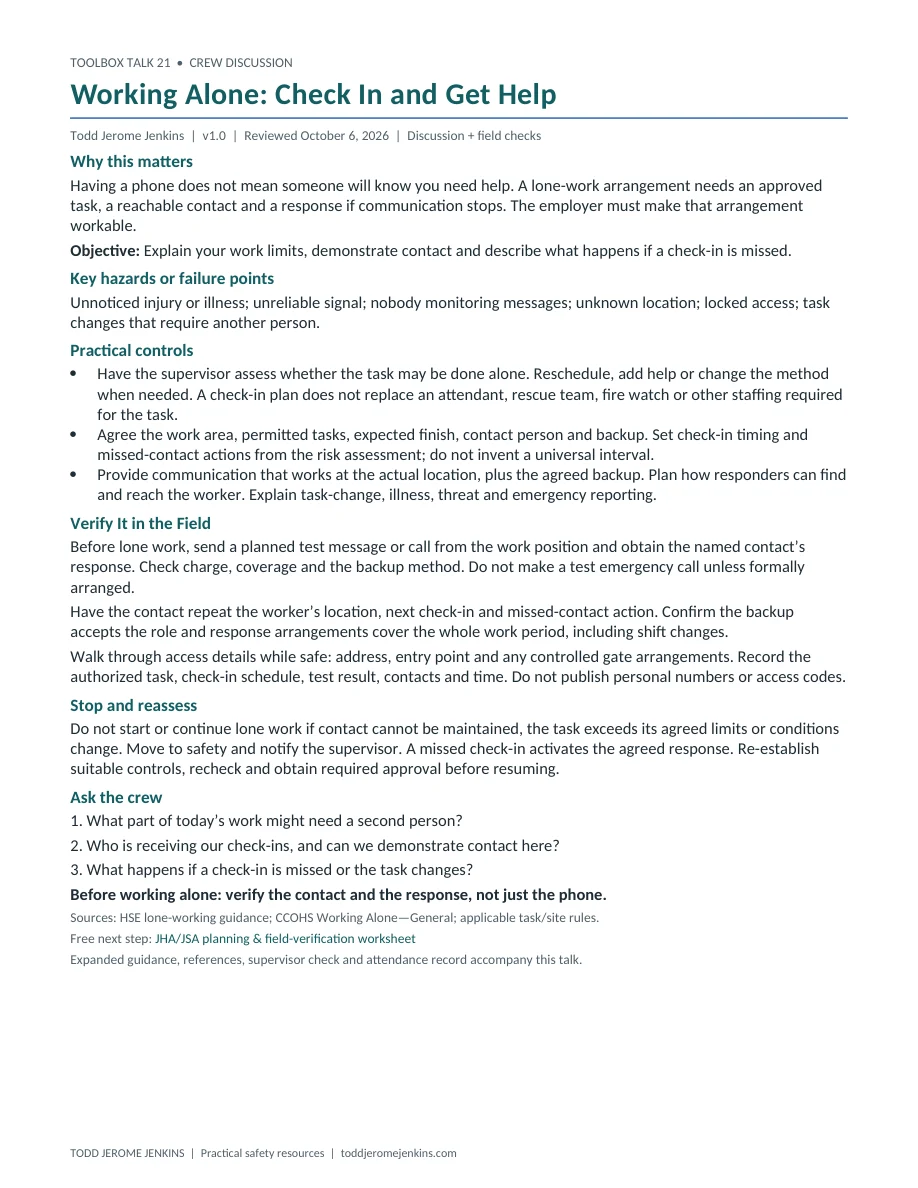
A 5–10 minute crew discussion, plus the time needed for field verification. All six downloads are free without a required signup.
Why this matters
Having a phone does not mean someone will know you need help. A lone-work arrangement needs an approved task, a reachable contact and a response if communication stops. The employer must make that arrangement workable.
Learning objective: Explain your work limits, demonstrate contact and describe what happens if a check-in is missed.
Key hazards or failure points
Unnoticed injury or illness; unreliable signal; nobody monitoring messages; unknown location; locked access; task changes that require another person.
Practical controls
- Have the supervisor assess whether the task may be done alone. Reschedule, add help or change the method when needed. A check-in plan does not replace an attendant, rescue team, fire watch or other staffing required for the task.
- Agree the work area, permitted tasks, expected finish, contact person and backup. Set check-in timing and missed-contact actions from the risk assessment; do not invent a universal interval.
- Provide communication that works at the actual location, plus the agreed backup. Plan how responders can find and reach the worker. Explain task-change, illness, threat and emergency reporting.
Verify It in the Field
Before lone work, send a planned test message or call from the work position and obtain the named contact’s response. Check charge, coverage and the backup method. Do not make a test emergency call unless formally arranged.
Have the contact repeat the worker’s location, next check-in and missed-contact action. Confirm the backup accepts the role and response arrangements cover the whole work period, including shift changes.
Walk through access details while safe: address, entry point and any controlled gate arrangements. Record the authorized task, check-in schedule, test result, contacts and time. Do not publish personal numbers or access codes.
Use the separate field check to record the source and criterion, safe method, checker, actual result and time. Mark VERIFIED, HOLD/NOT VERIFIED, or N/A with a reason. Check every required control; the examples below do not clear the whole task.
| Control | Safe verification | Evidence to record |
|---|---|---|
| Approved scope | Supervisor compares the task with lone-work assessment and applicable staffing requirements. | Permitted activities and limits recorded; unsuitable tasks assigned another arrangement. |
| Working contact | Planned call/message from the actual location, with acknowledgment. | Primary and backup contact confirmed; coverage failures resolved. |
| Response readiness | Contact explains missed-check action and confirms responder access information. | Timing, location, escalation and end-of-work confirmation agreed. |
Stop and reassess
Do not start or continue lone work if contact cannot be maintained, the task exceeds its agreed limits or conditions change. Move to safety and notify the supervisor. A missed check-in activates the agreed response. Re-establish suitable controls, recheck and obtain required approval before resuming.
Crew discussion questions
- What part of today’s work might need a second person?
- Who is receiving our check-ins, and can we demonstrate contact here?
- What happens if a check-in is missed or the task changes?
Before working alone: verify the contact and the response, not just the phone.
A situation to discuss
Illustrative situation: a worker can send messages from the parking area but loses coverage inside a service room. The pre-work contact check reveals the gap. The supervisor changes the communication or staffing arrangement before lone work is authorized.
Leader preparation and practical detail
Decide whether being alone is suitable
Begin with the consequence of an event and how quickly assistance could realistically arrive. Include hazards from the task, location, public contact, environment and worker capability. A check-in system is not a reason to permit work that requires immediate assistance or specific additional staffing. [1], [2]
A response needs a person with a clear assignment
Name who monitors contact and who takes over during breaks or shift change. Agree what information the worker gives, when the contact acts and how emergency response is initiated. A message sent to an unattended group chat is not evidence that monitoring is working.
Test the arrangement end to end
Use a planned, safe exercise to confirm delivery, acknowledgment, location information and the contact’s understanding of the response. Do not stage a false emergency. Keep personal contact details and access instructions in controlled site records. When the task ends, close out the arrangement so people know the worker has returned. [1], [2]
Short supervisor field check
- Task assessed as suitable for lone work; required staffing retained.
- Permitted work, location, duration and change limits agreed.
- Named contact and backup accept monitoring duties for the full period.
- Primary and backup communication tested from actual work location.
- Missed-contact response, emergency access and task closeout confirmed.
Use the separate form to document evidence, restrictions, corrective-action owner, recheck and required restart approval. An unresolved required control means hold the affected work. Missing evidence is not a pass. Complete all task-specific inspections and permits.
Attendance and follow-through
The separate attendance sheet records participants, language support, questions, actions and late-arrival rebriefs. Attendance does not establish competence or prove controls function. Keep completed records private under the employer’s procedures.
Technical scope and references
HSE is the British regulator; CCOHS is a Canadian occupational safety organization. Their materials are used here as practical guidance, not as U.S. legal requirements. U.S. employers must check the requirements for the actual task and jurisdiction, including any mandatory attendant, standby, rescue or staffing provisions. Neither source supplies a universal check-in interval for every job. [1], [2]
References checked October 6, 2026. Apply the jurisdiction, task, employer program and equipment instructions that govern the work. No site-specific manual, permit, engineering determination or product SDS has been approved by this general resource.
- HSE — Lone working: Training, supervision and monitoring — British regulatory guidance; practical guidance here, not U.S. legal authority.
- CCOHS — Working Alone: General — Canadian guidance; assessment, check-in and response principles.
Connect this discussion to your JHA/JSA
Use How to Conduct a Job Safety Analysis to connect today’s work steps, hazards and controls. Revisit Pre-Job JHA/JSA: What Changed Today? whenever conditions change.
Related Todd Jerome Jenkins video: Job Safety Analysis: A Basic Overview.
Put one check into practice
Download the free JHA/JSA planning and field-verification worksheet. For today’s task, record an important control, its source and the evidence needed before exposure. Complete the remaining required checks through your task plan.