Download the talk and separate crew records
Free to download without an account. Each PDF is one page. Use the Word version to adapt the record to your task and approved procedures.
Supervisor field check
Download supervisor field check (PDF, 1 page)Editable supervisor field check (Word)Preview the one-page crew talk
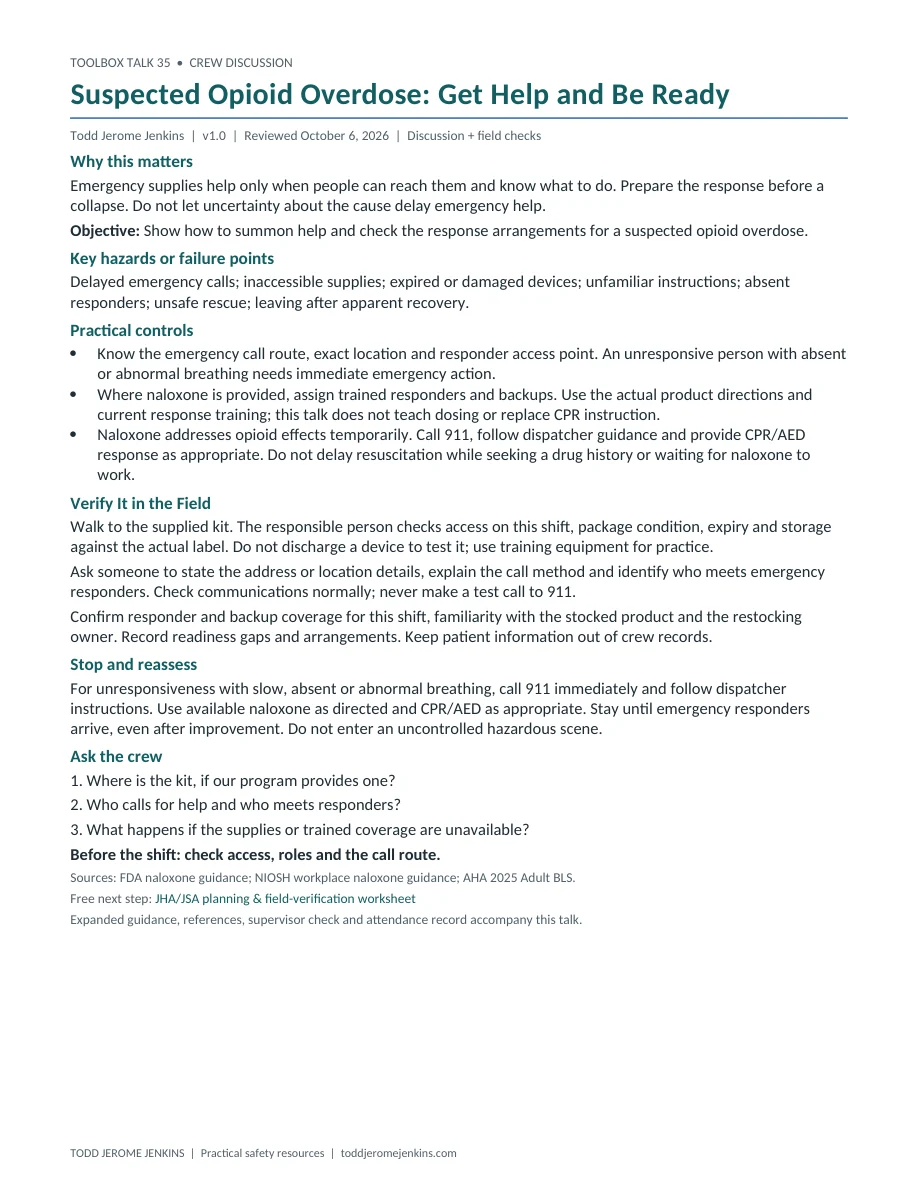
A 5–10 minute crew discussion, plus the time needed for field verification. All six downloads are free without a required signup.
Why this matters
Emergency supplies help only when people can reach them and know what to do. Prepare the response before a collapse. Do not let uncertainty about the cause delay emergency help.
Learning objective: Show how to summon help and check the response arrangements for a suspected opioid overdose.
Key hazards or failure points
Delayed emergency calls; inaccessible supplies; expired or damaged devices; unfamiliar instructions; absent responders; unsafe rescue; leaving after apparent recovery.
Practical controls
- Know the emergency call route, exact location and responder access point. An unresponsive person with absent or abnormal breathing needs immediate emergency action.
- Where naloxone is provided, assign trained responders and backups. Use the actual product directions and current response training; this talk does not teach dosing or replace CPR instruction.
- Naloxone addresses opioid effects temporarily. Call 911, follow dispatcher guidance and provide CPR/AED response as appropriate. Do not delay resuscitation while seeking a drug history or waiting for naloxone to work.
Verify It in the Field
Walk to the supplied kit. The responsible person checks access on this shift, package condition, expiry and storage against the actual label. Do not discharge a device to test it; use training equipment for practice.
Ask someone to state the address or location details, explain the call method and identify who meets emergency responders. Check communications normally; never make a test call to 911.
Confirm responder and backup coverage for this shift, familiarity with the stocked product and the restocking owner. Record readiness gaps and arrangements. Keep patient information out of crew records.
Use the separate field check to record the source and criterion, safe method, checker, actual result and time. Mark VERIFIED, HOLD/NOT VERIFIED, or N/A with a reason. Check every required control; the examples below do not clear the whole task.
| Control | Safe verification | Evidence to record |
|---|---|---|
| Reachable supplies | Walk the real access route and check the actual product label/package. | Location, access result, label criteria and expiry finding. |
| Emergency communication | Rehearse location information through a normal communications check. | Call method, location description and access meeting point. |
| Responder coverage | Confirm trained coverage and backup for the current shift. | Roles, coverage gap and corrective owner. |
Stop and reassess
For unresponsiveness with slow, absent or abnormal breathing, call 911 immediately and follow dispatcher instructions. Use available naloxone as directed and CPR/AED as appropriate. Stay until emergency responders arrive, even after improvement. Do not enter an uncontrolled hazardous scene.
Crew discussion questions
- Where is the kit, if our program provides one?
- Who calls for help and who meets responders?
- What happens if the supplies or trained coverage are unavailable?
Before the shift: check access, roles and the call route.
A situation to discuss
Illustrative situation: a site stocks naloxone in an office that is locked during the evening shift. The readiness walk identifies the access failure before an emergency. The program owner corrects access and checks that evening responders know the actual product instructions.
Leader preparation and practical detail
Organize a response, not just a purchase
A workplace program needs a responsible owner, accessible supplies, defined roles, training and maintenance. NIOSH’s program guidance supports those arrangements. Its older prescription-access discussion should not be used as current product-access advice; FDA describes current over-the-counter access. A stocked kit does not by itself prove response readiness. [1], [2]
Use product-specific directions
Products differ. Keep the directions for the stocked device available and use current training to explain administration and follow-up. Storage, expiry, repeat administration and replacement decisions come from the exact label and program, not this general checklist. Record the product checked and the actual finding; a tick beside “naloxone available” can hide an unusable or unreachable device. [1], [2]
Keep emergency care moving
Naloxone is not a substitute for emergency medical care or resuscitation. Its effect can wear off and symptoms can return. For an unresponsive adult who is not breathing normally, activate emergency help and start the appropriate CPR/AED response; follow dispatcher guidance. Trained responders should use their current breathing-support skills when indicated. [1], [3]
Short supervisor field check
- Emergency call method and exact location understood.
- Stocked naloxone accessible and checked against its label.
- Current trained responder and backup coverage confirmed.
- CPR/AED and emergency access roles clear.
- Defects, replacement and follow-up assigned without patient details.
Use the separate form to document evidence, restrictions, corrective-action owner, recheck and required restart approval. An unresolved required control means hold the affected work. Missing evidence is not a pass. Complete all task-specific inspections and permits.
Attendance and follow-through
The separate attendance sheet records participants, language support, questions, actions and late-arrival rebriefs. Attendance does not establish competence or prove controls function. Keep completed records private under the employer’s procedures.
Technical scope and references
This is US workplace readiness guidance. It does not require every employer to stock naloxone or establish universal training, storage or dosing rules. Determine the applicable workplace program and local requirements. OSHA 1926.50 concerns construction medical and first-aid arrangements; the relevant industry requirements still apply. [2], [4]
References checked October 6, 2026. Apply the jurisdiction, task, employer program and equipment instructions that govern the work. No site-specific manual, permit, engineering determination or product SDS has been approved by this general resource.
- Access to Naloxone Can Save a Life During an Opioid Overdose — Naloxone reverses opioid overdose temporarily; emergency medical help remains necessary and symptoms may return. Unresponsiveness and slow/shallow breathing are warning signs. Some products are OTC. Use exact current product directions; do not invent dose or repeat interval.
- Using Naloxone to Reverse Opioid Overdose in the Workplace — Organize defined response roles, emergency access, kit availability, trained staff, manufacturer storage instructions, expiry/replacement process and privacy. It is guidance, not a universal legal requirement to stock naloxone. Its old prescription-access language is superseded by current FDA OTC information; do not reuse old device brands, statistics, fixed storage temperatures or legal coverage claims.
- 2025 AHA Guidelines, Part 7: Adult Basic Life Support — Lay rescuer recognizes unresponsiveness plus absent/abnormal breathing, including gasping, without requiring pulse check. Activate emergency response promptly and start CPR. Compression-only appropriate for untrained/unwilling adult lay rescuers; trained rescuers encouraged to include breaths. 100–120/min is published adult rate if included. Briefing is not certification.
- 29 CFR 1926.50 Medical services and first aid — Construction-specific readiness requirements. No universal emergency response time or AED mandate derived here.
Connect this discussion to your JHA/JSA
Use How to Conduct a Job Safety Analysis to connect today’s work steps, hazards and controls. Revisit Pre-Job JHA/JSA: What Changed Today? whenever conditions change.
Related published crew resources: Emergency Evacuation: Know the Route and Count the Crew; Working Alone: Check In and Get Help; CPR and AED Readiness: Can We Act Now?.
Put one check into practice
Download the free JHA/JSA planning and field-verification worksheet. For today’s task, record an important control, its source and the evidence needed before exposure. Complete the remaining required checks through your task plan.