Download the talk and separate crew records
Free to download without an account. Each PDF is one page. Use the Word version to adapt the record to your task and approved procedures.
Supervisor field check
Download supervisor field check (PDF, 1 page)Editable supervisor field check (Word)Preview the one-page crew talk
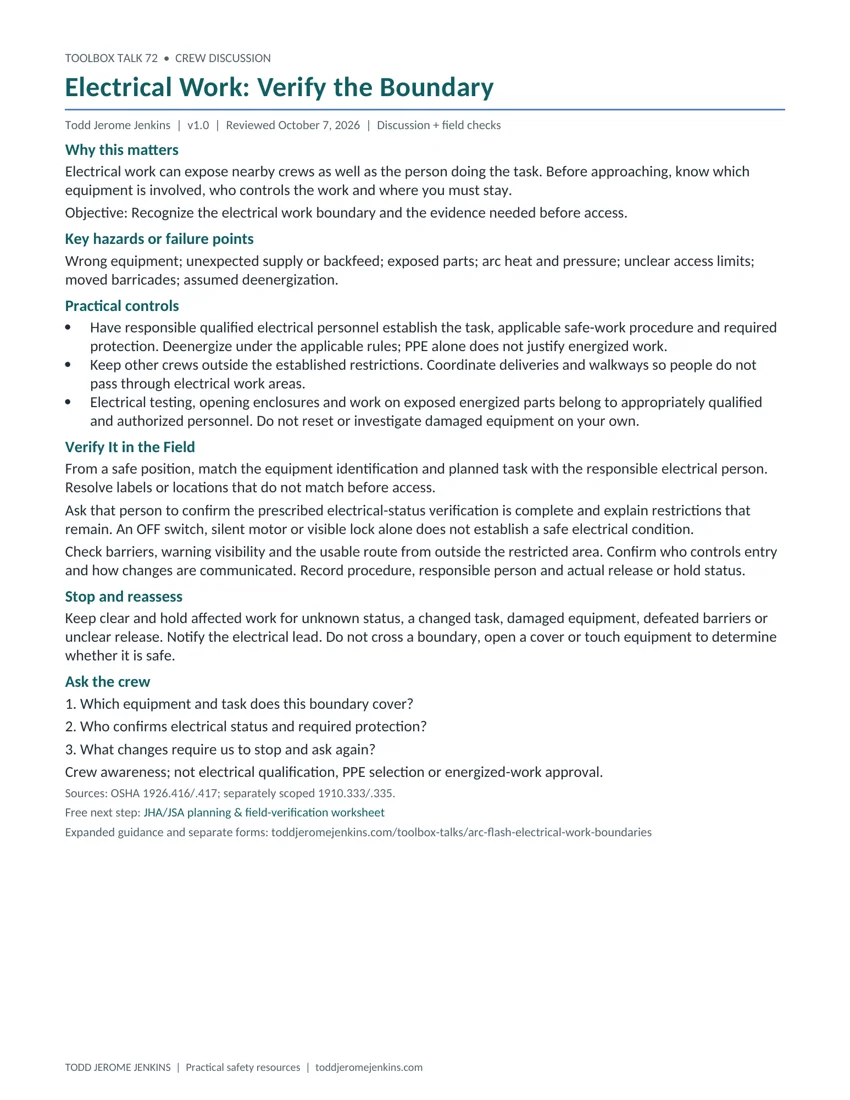
A 5–10 minute crew discussion, plus the time needed for field verification. All six downloads are free without a required signup.
Why this matters
Electrical work can expose nearby crews as well as the person doing the task. Before approaching, know which equipment is involved, who controls the work and where you must stay.
Learning objective: Recognize the electrical work boundary and the evidence needed before access.
Key hazards or failure points
Wrong equipment; unexpected supply or backfeed; exposed parts; arc heat and pressure; unclear access limits; moved barricades; assumed deenergization.
Practical controls
- Have responsible qualified electrical personnel establish the task, applicable safe-work procedure and required protection. Deenergize under the applicable rules; PPE alone does not justify energized work.
- Keep other crews outside the established restrictions. Coordinate deliveries and walkways so people do not pass through electrical work areas.
- Electrical testing, opening enclosures and work on exposed energized parts belong to appropriately qualified and authorized personnel. Do not reset or investigate damaged equipment on your own.
Verify It in the Field
From a safe position, match the equipment identification and planned task with the responsible electrical person. Resolve labels or locations that do not match before access.
Ask that person to confirm the prescribed electrical-status verification is complete and explain restrictions that remain. An OFF switch, silent motor or visible lock alone does not establish a safe electrical condition.
Check barriers, warning visibility and the usable route from outside the restricted area. Confirm who controls entry and how changes are communicated. Record procedure, responsible person and actual release or hold status.
Use the separate field check to record the acceptance source and criterion, safe method, checker, actual result and time. Mark VERIFIED, HOLD/NOT VERIFIED, or N/A with a reason. A checkmark alone is not evidence that protection works. Complete all required task checks; do not enter danger or improvise a test.
| Control | Safe verification | Evidence |
|---|---|---|
| Correct equipment | Compare visible identity with the electrical lead’s task record. | Equipment ID, procedure and resolved mismatch. |
| Verified status | Qualified lead confirms required verification and remaining restrictions. | Verification reference, responsible person and release/hold. |
| Protected access | Observe boundary and alternate route from safe positions. | Extent, gaps, route and entry controller. |
Stop and reassess
Keep clear and hold affected work for unknown status, a changed task, damaged equipment, defeated barriers or unclear release. Notify the electrical lead. Do not cross a boundary, open a cover or touch equipment to determine whether it is safe.
Crew discussion questions
- Which equipment and task does this boundary cover?
- Who confirms electrical status and required protection?
- What changes require us to stop and ask again?
A situation to discuss
Illustrative situation: an adjacent crew moves a barrier to deliver materials while an electrical task continues. The affected movement stops, people stay clear and the electrical lead reestablishes the required boundary and route before access resumes.
Leader preparation and practical detail
Separate the industry requirements
Construction 1926.416 addresses identification and protection from circuit hazards; 1926.417 addresses construction circuit controls and tagging. General-industry 1910.333 has its own deenergization, limited-exception and qualified-person verification provisions. Do not label one rule as a complete electrical procedure for every industry. Power generation, transmission and distribution need their separately applicable requirements. [1–3]
Use the actual electrical assessment
The responsible electrical personnel must establish protection for the actual equipment, task and conditions. This page does not calculate arc energy, choose a clothing rating or provide a universal approach distance. General-industry 1910.335 addresses appropriate electrical protection and safeguards. A label or PPE item cannot replace the applicable assessment and work controls. [4]
Make the boundary understandable
For the nearby crew, the useful questions are where it can work, which route is available and who may change the restriction. Qualified personnel perform technical verification under the appropriate procedure; other workers verify the communicated boundary from safety. If the task moves or another supply is discovered, the previous release cannot be assumed to cover it. [1–4]
Short supervisor field check
- Equipment and task identification match.
- Applicable procedure and qualified electrical lead confirmed.
- Required status verification and restrictions documented.
- Barriers and safe adjacent routes physically checked.
- Entry authority and change communication understood.
Record unresolved items, restrictions, correction owner, recheck result and required restart authorization. Reference permits and specialist inspections rather than treating this form as a replacement. Rebrief workers affected by a change.
Attendance and follow-through
Use the separate attendance sheet for participants, discussion concerns, actions and late-arrival rebriefs. Attendance does not establish competence, verify controls or authorize work. Keep completed records private under the employer’s recordkeeping procedures.
Technical scope and references
Awareness for crews around electrical work. Construction and general-industry provisions are cited separately. This discussion supplies no arc-flash boundary, PPE rating, voltage-test method or authorization to perform electrical work. Apply the actual assessment, program and specialist requirements. [1–4]
References reviewed October 7, 2026. Apply the industry, activity and jurisdiction that govern the work. No actual site permit, equipment manual, exposure assessment or engineering determination was supplied for this general discussion.
- OSHA 1926.416 — General electrical requirements — Construction circuit-hazard identification, protection and work areas.
- OSHA 1926.417 — Lockout and tagging of circuits — Construction circuit controls and tagging.
- OSHA 1910.333 — Selection and use of work practices — General-industry deenergization, verification and qualified-person work.
- OSHA 1910.335 — Safeguards for personnel protection — General-industry electrical protection, signs, barriers and attendants.
Connect this discussion to your JHA/JSA
Use How to Conduct a Job Safety Analysis to connect task steps, hazards and controls. Revisit Pre-Job JHA/JSA: What Changed Today? when conditions change.
Related Todd Jerome Jenkins video: What Is Lockout Tagout?.
Related crew discussions
- Electrical & Extension-Cord Checks
- Barricades: What Does This Boundary Keep Out?
- Energy Isolation: Verify Before Servicing
Put one check into practice
Use the free JHA/JSA planning and field-verification worksheet to record today’s changes, important controls and the evidence needed before exposure.