Download the free crew talk
The one-page talk, editable Word version, and guidance below are open to everyone. No account required.
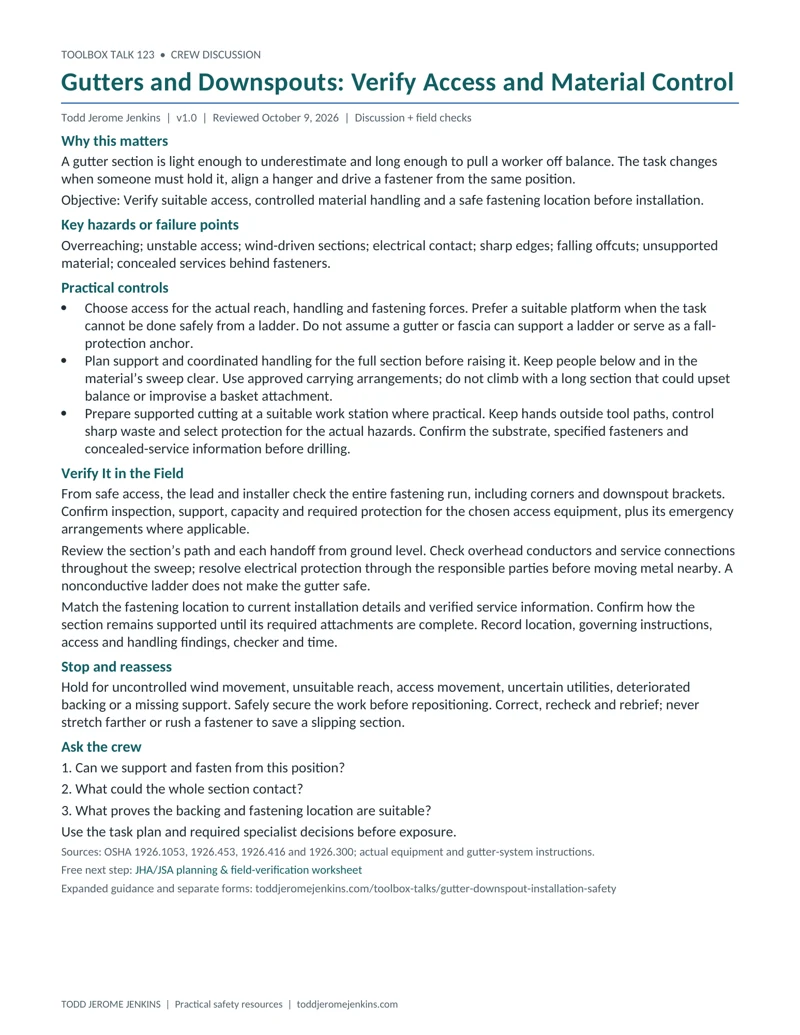
Preview the one-page crew talk
Supporting documents
Included with free Safety & Systems membership.
Supervisor field check
A separate check to verify conditions and controls before work. Includes a one-page PDF and editable Word file.
Attendance sheet
A separate sign-in sheet to record the crew discussion. Includes a one-page PDF and editable Word file.
Need the crew records? Join free to use these supporting documents and the Safety & Systems Academy. No payment details. Email updates are optional.
Get supporting documents — free membershipAlready a member? Use the same link to sign in.
A 5–10 minute crew discussion, plus time to verify the actual controls. The crew talk and Word version are public. Separate supervisor and attendance records are included with free Safety & Systems membership.
Why this matters
A gutter section is light enough to underestimate and long enough to pull a worker off balance. The task changes when someone must hold it, align a hanger and drive a fastener from the same position.
Learning objective
Verify suitable access, controlled material handling and a safe fastening location before installation.
Key hazards or failure points
Overreaching; unstable access; wind-driven sections; electrical contact; sharp edges; falling offcuts; unsupported material; concealed services behind fasteners.
Practical controls
- Choose access for the actual reach, handling and fastening forces. Prefer a suitable platform when the task cannot be done safely from a ladder. Do not assume a gutter or fascia can support a ladder or serve as a fall-protection anchor.
- Plan support and coordinated handling for the full section before raising it. Keep people below and in the material’s sweep clear. Use approved carrying arrangements; do not climb with a long section that could upset balance or improvise a basket attachment.
- Prepare supported cutting at a suitable work station where practical. Keep hands outside tool paths, control sharp waste and select protection for the actual hazards. Confirm the substrate, specified fasteners and concealed-service information before drilling.
Verify It in the Field
- From safe access, the lead and installer check the entire fastening run, including corners and downspout brackets. Confirm inspection, support, capacity and required protection for the chosen access equipment, plus its emergency arrangements where applicable.
- Review the section’s path and each handoff from ground level. Check overhead conductors and service connections throughout the sweep; resolve electrical protection through the responsible parties before moving metal nearby. A nonconductive ladder does not make the gutter safe.
- Match the fastening location to current installation details and verified service information. Confirm how the section remains supported until its required attachments are complete. Record location, governing instructions, access and handling findings, checker and time.
Stop and reassess
Hold for uncontrolled wind movement, unsuitable reach, access movement, uncertain utilities, deteriorated backing or a missing support. Safely secure the work before repositioning. Correct, recheck and rebrief; never stretch farther or rush a fastener to save a slipping section.
Crew discussion questions
- Can we support and fasten from this position?
- What could the whole section contact?
- What proves the backing and fastening location are suitable?
For each required control, record its acceptance source and criterion, safe verification method, responsible checker, actual result and time. Use VERIFIED, HOLD/NOT VERIFIED, or N/A with a reason. A tick alone is not evidence. Complete all applicable task inspections; do not enter danger or improvise a test to fill out a form.
Leader preparation and practical detail
Choose access for the complete operation
TBT05 covers ladder readiness and TBT67 covers boom-lift preparation. This talk adds the gutter run, long-section handling and support-to-fastening handoff. A ladder can be undamaged yet unsuitable for two-handed positioning and side force. Review the entire operation before selection. The related boom-lift JHA is an access example, not a gutter attachment design or permission to carry any section in a basket.
Do not borrow strength from the gutter
Obtain actual ladder/support-accessory instructions and a suitable bearing arrangement; avoid relying on the gutter’s appearance. A completed gutter, downspout or fascia is not an assumed fall-protection anchor. If working from a boom lift, maintain the designated compatible machine attachment and remain on the platform floor; do not connect to the building while working from the lift.
Electrical review includes the moving material
Section 1926.416 requires the employer to identify exposed or concealed energized circuits that the work could contact and establish protection. Review the whole gutter/downspout sweep, tools, ladder and platform movement near service drops and wall entries. Obtain the applicable controls and distances for the actual equipment and electrical conditions; this talk supplies no universal clearance. Do not touch, shift or cover a service conductor yourself.
Fastening needs two separate confirmations
First establish suitable backing, hangers, fasteners and temporary support from the actual installation detail. Then resolve what lies behind each penetration, including electrical and other services. A short screw or an old hole is not evidence of clearance. Unknown backing, hidden-service location or unexpected resistance means stop for the responsible technical person; do not drill an exploratory hole to prove the route.
Release and closeout are part of installation
Confirm required attachments before removing the planned temporary support. Collect sharp offcuts, loose screws and cut ends without reaching into an uncontrolled blade path. Before opening the walkway below, inspect for unsecured sections and remaining overhead work. No gutter product manual, substrate design, access model or site utility record was supplied; those sources must establish the actual acceptance criteria.
Short supervisor field check
- Access suits reach and installation forces.
- Section support and handoffs confirmed.
- Electrical and concealed-service risks resolved.
- Cutting, sharp waste and area below controlled.
- Specified attachments verified before support release.
Confirm the relevant trained/authorized people, unresolved items, interim protection, correction owner and recheck. Record required release authority and rebrief anyone affected. The separate sheet supports these records; it does not replace a specialist inspection, permit or engineering determination.
Attendance and follow-through
Use the separate attendance sheet for participants, roles, discussion concerns, actions and late-arrival rebriefs. Attendance is not proof of competence, functioning controls or authorization to work. Keep completed records private under employer procedures.
Technical scope and references
Reviewed October 9, 2026 for construction crew preparation. Apply the actual task, jurisdiction and relevant standard provisions. Any manufacturer guidance is reference material, not approval of your equipment or installation. No site-specific design, permit, exposure assessment, product SDS or current model manual was supplied; obtain the applicable documents before work. This discussion does not replace required training.
- OSHA 1926.1053(b) — Construction ladder use, support, load, electrical precautions and material carrying.
- OSHA 1926.453(b)(2) — Boom-platform controls, authorized operators, work position and load limits.
- OSHA 1926.416(a) — Construction protection from electrical contact and identification of exposed or concealed circuits before work.
- OSHA 1926.300 — Tool condition, guarding and hazard-specific protective equipment.
Connect this discussion to your JHA/JSA
Related reference: worked JHA/JSA/AHA example. This boom-lift example supports access planning only. It does not provide a gutter fastening design, authorize basket material handling or replace the task-specific installation plan. Return to What Changed Today? when the plan or conditions change.
Related Todd Jerome Jenkins article: How to Conduct a Job Safety Analysis.
Related crew discussions
Put one check into practice
Use the free JHA/JSA planning and field-verification worksheet to record today’s change, the required protection and the evidence needed before exposure.