Download the talk and separate crew records
Free to download without an account. Each PDF is one page. Use the Word version to adapt the record to your task and approved procedures.
Supervisor field check
Download supervisor field check (PDF, 1 page)Editable supervisor field check (Word)Preview the one-page crew talk
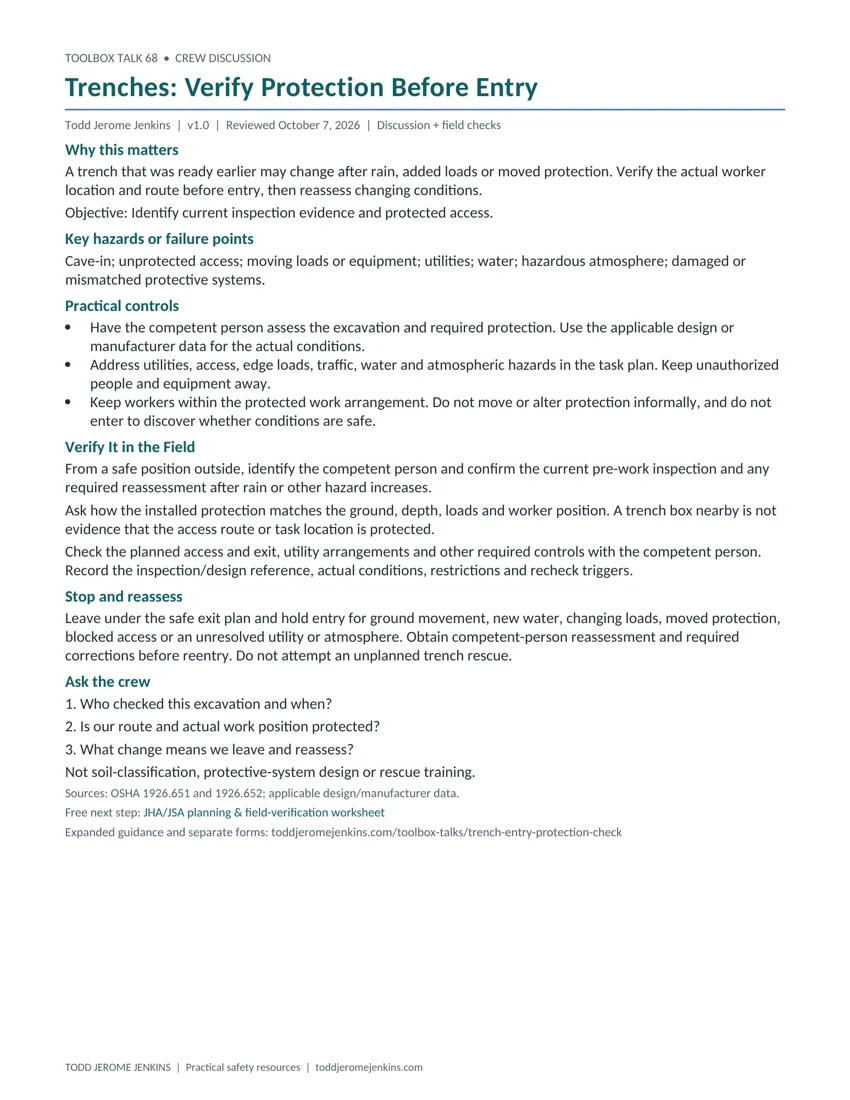
A 5–10 minute crew discussion, plus the time needed for field verification. All six downloads are free without a required signup.
Why this matters
A trench that was ready earlier may change after rain, added loads or moved protection. Verify the actual worker location and route before entry, then reassess changing conditions.
Learning objective: Identify current inspection evidence and protected access.
Key hazards or failure points
Cave-in; unprotected access; moving loads or equipment; utilities; water; hazardous atmosphere; damaged or mismatched protective systems.
Practical controls
- Have the competent person assess the excavation and required protection. Use the applicable design or manufacturer data for the actual conditions.
- Address utilities, access, edge loads, traffic, water and atmospheric hazards in the task plan. Keep unauthorized people and equipment away.
- Keep workers within the protected work arrangement. Do not move or alter protection informally, and do not enter to discover whether conditions are safe.
Verify It in the Field
From a safe position outside, identify the competent person and confirm the current pre-work inspection and any required reassessment after rain or other hazard increases.
Ask how the installed protection matches the ground, depth, loads and worker position. A trench box nearby is not evidence that the access route or task location is protected.
Check the planned access and exit, utility arrangements and other required controls with the competent person. Record the inspection/design reference, actual conditions, restrictions and recheck triggers.
Use the separate field check to record the acceptance source and criterion, safe method, checker, actual result and time. Mark VERIFIED, HOLD/NOT VERIFIED, or N/A with a reason. A checkmark alone is not evidence that protection works. Complete all required task checks; do not enter danger or improvise a test.
| Control | Safe verification | Evidence |
|---|---|---|
| Current condition | Review competent-person inspection from a safe position. | Inspection time, changes and restrictions. |
| Effective protection | Compare the installed system and work position with applicable data. | Design basis, configuration and resolved discrepancies. |
| Usable exit | Verify the actual safe route before entry. | Access location, applicable criterion and obstruction check. |
Stop and reassess
Leave under the safe exit plan and hold entry for ground movement, new water, changing loads, moved protection, blocked access or an unresolved utility or atmosphere. Obtain competent-person reassessment and required corrections before reentry. Do not attempt an unplanned trench rescue.
Crew discussion questions
- Who checked this excavation and when?
- Is our route and actual work position protected?
- What change means we leave and reassess?
A situation to discuss
Illustrative situation: a delivery places a new load beside a trench after its morning inspection. The crew holds entry while the competent person reassesses the changed loading and required protection.
Leader preparation and practical detail
Do not turn a depth into a guarantee
Protective-system requirements and their limited exceptions must be evaluated under 1926.652. The less-than-five-foot exception also requires competent-person examination finding no indication of a potential cave-in. Being shallow does not by itself establish safety. [2]
Verify access for the actual position
Under 1926.651(c)(2), trenches four feet or deeper need safe egress arranged so workers travel no more than 25 feet laterally. Apply that requirement to the actual work location and protected route. The presence of a ladder somewhere on site does not prove usable egress. [1]
Treat changed conditions as new evidence
Inspections occur before work and as needed during the shift, including after rainstorms or other hazard-increasing events. Water, utilities, traffic and nearby loads need their applicable controls. The competent person must remove exposed workers when hazardous conditions are identified until the necessary precautions are taken. [1]
Short supervisor field check
- Current competent-person inspection confirmed.
- Protective system matches actual conditions and work.
- Utilities and safe exposure method addressed.
- Access, edge loads, water and atmosphere addressed.
- Withdrawal and reassessment triggers understood.
Record unresolved items, restrictions, correction owner, recheck result and required restart authorization. Reference permits and specialist inspections rather than treating this form as a replacement. Rebrief workers affected by a change.
Attendance and follow-through
Use the separate attendance sheet for participants, discussion concerns, actions and late-arrival rebriefs. Attendance does not establish competence, verify controls or authorize work. Keep completed records private under the employer’s recordkeeping procedures.
Technical scope and references
Construction excavation awareness under Subpart P. This briefing does not qualify a person to classify soil, design protection, approve entry or conduct rescue. Use applicable engineering/manufacturer data and competent-person decisions. [1, 2]
References reviewed October 7, 2026. Apply the industry, activity and jurisdiction that govern the work. No actual site permit, equipment manual, exposure assessment or engineering determination was supplied for this general discussion.
- OSHA 1926.651 — Specific excavation requirements — Utilities, access, water, atmosphere, loads and inspections.
- OSHA 1926.652 — Protective systems — Protection selection, design and installation requirements.
Connect this discussion to your JHA/JSA
Use How to Conduct a Job Safety Analysis to connect task steps, hazards and controls. Revisit Pre-Job JHA/JSA: What Changed Today? when conditions change.
Work through the related Excavation and Trenching JSA, then adapt its assumptions to the actual work.
Related crew discussions
- Electrical & Extension-Cord Checks
- Mobile Equipment: Separate People from Movement
- Competent Person: Know Who Can Correct the Hazard
- Incident Response: Protect People and Call for Help
Put one check into practice
Use the free JHA/JSA planning and field-verification worksheet to record today’s changes, important controls and the evidence needed before exposure.