Download the talk and separate crew records
Free to download without an account. Each PDF is one page. Use the Word version to adapt the record to your task and approved procedures.
Supervisor field check
Download supervisor field check (PDF, 1 page)Editable supervisor field check (Word)Preview the one-page crew talk
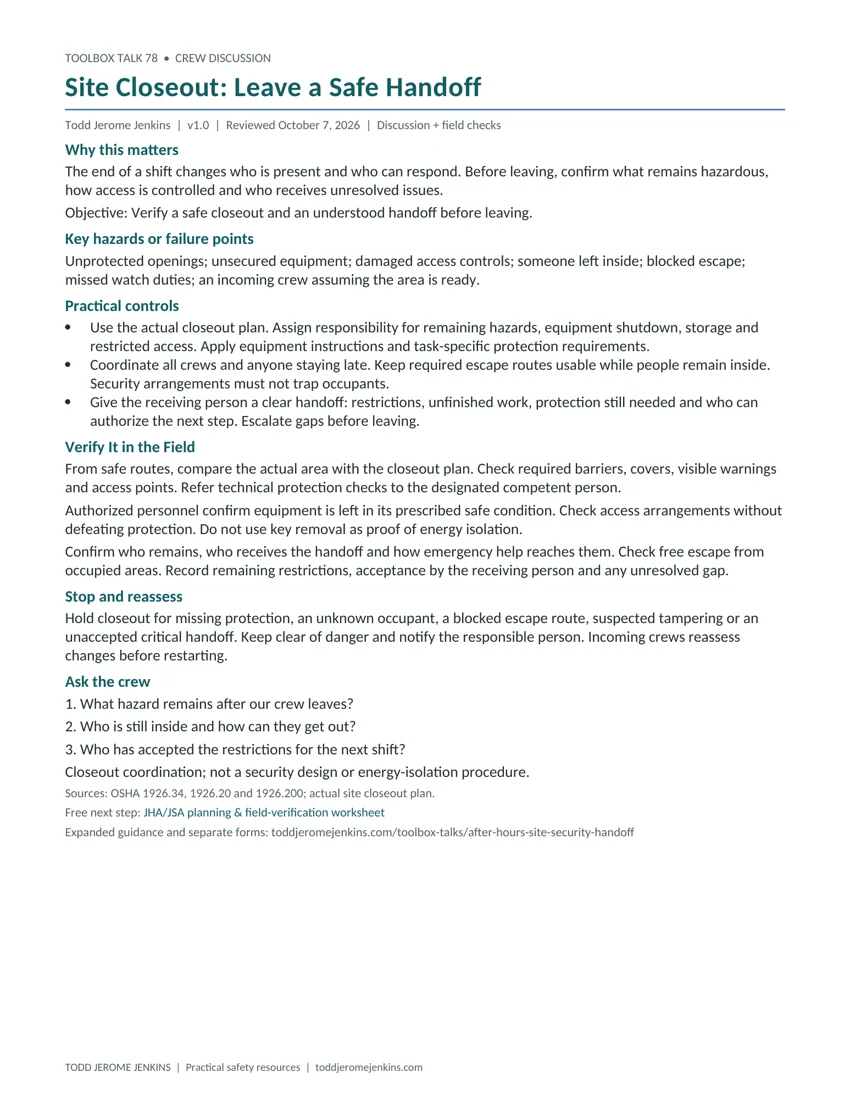
A 5–10 minute crew discussion, plus the time needed for field verification. All six downloads are free without a required signup.
Why this matters
The end of a shift changes who is present and who can respond. Before leaving, confirm what remains hazardous, how access is controlled and who receives unresolved issues.
Learning objective: Verify a safe closeout and an understood handoff before leaving.
Key hazards or failure points
Unprotected openings; unsecured equipment; damaged access controls; someone left inside; blocked escape; missed watch duties; an incoming crew assuming the area is ready.
Practical controls
- Use the actual closeout plan. Assign responsibility for remaining hazards, equipment shutdown, storage and restricted access. Apply equipment instructions and task-specific protection requirements.
- Coordinate all crews and anyone staying late. Keep required escape routes usable while people remain inside. Security arrangements must not trap occupants.
- Give the receiving person a clear handoff: restrictions, unfinished work, protection still needed and who can authorize the next step. Escalate gaps before leaving.
Verify It in the Field
From safe routes, compare the actual area with the closeout plan. Check required barriers, covers, visible warnings and access points. Refer technical protection checks to the designated competent person.
Authorized personnel confirm equipment is left in its prescribed safe condition. Check access arrangements without defeating protection. Do not use key removal as proof of energy isolation.
Confirm who remains, who receives the handoff and how emergency help reaches them. Check free escape from occupied areas. Record remaining restrictions, acceptance by the receiving person and any unresolved gap.
Use the separate field check to record the acceptance source and criterion, safe method, checker, actual result and time. Mark VERIFIED, HOLD/NOT VERIFIED, or N/A with a reason. A checkmark alone is not evidence that protection works. Complete all required task checks; do not enter danger or improvise a test.
| Control | Safe verification | Evidence |
|---|---|---|
| Continuing protection | Inspect accessible areas and reference required specialist checks. | Location, protection status, inspector and unresolved restriction. |
| Safe occupied building | Confirm remaining people and usable escape arrangements. | Occupancy handoff, route and observed obstruction status. |
| Accepted handoff | Have the receiving person repeat restrictions and next actions. | Recipient, time, restriction and correction owner. |
Stop and reassess
Hold closeout for missing protection, an unknown occupant, a blocked escape route, suspected tampering or an unaccepted critical handoff. Keep clear of danger and notify the responsible person. Incoming crews reassess changes before restarting.
Crew discussion questions
- What hazard remains after our crew leaves?
- Who is still inside and how can they get out?
- Who has accepted the restrictions for the next shift?
A situation to discuss
Illustrative situation: the main crew is ready to secure the building, but a subcontractor is still working inside. Closeout pauses until the crews agree on safe escape, access, emergency contact and who will perform the final handoff.
Leader preparation and practical detail
Make the handoff specific
This is an original closeout workflow, not a claim that OSHA requires a universal security checklist. Identify the actual hazards that survive the shift: openings, unstable materials, powered equipment or continuing fire-watch duties. Assign their protection under the applicable task rules and site plan. General construction inspection responsibilities remain with the employer and designated competent persons. [2]
Preserve escape while controlling entry
Construction 1926.34 requires free, unobstructed egress from occupied buildings and structures and prohibits locks that prevent free escape, subject to its narrow stated exception. Check the inside escape arrangement before securing access. Do not assume the last worker has left because the usual parking area is empty. [1]
Check again at return
Required construction signs must remain visible during work under 1926.200(a). Signs alone do not establish that structural protection, isolation or access control is adequate. Treat damaged barriers, a moved cover or suspected tampering as a reason to hold the affected activity and obtain the appropriate inspection before the next crew proceeds. [3]
Short supervisor field check
- Remaining hazards and required protections identified.
- Designated people completed equipment and area checks.
- Remaining occupants and free escape confirmed.
- Restricted access and emergency contact usable.
- Receiving person accepted restrictions and follow-up.
Record unresolved items, restrictions, correction owner, recheck result and required restart authorization. Reference permits and specialist inspections rather than treating this form as a replacement. Rebrief workers affected by a change.
Attendance and follow-through
Use the separate attendance sheet for participants, discussion concerns, actions and late-arrival rebriefs. Attendance does not establish competence, verify controls or authorize work. Keep completed records private under the employer’s recordkeeping procedures.
Technical scope and references
Construction end-of-shift coordination. Site security, public protection, fire codes and equipment requirements depend on the location and activities. The cited OSHA provisions support specific egress, inspection and sign duties; they are not a complete site-security standard. [1–3]
References reviewed October 7, 2026. Apply the industry, activity and jurisdiction that govern the work. No actual site permit, equipment manual, exposure assessment or engineering determination was supplied for this general discussion.
- OSHA 1926.34 — Means of egress — Construction escape arrangements in occupied buildings and structures.
- OSHA 1926.20 — General safety and health provisions — Employer programs, designated competent-person inspections and equipment use.
- OSHA 1926.200 — Accident prevention signs and tags — Visibility and scope of construction signs; not a universal fencing rule.
Connect this discussion to your JHA/JSA
Use How to Conduct a Job Safety Analysis to connect task steps, hazards and controls. Revisit Pre-Job JHA/JSA: What Changed Today? when conditions change.
Related crew discussions
- Emergency Evacuation: Know the Route and Count the Crew
- Working Alone: Check In and Get Help
- Barricades: What Does This Boundary Keep Out?
- Site-Specific Safety Plan: Check the Interfaces Today
- Energy Isolation: Verify Before Servicing
- Hot Work: Verify the Area and Fire Watch
Put one check into practice
Use the free JHA/JSA planning and field-verification worksheet to record today’s changes, important controls and the evidence needed before exposure.