Download the free crew talk
The one-page talk, editable Word version, and guidance below are open to everyone. No account required.
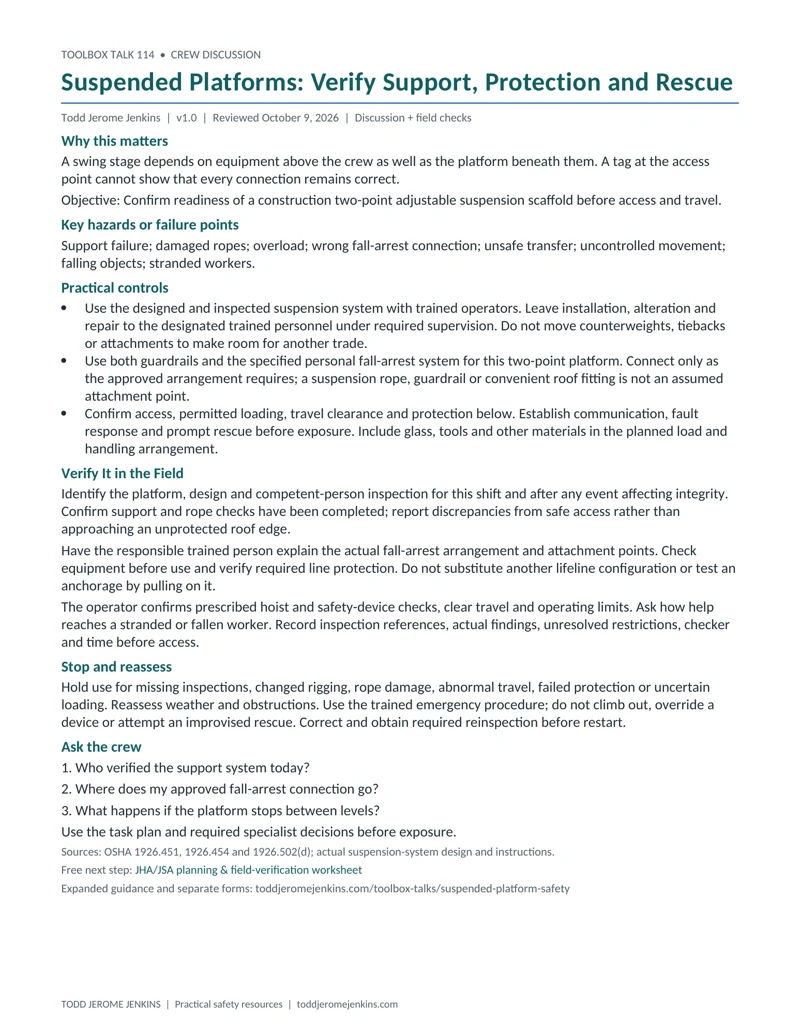
Preview the one-page crew talk
Supporting documents
Included with free Safety & Systems membership.
Supervisor field check
A separate check to verify conditions and controls before work. Includes a one-page PDF and editable Word file.
Attendance sheet
A separate sign-in sheet to record the crew discussion. Includes a one-page PDF and editable Word file.
Need the crew records? Join free to use these supporting documents and the Safety & Systems Academy. No payment details. Email updates are optional.
Get supporting documents — free membershipAlready a member? Use the same link to sign in.
A 5–10 minute crew discussion, plus time to verify the actual controls. The crew talk and Word version are public. Separate supervisor and attendance records are included with free Safety & Systems membership.
Why this matters
A swing stage depends on equipment above the crew as well as the platform beneath them. A tag at the access point cannot show that every connection remains correct.
Learning objective
Confirm readiness of a construction two-point adjustable suspension scaffold before access and travel.
Key hazards or failure points
Support failure; damaged ropes; overload; wrong fall-arrest connection; unsafe transfer; uncontrolled movement; falling objects; stranded workers.
Practical controls
- Use the designed and inspected suspension system with trained operators. Leave installation, alteration and repair to the designated trained personnel under required supervision. Do not move counterweights, tiebacks or attachments to make room for another trade.
- Use both guardrails and the specified personal fall-arrest system for this two-point platform. Connect only as the approved arrangement requires; a suspension rope, guardrail or convenient roof fitting is not an assumed attachment point.
- Confirm access, permitted loading, travel clearance and protection below. Establish communication, fault response and prompt rescue before exposure. Include glass, tools and other materials in the planned load and handling arrangement.
Verify It in the Field
- Identify the platform, design and competent-person inspection for this shift and after any event affecting integrity. Confirm support and rope checks have been completed; report discrepancies from safe access rather than approaching an unprotected roof edge.
- Have the responsible trained person explain the actual fall-arrest arrangement and attachment points. Check equipment before use and verify required line protection. Do not substitute another lifeline configuration or test an anchorage by pulling on it.
- The operator confirms prescribed hoist and safety-device checks, clear travel and operating limits. Ask how help reaches a stranded or fallen worker. Record inspection references, actual findings, unresolved restrictions, checker and time before access.
Stop and reassess
Hold use for missing inspections, changed rigging, rope damage, abnormal travel, failed protection or uncertain loading. Reassess weather and obstructions. Use the trained emergency procedure; do not climb out, override a device or attempt an improvised rescue. Correct and obtain required reinspection before restart.
Crew discussion questions
- Who verified the support system today?
- Where does my approved fall-arrest connection go?
- What happens if the platform stops between levels?
For each required control, record its acceptance source and criterion, safe verification method, responsible checker, actual result and time. Use VERIFIED, HOLD/NOT VERIFIED, or N/A with a reason. A tick alone is not evidence. Complete all applicable task inspections; do not enter danger or improvise a test to fill out a form.
Leader preparation and practical detail
Use the right scaffold scope
This briefing concerns construction work from a two-point adjustable suspension scaffold. It does not cover rope-access work, boatswain chairs, permanent building-maintenance installations or mast climbers. The related scaffold JHA is a supported-frame example and expressly excludes suspended scaffolds: use it only as a comparison of planning structure, never as a suspended-platform method. Prepare a separate task-specific JHA for this system.
Confirm the installed arrangement
The OSHA two-point eTool explains the support, rope and hoist checks behind a readiness decision. Competent-person inspection must address the actual system, not merely a visible tag. Have responsible personnel resolve structural support and required tiebacks against the design. Users must not change rigging or substitute materials as counterweights.
Fall-arrest configurations are not interchangeable
Under 1926.451(g)(3), vertical lifelines require independent safe anchorages and edge protection; they cannot be used on these adjustable suspension scaffolds when overhead components are present. For lanyards attached to horizontal lifelines or scaffold structural members, additional independent support lines and automatic locking devices are required. The standard also separates lifeline, support-line and suspension-rope attachment points. Use a compliant designed arrangement, not a generic instruction to clip to the platform.
Train for the actual work and recovery
Section 1926.454 separates scaffold-user instruction from training for operation, movement, inspection and other activities, and requires retraining when indicated. The employer must provide prompt fall rescue or assure self-rescue under 1926.502(d)(20). Identify the available equipment, trained responders, communication and access for the actual location; a phone number alone does not demonstrate a workable response.
Keep limits with their acceptance sources
No platform model, rigging drawing or site rescue plan was supplied. Obtain those documents for loading, travel, weather and safety-device checks. Do not deliberately stall a hoist, defeat a brake or overload the platform to demonstrate protection. Record findings and stop for an unresolved condition.
Short supervisor field check
- System identity and current inspections confirmed.
- Support and rope findings resolved.
- Correct guardrails and PFAS arrangement ready.
- Load, access and travel route verified.
- Trained operator and rescue arrangements ready.
Confirm the relevant trained/authorized people, unresolved items, interim protection, correction owner and recheck. Record required release authority and rebrief anyone affected. The separate sheet supports these records; it does not replace a specialist inspection, permit or engineering determination.
Attendance and follow-through
Use the separate attendance sheet for participants, roles, discussion concerns, actions and late-arrival rebriefs. Attendance is not proof of competence, functioning controls or authorization to work. Keep completed records private under employer procedures.
Technical scope and references
Reviewed October 9, 2026 for construction crew preparation. Apply the actual task, jurisdiction and relevant standard provisions. Manufacturer sources below are reference examples, not approval of your equipment. No site-specific design, permit, exposure assessment, product SDS or current model manual was supplied; obtain the applicable documents before work. This discussion does not replace required training.
- OSHA 1926.451 — Construction suspension scaffold support, inspection, loading and configuration-specific fall protection.
- OSHA — Two-point suspended scaffolds — Explanatory guidance on support, ropes, access and fall protection; actual standard governs.
- OSHA 1926.454 — User and activity-specific training and retraining.
- OSHA 1926.502(d) — PFAS inspection and prompt rescue, applied through scaffold provisions.
Connect this discussion to your JHA/JSA
Related reference: worked JHA/JSA/AHA example. The linked supported-scaffold JHA is a planning-format comparison only. It does not cover suspended-platform installation, use or rescue. Prepare a task-specific JHA using the actual suspension-system design, operating instructions and rescue arrangements; use the free JHA/JSA planning and field-verification worksheet to record the checks. Return to What Changed Today? when the plan or conditions change.
Related Todd Jerome Jenkins article: How to Conduct a Job Safety Analysis.
Related crew discussions
Put one check into practice
Use the free JHA/JSA planning and field-verification worksheet to record today’s change, the required protection and the evidence needed before exposure.