Download the talk and separate crew records
Free to download without an account. Each PDF is one page. Use the Word version to adapt the record to your task and approved procedures.
Supervisor field check
Download supervisor field check (PDF, 1 page)Editable supervisor field check (Word)Preview the one-page crew talk
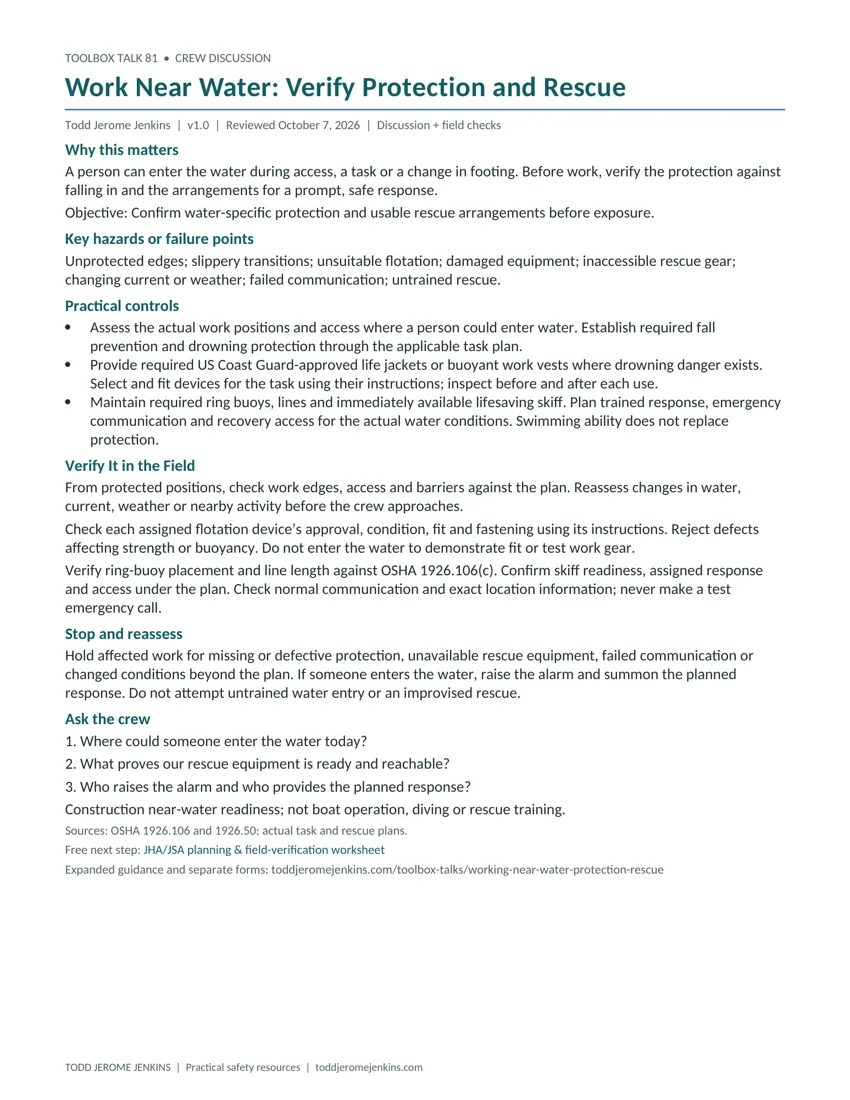
A 5–10 minute crew discussion, plus the time needed for field verification. All six downloads are free without a required signup.
Why this matters
A person can enter the water during access, a task or a change in footing. Before work, verify the protection against falling in and the arrangements for a prompt, safe response.
Learning objective: Confirm water-specific protection and usable rescue arrangements before exposure.
Key hazards or failure points
Unprotected edges; slippery transitions; unsuitable flotation; damaged equipment; inaccessible rescue gear; changing current or weather; failed communication; untrained rescue.
Practical controls
- Assess the actual work positions and access where a person could enter water. Establish required fall prevention and drowning protection through the applicable task plan.
- Provide required US Coast Guard-approved life jackets or buoyant work vests where drowning danger exists. Select and fit devices for the task using their instructions; inspect before and after each use.
- Maintain required ring buoys, lines and immediately available lifesaving skiff. Plan trained response, emergency communication and recovery access for the actual water conditions. Swimming ability does not replace protection.
Verify It in the Field
From protected positions, check work edges, access and barriers against the plan. Reassess changes in water, current, weather or nearby activity before the crew approaches.
Check each assigned flotation device’s approval, condition, fit and fastening using its instructions. Reject defects affecting strength or buoyancy. Do not enter the water to demonstrate fit or test work gear.
Verify ring-buoy placement and line length against OSHA 1926.106(c). Confirm skiff readiness, assigned response and access under the plan. Check normal communication and exact location information; never make a test emergency call.
Use the separate field check to record the acceptance source and criterion, safe method, checker, actual result and time. Mark VERIFIED, HOLD/NOT VERIFIED, or N/A with a reason. A checkmark alone is not evidence that protection works. Complete all required task checks; do not enter danger or improvise a test.
| Control | Safe verification | Evidence |
|---|---|---|
| Suitable flotation | Inspect approval, condition and fit using actual instructions. | Device identity, inspection finding and fit correction. |
| Available rescue gear | Check ring-buoy line/spacing and immediate skiff access safely. | Applicable criterion, measurements, location and readiness findings. |
| Usable response | Confirm assigned trained capability and normal communication. | Available roles, contact result, recovery access and remaining gaps. |
Stop and reassess
Hold affected work for missing or defective protection, unavailable rescue equipment, failed communication or changed conditions beyond the plan. If someone enters the water, raise the alarm and summon the planned response. Do not attempt untrained water entry or an improvised rescue.
Crew discussion questions
- Where could someone enter the water today?
- What proves our rescue equipment is ready and reachable?
- Who raises the alarm and who provides the planned response?
A situation to discuss
Illustrative situation: rescue equipment is listed as available, but the skiff is behind a locked gate after a site-layout change. The crew holds the water-exposed task while the responsible person restores immediate availability and verifies the response arrangement.
Leader preparation and practical detail
Check protection for the actual exposure
Construction 1926.106(a) requires US Coast Guard-approved life jackets or buoyant work vests where drowning danger exists. Paragraph (b) requires inspection before and after each use and prohibits defective units. Select and fit the actual device through the appropriate process. A fall-arrest connection or a person’s swimming ability is not automatic proof that drowning risk has been eliminated. [1]
Verify the specified rescue equipment
Section 1926.106(c) requires readily available ring buoys with at least 90 feet of line and no more than 200 feet between ring buoys. Paragraph (d) requires at least one lifesaving skiff immediately available where employees work over or adjacent to water. These equipment provisions have their own language; do not assume they disappear simply because flotation is worn. [1]
Make the response usable at this location
The employer’s response arrangement must account for actual access, conditions and appropriately trained people. Check how help is summoned and where emergency services can reach the recovery point. Section 1926.50 addresses construction medical and communication arrangements. A verbal rehearsal and safe equipment checks can expose gaps without staging a hazardous in-water demonstration. The specified equipment minimums alone do not establish a complete rescue plan. [2]
Short supervisor field check
- Water exposures, access and barriers assessed.
- Required approved flotation fits and passes inspection.
- Ring-buoy availability, lines and spacing verified.
- Required skiff and trained response arrangements ready.
- Communication, recovery access and change triggers confirmed.
Record unresolved items, restrictions, correction owner, recheck result and required restart authorization. Reference permits and specialist inspections rather than treating this form as a replacement. Rebrief workers affected by a change.
Attendance and follow-through
Use the separate attendance sheet for participants, discussion concerns, actions and late-arrival rebriefs. Attendance does not establish competence, verify controls or authorize work. Keep completed records private under the employer’s recordkeeping procedures.
Technical scope and references
Construction work over or near water under 1926.106. Marine operations, diving, boat operation and rescue training require separate requirements and expertise. No universal water-depth threshold, shore distance, boat specification or response-time guarantee is supplied. Use the actual task, equipment and rescue plans. [1, 2]
References reviewed October 7, 2026. Apply the industry, activity and jurisdiction that govern the work. No actual site permit, equipment manual, exposure assessment or engineering determination was supplied for this general discussion.
- OSHA 1926.106 — Working over or near water — Flotation, inspection, ring-buoy lines/spacing and lifesaving-skiff availability.
- OSHA 1926.50 — Medical services and first aid — Construction medical response and emergency communication arrangements.
Connect this discussion to your JHA/JSA
Use How to Conduct a Job Safety Analysis to connect task steps, hazards and controls. Revisit Pre-Job JHA/JSA: What Changed Today? when conditions change.
Related crew discussions
- Fall Prevention: Verify the Controls
- Working Alone: Check In and Get Help
- Severe Weather: Know When and Where to Shelter
- Barricades: What Does This Boundary Keep Out?
- CPR and AED Readiness: Can We Act Now?
- Emergency Readiness: Can We Reach Supplies and Call for Help?
- Incident Response: Protect People and Call for Help
Put one check into practice
Use the free JHA/JSA planning and field-verification worksheet to record today’s changes, important controls and the evidence needed before exposure.