Download the free crew talk
The one-page talk, editable Word version, and guidance below are open to everyone. No account required.
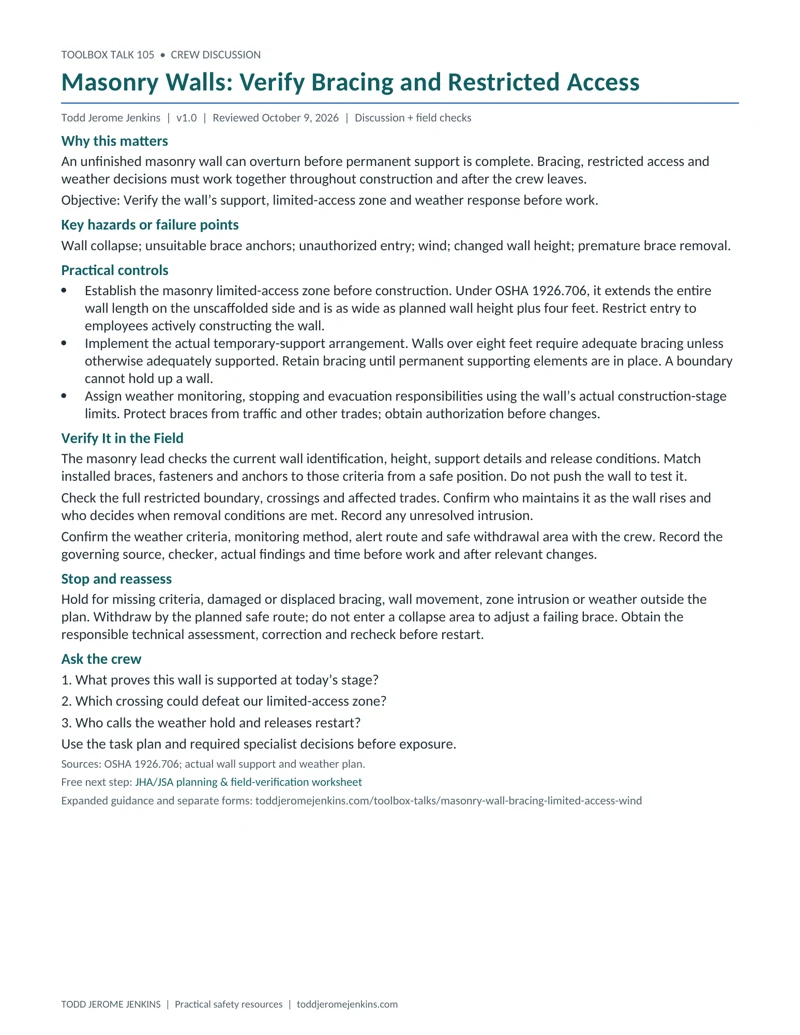
Preview the one-page crew talk
Supporting documents
Included with free Safety & Systems membership.
Supervisor field check
A separate check to verify conditions and controls before work. Includes a one-page PDF and editable Word file.
Attendance sheet
A separate sign-in sheet to record the crew discussion. Includes a one-page PDF and editable Word file.
Need the crew records? Join free to use these supporting documents and the Safety & Systems Academy. No payment details. Email updates are optional.
Get supporting documents — free membershipAlready a member? Use the same link to sign in.
A 5–10 minute crew discussion, plus time to verify the actual controls. The crew talk and Word version are public. Separate supervisor and attendance records are included with free Safety & Systems membership.
Why this matters
An unfinished masonry wall can overturn before permanent support is complete. Bracing, restricted access and weather decisions must work together throughout construction and after the crew leaves.
Learning objective
Verify the wall’s support, limited-access zone and weather response before work.
Key hazards or failure points
Wall collapse; unsuitable brace anchors; unauthorized entry; wind; changed wall height; premature brace removal.
Practical controls
- Establish the masonry limited-access zone before construction. Under OSHA 1926.706, it extends the entire wall length on the unscaffolded side and is as wide as planned wall height plus four feet. Restrict entry to employees actively constructing the wall.
- Implement the actual temporary-support arrangement. Walls over eight feet require adequate bracing unless otherwise adequately supported. Retain bracing until permanent supporting elements are in place. A boundary cannot hold up a wall.
- Assign weather monitoring, stopping and evacuation responsibilities using the wall’s actual construction-stage limits. Protect braces from traffic and other trades; obtain authorization before changes.
Verify It in the Field
- The masonry lead checks the current wall identification, height, support details and release conditions. Match installed braces, fasteners and anchors to those criteria from a safe position. Do not push the wall to test it.
- Check the full restricted boundary, crossings and affected trades. Confirm who maintains it as the wall rises and who decides when removal conditions are met. Record any unresolved intrusion.
- Confirm the weather criteria, monitoring method, alert route and safe withdrawal area with the crew. Record the governing source, checker, actual findings and time before work and after relevant changes.
Stop and reassess
Hold for missing criteria, damaged or displaced bracing, wall movement, zone intrusion or weather outside the plan. Withdraw by the planned safe route; do not enter a collapse area to adjust a failing brace. Obtain the responsible technical assessment, correction and recheck before restart.
Crew discussion questions
- What proves this wall is supported at today’s stage?
- Which crossing could defeat our limited-access zone?
- Who calls the weather hold and releases restart?
For each required control, record its acceptance source and criterion, safe verification method, responsible checker, actual result and time. Use VERIFIED, HOLD/NOT VERIFIED, or N/A with a reason. A tick alone is not evidence. Complete all applicable task inspections; do not enter danger or improvise a test to fill out a form.
Leader preparation and practical detail
The zone has a specific purpose
The regulatory zone is not a fall-protection controlled-access zone or a universal collapse-clearance calculation. Apply all of 1926.706(a), including its retention conditions; where the wall exceeds eight feet, paragraph(b) also governs. Assess exposures on both sides through the task plan. Restricted entry does not make an inadequately supported wall safe for masons.
Do not guess stability from reinforcement
OSHA’s 1996 interpretation explains that reinforcing steel does not remove the need for adequate construction-stage support. The employer must substantiate a determination that the wall withstands expected forces, including prevailing wind, geometry and location. Obtain appropriate technical support for the actual wall; this talk supplies no brace angle, anchor capacity, spacing, curing time or wind threshold.
Keep weather decisions ahead of exposure
Illustrative situation: wind is rising and a following trade asks to move a brace. Hold both changes while the responsible lead checks the support arrangement and weather response. Do not wait for visible movement to decide where workers should withdraw. Plan how the unfinished wall and boundaries remain protected overnight and how conditions are checked before return.
Separate the release decisions
Final height alone does not authorize brace removal. Record required permanent support and the responsible person’s removal decision. Scaffold readiness, wall stability and limited access are different checks; completion of one does not release the others. The linked JHA is a fictional ten-foot CMU-wall example, not an approved design for this job.
Short supervisor field check
- Wall and construction-stage support identified.
- Braces, anchors and fasteners checked against details.
- Required zone established and access controlled.
- Weather monitoring and withdrawal plan ready.
- Removal/restart authority and evidence recorded.
Confirm the relevant trained/authorized people, unresolved items, interim protection, correction owner and recheck. Record required release authority and rebrief anyone affected. The separate sheet supports these records; it does not replace a specialist inspection, permit or engineering determination.
Attendance and follow-through
Use the separate attendance sheet for participants, roles, discussion concerns, actions and late-arrival rebriefs. Attendance is not proof of competence, functioning controls or authorization to work. Keep completed records private under employer procedures.
Technical scope and references
Reviewed October 9, 2026 for construction crew preparation. Apply the actual task, jurisdiction and relevant standard provisions. Manufacturer sources below are reference examples, not approval of your equipment. No site-specific design, permit, exposure assessment, product SDS or current model manual was supplied; obtain the applicable documents before work. This discussion does not replace required training.
- OSHA 1926.706 — Masonry limited-access-zone and wall-bracing requirements.
- OSHA masonry-bracing interpretation, June 25, 1996 — Historical interpretation: reinforcement alone does not establish stability; expected wind and construction forces matter.
Connect this discussion to your JHA/JSA
Use the related worked JHA/JSA/AHA example to prepare task steps, hazards and controls. Return to What Changed Today? when the plan or conditions change.
Related Todd Jerome Jenkins article: How to Conduct a Job Safety Analysis.
Related crew discussions
Put one check into practice
Use the free JHA/JSA planning and field-verification worksheet to record today’s change, the required protection and the evidence needed before exposure.