Download the free crew talk
The one-page talk, editable Word version, and guidance below are open to everyone. No account required.
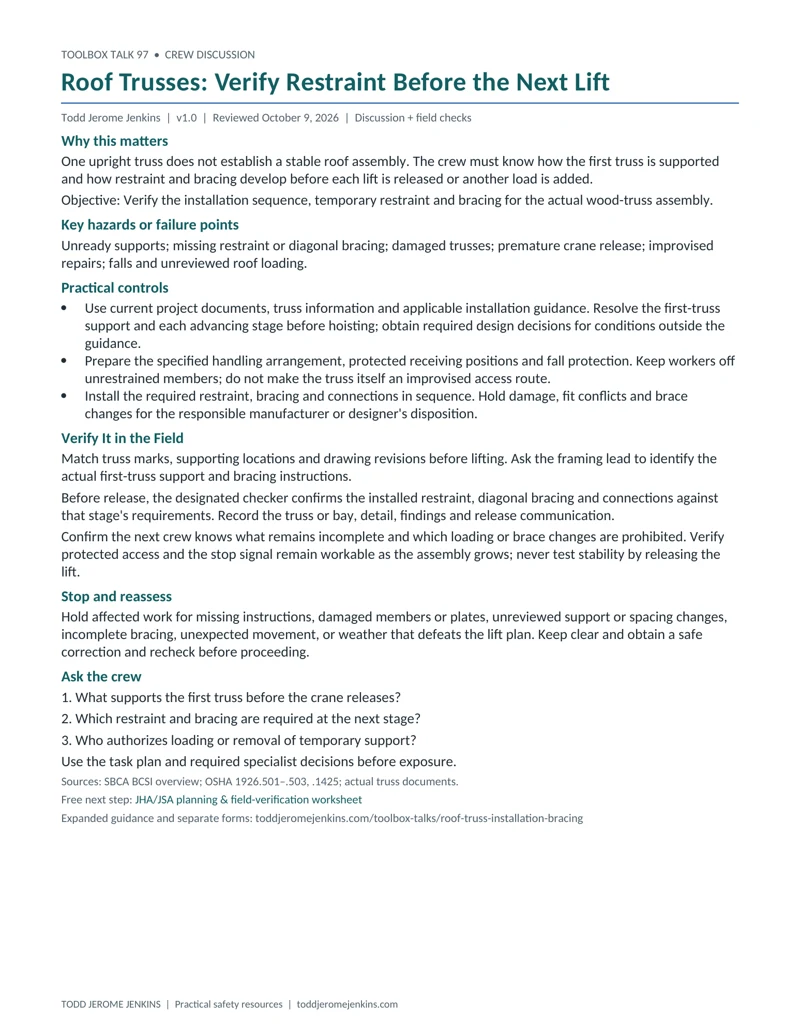
Preview the one-page crew talk
Supporting documents
Included with free Safety & Systems membership.
Supervisor field check
A separate check to verify conditions and controls before work. Includes a one-page PDF and editable Word file.
Attendance sheet
A separate sign-in sheet to record the crew discussion. Includes a one-page PDF and editable Word file.
Need the crew records? Join free to use these supporting documents and the Safety & Systems Academy. No payment details. Email updates are optional.
Get supporting documents — free membershipAlready a member? Use the same link to sign in.
A 5–10 minute crew discussion, plus time to verify the actual controls. The crew talk and Word version are public. Separate supervisor and attendance records are included with free Safety & Systems membership.
Why this matters
One upright truss does not establish a stable roof assembly. The crew must know how the first truss is supported and how restraint and bracing develop before each lift is released or another load is added.
Learning objective
Verify the installation sequence, temporary restraint and bracing for the actual wood-truss assembly.
Key hazards or failure points
Unready supports; missing restraint or diagonal bracing; damaged trusses; premature crane release; improvised repairs; falls and unreviewed roof loading.
Practical controls
- Use current project documents, truss information and applicable installation guidance. Resolve the first-truss support and each advancing stage before hoisting; obtain required design decisions for conditions outside the guidance.
- Prepare the specified handling arrangement, protected receiving positions and fall protection. Keep workers off unrestrained members; do not make the truss itself an improvised access route.
- Install the required restraint, bracing and connections in sequence. Hold damage, fit conflicts and brace changes for the responsible manufacturer or designer's disposition.
Verify It in the Field
- Match truss marks, supporting locations and drawing revisions before lifting. Ask the framing lead to identify the actual first-truss support and bracing instructions.
- Before release, the designated checker confirms the installed restraint, diagonal bracing and connections against that stage's requirements. Record the truss or bay, detail, findings and release communication.
- Confirm the next crew knows what remains incomplete and which loading or brace changes are prohibited. Verify protected access and the stop signal remain workable as the assembly grows; never test stability by releasing the lift.
Stop and reassess
Hold affected work for missing instructions, damaged members or plates, unreviewed support or spacing changes, incomplete bracing, unexpected movement, or weather that defeats the lift plan. Keep clear and obtain a safe correction and recheck before proceeding.
Crew discussion questions
- What supports the first truss before the crane releases?
- Which restraint and bracing are required at the next stage?
- Who authorizes loading or removal of temporary support?
For each required control, record its acceptance source and criterion, safe verification method, responsible checker, actual result and time. Use VERIFIED, HOLD/NOT VERIFIED, or N/A with a reason. A tick alone is not evidence. Complete all applicable task inspections; do not enter danger or improvise a test to fill out a form.
Leader preparation and practical detail
Keep the first stage explicit
Illustrative situation: a delivery has the expected truss marks, but the receiving wall arrangement differs from the plan. The framing lead stops installation and obtains the responsible design decision. Matching the truss label does not verify the support beneath it.
Use current guidance, not remembered spacing
SBCA's public BCSI overview identifies the 2025 edition and describes temporary and permanent restraint and bracing guidance for metal-plate-connected wood trusses. The overview is not the project installation design. Obtain the applicable current instructions and project requirements; this briefing reproduces no BCSI tables or prescribed sequence.
Check the assembly, not just one connection
Use the related JHA to identify checks at first-truss support, advancing installation and sheathing handover. Have the lead establish what evidence permits each transition. Do not replace the specified bracing with whatever material is available or remove it simply because sheathing has begun.
Prepare access before receiving
Apply the actual fall-protection provisions and system criteria in 1926.501–.502. A roof-truss task does not automatically qualify for a roofing exception or an alternative fall plan. Confirm trained workers, safe attachment and rescue where required. Section 1926.503 requires fall-hazard training beyond this short discussion.
Keep the worked-example scope
The JHA covers metal-plate-connected wood trusses from protected access. It excludes long-span special erection schemes, repair and walking unrestrained trusses. Steel trusses and specialized configurations need their own requirements. No brace spacing, fastening schedule, wind speed, lifting method or repair detail is supplied.
Short supervisor field check
- Truss identity, support and current documents matched.
- First-truss support and sequence confirmed.
- Required restraint, bracing and connections verified.
- Protected access and release communication ready.
- Damage, loading and handoff restrictions resolved.
Confirm the relevant trained/authorized people, unresolved items, interim protection, correction owner and recheck. Record required release authority and rebrief anyone affected. The separate sheet supports these records; it does not replace a specialist inspection, permit or engineering determination.
Attendance and follow-through
Use the separate attendance sheet for participants, roles, discussion concerns, actions and late-arrival rebriefs. Attendance is not proof of competence, functioning controls or authorization to work. Keep completed records private under employer procedures.
Technical scope and references
Reviewed October 9, 2026 for construction crew preparation. Apply the actual task, jurisdiction and relevant standard provisions. Manufacturer sources below are reference examples, not approval of your equipment. No site-specific design, permit, exposure assessment, product SDS or current model manual was supplied; obtain the applicable documents before work. This discussion does not replace required training.
- SBCA — BCSI overview — Industry guidance framework and current edition; reference-only, not the full manual or a project design.
- OSHA 1926.501 — Construction fall duties; choose the actual activity provision.
- OSHA 1926.502 — Fall-system criteria and limits on alternative plans.
- OSHA 1926.503 — Fall-hazard training and retraining.
- OSHA 1926.1425 — Crane load exposure and receiving restrictions.
Connect this discussion to your JHA/JSA
Use the related worked JHA/JSA/AHA example to prepare task steps, hazards and controls. Return to What Changed Today? when the plan or conditions change.
Related Todd Jerome Jenkins article: How to Conduct a Job Safety Analysis.
Related crew discussions
Put one check into practice
Use the free JHA/JSA planning and field-verification worksheet to record today’s change, the required protection and the evidence needed before exposure.