Download the free crew talk
The one-page talk, editable Word version, and guidance below are open to everyone. No account required.
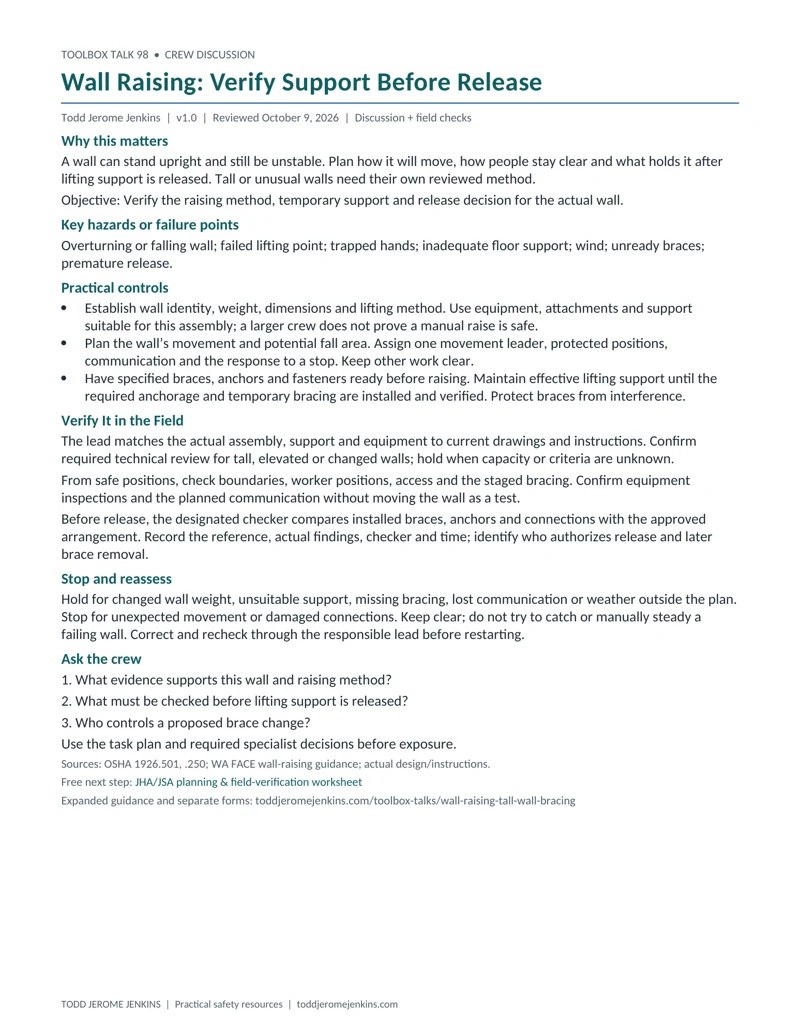
Preview the one-page crew talk
Supporting documents
Included with free Safety & Systems membership.
Supervisor field check
A separate check to verify conditions and controls before work. Includes a one-page PDF and editable Word file.
Attendance sheet
A separate sign-in sheet to record the crew discussion. Includes a one-page PDF and editable Word file.
Need the crew records? Join free to use these supporting documents and the Safety & Systems Academy. No payment details. Email updates are optional.
Get supporting documents — free membershipAlready a member? Use the same link to sign in.
A 5–10 minute crew discussion, plus time to verify the actual controls. The crew talk and Word version are public. Separate supervisor and attendance records are included with free Safety & Systems membership.
Why this matters
A wall can stand upright and still be unstable. Plan how it will move, how people stay clear and what holds it after lifting support is released. Tall or unusual walls need their own reviewed method.
Learning objective
Verify the raising method, temporary support and release decision for the actual wall.
Key hazards or failure points
Overturning or falling wall; failed lifting point; trapped hands; inadequate floor support; wind; unready braces; premature release.
Practical controls
- Establish wall identity, weight, dimensions and lifting method. Use equipment, attachments and support suitable for this assembly; a larger crew does not prove a manual raise is safe.
- Plan the wall’s movement and potential fall area. Assign one movement leader, protected positions, communication and the response to a stop. Keep other work clear.
- Have specified braces, anchors and fasteners ready before raising. Maintain effective lifting support until the required anchorage and temporary bracing are installed and verified. Protect braces from interference.
Verify It in the Field
- The lead matches the actual assembly, support and equipment to current drawings and instructions. Confirm required technical review for tall, elevated or changed walls; hold when capacity or criteria are unknown.
- From safe positions, check boundaries, worker positions, access and the staged bracing. Confirm equipment inspections and the planned communication without moving the wall as a test.
- Before release, the designated checker compares installed braces, anchors and connections with the approved arrangement. Record the reference, actual findings, checker and time; identify who authorizes release and later brace removal.
Stop and reassess
Hold for changed wall weight, unsuitable support, missing bracing, lost communication or weather outside the plan. Stop for unexpected movement or damaged connections. Keep clear; do not try to catch or manually steady a failing wall. Correct and recheck through the responsible lead before restarting.
Crew discussion questions
- What evidence supports this wall and raising method?
- What must be checked before lifting support is released?
- Who controls a proposed brace change?
For each required control, record its acceptance source and criterion, safe verification method, responsible checker, actual result and time. Use VERIFIED, HOLD/NOT VERIFIED, or N/A with a reason. A tick alone is not evidence. Complete all applicable task inspections; do not enter danger or improvise a test to fill out a form.
Leader preparation and practical detail
Tall walls need a new decision
Illustrative situation: sheathing is added to a wall after the raising method was planned. The lead holds the raise because the weight, wind exposure and lifting arrangement may have changed. Obtain a reviewed method for the actual assembly. Tall-wall height, brace spacing, anchorage, wind limits and lifting capacity are not supplied by this talk. The responsible project technical personnel must establish these criteria; obtain engineering where the assembly or temporary works require it.
Keep the JHA example within its boundary
The linked wall-raising example describes a prefabricated wood wall raised from a ground-floor slab. It expressly excludes tall walls and elevated exterior walls. Use it to understand the verification sequence, not to authorize those excluded operations. This talk adds a hold point for task-specific planning; it does not extend the example into a tall-wall design.
Check the complete temporary support path
Trace the approved support arrangement from the wall through each specified brace, fastener and anchor to the supporting substrate. A brace merely touching the wall is not evidence of the required connection. Keep people protected while checking; do not push the wall or loosen a brace as a test. Temporary conditions can differ from the completed building, so permanent wall-bracing details alone do not establish the raising arrangement.
Plan removal and the next trade
Mark support status through the site system and tell following crews what must remain. A brace obstructing another task requires a reviewed alternative and authorized change, not casual removal. Worker fall protection and floor-loading duties apply to their actual conditions. Steel-erection and masonry-wall provisions are not generic wood-framing brace specifications. Washington FACE guidance recommends advance wall-raising planning, known weight, supervision, training and manufacturer-directed equipment use; it is historical incident-based guidance, not a federal tall-wall design rule.
Apply this briefing to framing and masonry work
Wall raising: find the pinch point before the wall moves
Review the whole movement, including the final few inches. The bottom plate can slide, a projecting end can strike someone, and the closing space between a wall and stacked material can trap a worker.
With the wall stationary and safely supported, the movement leader and crew review the planned positions from a safe location. Trace the wall's sweep, potential fall area, jack-pole movement and each person's clear route away. Include doorways where another trade could enter. Resolve any step that puts a hand between moving members or places a worker beneath the wall; use the planned positioning equipment and method.
Check those positions against the wall-raising plan and the actual lifting-equipment instructions. Record who controls movement and who checks the restricted area. If the planned position becomes blocked, communication fails or alignment requires entering a closing gap, stop and restore a safe method. Do not make a trial movement with someone in the hazard area.
Reference reviewed October 9, 2026: Washington FACE wall-raising recommendations, 2020.
Record the acceptance source, safe check method, assigned verifier, actual result and time. Hold affected work for an unresolved required control; correct, recheck and rebrief before authorized restart.
Short supervisor field check
- Wall identity, weight and raising method established.
- Support, lifting equipment and attachment criteria verified.
- Worker positions, boundaries and communication ready.
- Braces and anchors installed and checked before release.
- Release evidence and brace-removal authority recorded.
Confirm the relevant trained/authorized people, unresolved items, interim protection, correction owner and recheck. Record required release authority and rebrief anyone affected. The separate sheet supports these records; it does not replace a specialist inspection, permit or engineering determination.
Attendance and follow-through
Use the separate attendance sheet for participants, roles, discussion concerns, actions and late-arrival rebriefs. Attendance is not proof of competence, functioning controls or authorization to work. Keep completed records private under employer procedures.
Technical scope and references
Reviewed October 9, 2026 for construction crew preparation. Apply the actual task, jurisdiction and relevant standard provisions. Manufacturer sources below are reference examples, not approval of your equipment. No site-specific design, permit, exposure assessment, product SDS or current model manual was supplied; obtain the applicable documents before work. This discussion does not replace required training.
- OSHA 1926.501 — Construction surface strength and task-specific fall-protection duties.
- OSHA 1926.250 — Construction storage and floor-load limits; not a wall-brace design.
- Washington FACE: Framer Struck by Falling Wall Section, 2020 — Historical primary incident guidance; recommendations, not universal design criteria.
Connect this discussion to your JHA/JSA
Use the related worked JHA/JSA/AHA example to prepare task steps, hazards and controls. Return to What Changed Today? when the plan or conditions change.
Related Todd Jerome Jenkins article: How to Conduct a Job Safety Analysis.
Related crew discussions
Put one check into practice
Use the free JHA/JSA planning and field-verification worksheet to record today’s change, the required protection and the evidence needed before exposure.