Download the free crew talk
The one-page talk, editable Word version, and guidance below are open to everyone. No account required.
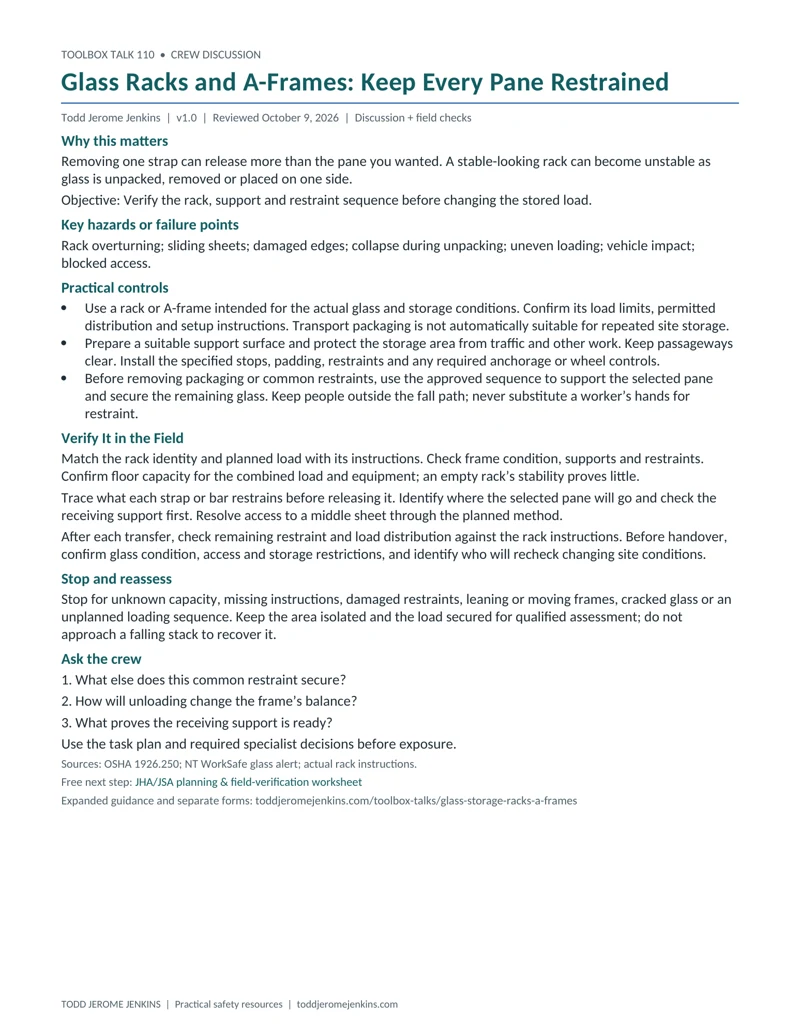
Preview the one-page crew talk
Supporting documents
Included with free Safety & Systems membership.
Supervisor field check
A separate check to verify conditions and controls before work. Includes a one-page PDF and editable Word file.
Attendance sheet
A separate sign-in sheet to record the crew discussion. Includes a one-page PDF and editable Word file.
Need the crew records? Join free to use these supporting documents and the Safety & Systems Academy. No payment details. Email updates are optional.
Get supporting documents — free membershipAlready a member? Use the same link to sign in.
A 5–10 minute crew discussion, plus time to verify the actual controls. The crew talk and Word version are public. Separate supervisor and attendance records are included with free Safety & Systems membership.
Why this matters
Removing one strap can release more than the pane you wanted. A stable-looking rack can become unstable as glass is unpacked, removed or placed on one side.
Learning objective
Verify the rack, support and restraint sequence before changing the stored load.
Key hazards or failure points
Rack overturning; sliding sheets; damaged edges; collapse during unpacking; uneven loading; vehicle impact; blocked access.
Practical controls
- Use a rack or A-frame intended for the actual glass and storage conditions. Confirm its load limits, permitted distribution and setup instructions. Transport packaging is not automatically suitable for repeated site storage.
- Prepare a suitable support surface and protect the storage area from traffic and other work. Keep passageways clear. Install the specified stops, padding, restraints and any required anchorage or wheel controls.
- Before removing packaging or common restraints, use the approved sequence to support the selected pane and secure the remaining glass. Keep people outside the fall path; never substitute a worker’s hands for restraint.
Verify It in the Field
- Match the rack identity and planned load with its instructions. Check frame condition, supports and restraints. Confirm floor capacity for the combined load and equipment; an empty rack’s stability proves little.
- Trace what each strap or bar restrains before releasing it. Identify where the selected pane will go and check the receiving support first. Resolve access to a middle sheet through the planned method.
- After each transfer, check remaining restraint and load distribution against the rack instructions. Before handover, confirm glass condition, access and storage restrictions, and identify who will recheck changing site conditions.
Stop and reassess
Stop for unknown capacity, missing instructions, damaged restraints, leaning or moving frames, cracked glass or an unplanned loading sequence. Keep the area isolated and the load secured for qualified assessment; do not approach a falling stack to recover it.
Crew discussion questions
- What else does this common restraint secure?
- How will unloading change the frame’s balance?
- What proves the receiving support is ready?
For each required control, record its acceptance source and criterion, safe verification method, responsible checker, actual result and time. Use VERIFIED, HOLD/NOT VERIFIED, or N/A with a reason. A tick alone is not evidence. Complete all applicable task inspections; do not enter danger or improvise a test to fill out a form.
Leader preparation and practical detail
Separate storage from installation
Use the linked JHA for a planned transfer between an identified transport rack and a suitable A-frame. It excludes trailer access, hoisting an unrated rack and installation into an opening. The glass-handling talk addresses the moving pane; this briefing focuses on the load left behind and the storage system receiving it.
Use design information, not a familiar rack shape
Obtain the actual rack capacity, permitted load distribution, setup and movement instructions. An A shape alone establishes none of these. Do not invent a universal lean angle, anchorage arrangement or rule requiring identical loads on each side; the actual system must remain stable through the planned loading sequence. Damaged or undocumented systems need resolution by the appropriate supplier or qualified person before use.
Check the storage location
Section 1926.250 addresses stable storage, safe structural floor loads, clear passageways and housekeeping in construction. Its indoor storage setbacks apply where stated; check the actual openings and wall condition rather than relying only on a painted rack footprint. Account for handling equipment as well as stored glass. The rack does not protect itself from adjacent vehicle operations or changing ground conditions.
Make restraint changes a hold point
The NT WorkSafe alert supports restraint before unpacking and staying out of the stored sheets’ fall path. Queensland guidance highlights support for unbalanced loads. These Australian regulator sources provide practical prevention guidance, not US legal requirements. Plan temporary support and the order of removing common packaging before anyone begins; handing an unsecured stack to a helper is not a control.
Apply this briefing to glazing and roofing work
Glass delivery: accept the receiving setup before unloading
Confirm the actual delivery against the staging plan before restraints are changed. The receiving lead checks pane sizes, rack type, quantity and intended unloading order with the supplier and unloading team. A different rack or pane sequence can invalidate an otherwise workable layout.
From safe access, verify the receiving support, handling route and space for the delivered configuration. Compare the combined storage load with the floor information and the rack's actual instructions. Keep the unloading area separated from normal access, with a usable route for other people. Arrange any trailer access or mechanical unloading through its own assessed method.
Identify who accepts the receiving rack and who controls the restraint handoff. Keep glass supported and restrained through the planned sequence; do not unpack it to investigate a suspected shifted load. Record delivery/rack identity, staging location, instruction references, findings and time. Hold unloading for damaged packaging, a changed load, unsuitable support or an unready receiving system.
Sources checked October 9, 2026: OSHA 1926.250; NT WorkSafe glass-storage guidance, Australian guidance, not US law.
Record the acceptance source, safe check method, assigned verifier, actual result and time. Hold affected work for an unresolved required control; correct, recheck and rebrief before authorized restart.
Short supervisor field check
- Rack and load limits identified.
- Support and floor capacity confirmed.
- Restraints and components checked.
- Transfer sequence protects remaining panes.
- Final restraint and access checked.
Confirm the relevant trained/authorized people, unresolved items, interim protection, correction owner and recheck. Record required release authority and rebrief anyone affected. The separate sheet supports these records; it does not replace a specialist inspection, permit or engineering determination.
Attendance and follow-through
Use the separate attendance sheet for participants, roles, discussion concerns, actions and late-arrival rebriefs. Attendance is not proof of competence, functioning controls or authorization to work. Keep completed records private under employer procedures.
Technical scope and references
Reviewed October 9, 2026 for construction crew preparation. Apply the actual task, jurisdiction and relevant standard provisions. Manufacturer sources below are reference examples, not approval of your equipment. No site-specific design, permit, exposure assessment, product SDS or current model manual was supplied; obtain the applicable documents before work. This discussion does not replace required training.
- OSHA 1926.250(a), (b)(1), (c) — Construction storage stability, structural load limits, clear access and applicable opening setbacks.
- NT WorkSafe — Handling and storage of sheet glass — Australian regulator safety alert, updated 2022; restraint before unpacking and avoiding the fall path. Guidance, not US law.
- WorkSafe Queensland — Workers injured by glass sheets — 2018 regulator alert; mechanical handling, planned lifts and support for unbalanced loads. Guidance, not US law.
Connect this discussion to your JHA/JSA
Use the related worked JHA/JSA/AHA example to prepare task steps, hazards and controls. Return to What Changed Today? when the plan or conditions change.
Related Todd Jerome Jenkins article: How to Conduct a Job Safety Analysis.
Related crew discussions
Put one check into practice
Use the free JHA/JSA planning and field-verification worksheet to record today’s change, the required protection and the evidence needed before exposure.