Download the talk and separate crew records
Free to download without an account. Each PDF is one page. Use the Word version to adapt the record to your task and approved procedures.
Supervisor field check
Download supervisor field check (PDF, 1 page)Editable supervisor field check (Word)Preview the one-page crew talk
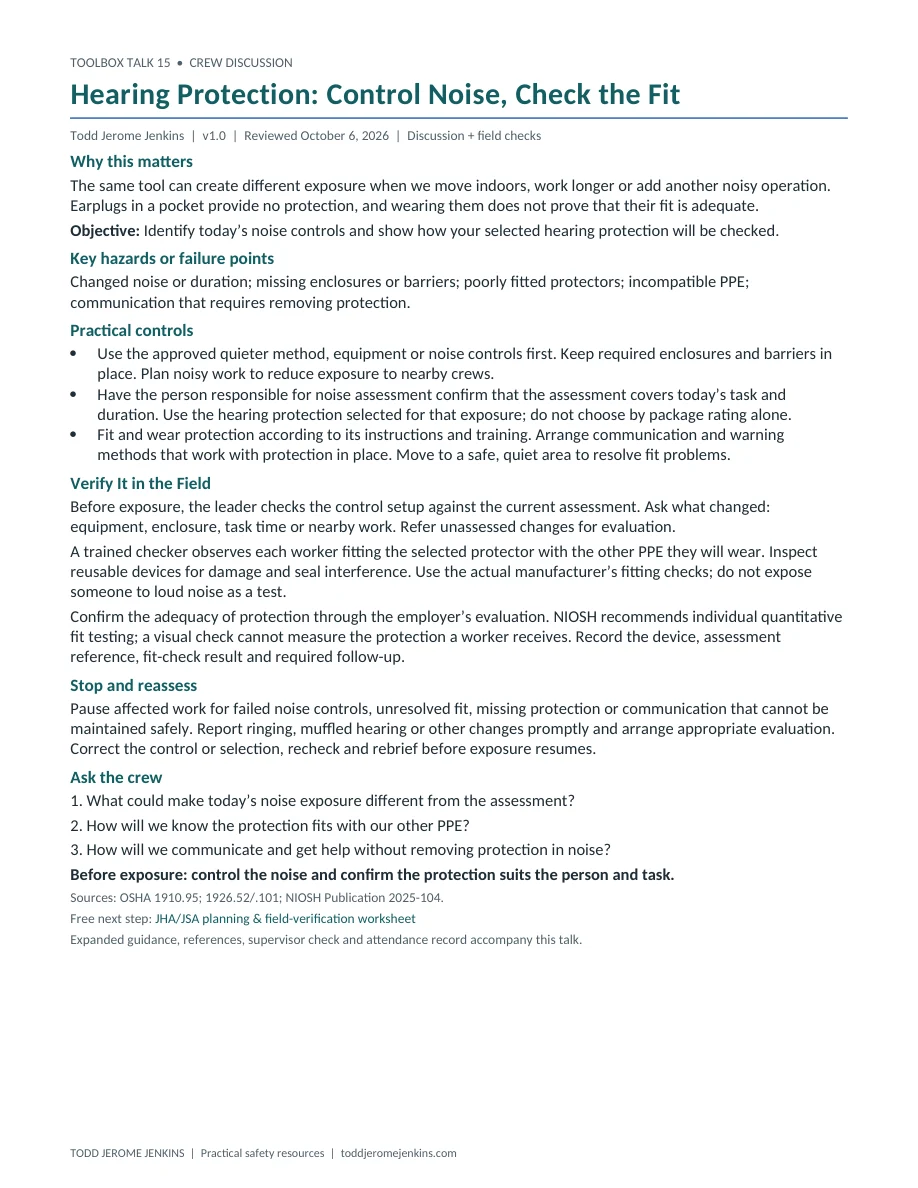
A 5–10 minute crew discussion, plus the time needed for field verification. All six downloads are free without a required signup.
Why this matters
The same tool can create different exposure when we move indoors, work longer or add another noisy operation. Earplugs in a pocket provide no protection, and wearing them does not prove that their fit is adequate.
Learning objective: Identify today’s noise controls and show how your selected hearing protection will be checked.
Key hazards or failure points
Changed noise or duration; missing enclosures or barriers; poorly fitted protectors; incompatible PPE; communication that requires removing protection.
Practical controls
- Use the approved quieter method, equipment or noise controls first. Keep required enclosures and barriers in place. Plan noisy work to reduce exposure to nearby crews.
- Have the person responsible for noise assessment confirm that the assessment covers today’s task and duration. Use the hearing protection selected for that exposure; do not choose by package rating alone.
- Fit and wear protection according to its instructions and training. Arrange communication and warning methods that work with protection in place. Move to a safe, quiet area to resolve fit problems.
Verify It in the Field
Before exposure, the leader checks the control setup against the current assessment. Ask what changed: equipment, enclosure, task time or nearby work. Refer unassessed changes for evaluation.
A trained checker observes each worker fitting the selected protector with the other PPE they will wear. Inspect reusable devices for damage and seal interference. Use the actual manufacturer’s fitting checks; do not expose someone to loud noise as a test.
Confirm the adequacy of protection through the employer’s evaluation. NIOSH recommends individual quantitative fit testing; a visual check cannot measure the protection a worker receives. Record the device, assessment reference, fit-check result and required follow-up.
Use the separate field check to record the source and criterion, safe method, checker, actual result and time. Mark VERIFIED, HOLD/NOT VERIFIED, or N/A with a reason. Check every required control; the examples below do not clear the whole task.
| Control | Safe verification | Evidence to record |
|---|---|---|
| Noise control | Compare today’s enclosure, barriers and work duration with the assessment. | Assessment remains applicable, or changed work is held for evaluation. |
| Protector fit | Observe the manufacturer’s fitting method with all other required PPE. | Device, worker check and unresolved interference recorded without a loud-noise trial. |
| Adequate protection | Responsible person evaluates attenuation for the exposure; use quantitative fit testing as recommended by NIOSH. | Evaluation reference and any individual test result retained in the appropriate record. |
Stop and reassess
Pause affected work for failed noise controls, unresolved fit, missing protection or communication that cannot be maintained safely. Report ringing, muffled hearing or other changes promptly and arrange appropriate evaluation. Correct the control or selection, recheck and rebrief before exposure resumes.
Crew discussion questions
- What could make today’s noise exposure different from the assessment?
- How will we know the protection fits with our other PPE?
- How will we communicate and get help without removing protection in noise?
Before exposure: control the noise and confirm the protection suits the person and task.
A situation to discuss
Illustrative situation: a cutting task moves from an open yard into a partly enclosed room. The crew plans to use the same protectors. The leader pauses to have the changed exposure evaluated and checks whether the new communication arrangement works with all required PPE.
Leader preparation and practical detail
A noise reading needs context
Use the assessment for the task, work pattern and exposure duration. A momentary phone reading or a worker saying that it sounds quieter does not establish daily exposure. Record changes that could make the existing assessment unrepresentative. The responsible specialist decides what measurement or reassessment is needed. [1], [2]
Separate fitting from measured performance
A worker can demonstrate the insertion or adjustment method and identify a damaged cushion. These checks are useful, but they do not quantify attenuation. NIOSH’s January 2025 policy update recommends individual quantitative fit testing and supersedes its older derating guidance. This is a NIOSH recommendation; do not present it as a new universal OSHA fit-test mandate. [4]
Resolve the reason people remove protection
Ask whether a radio, alarm or conversation becomes difficult to understand. Bring the problem to the supervisor and hearing-conservation lead. The solution may involve the work arrangement or an appropriate communication system, with its performance verified. Telling someone to keep plugs in does not fix an unusable communication method.
Short supervisor field check
- Current noise assessment covers task, duration, enclosure and adjacent work.
- Specified engineering/work controls are present and usable.
- Selected protectors and attenuation evaluation match the exposure.
- Individual fitting checked with other PPE; defects or interference resolved.
- Communication, symptom reporting and reassessment triggers understood.
Use the separate form to document evidence, restrictions, corrective-action owner, recheck and required restart approval. An unresolved required control means hold the affected work. Missing evidence is not a pass. Complete all task-specific inspections and permits.
Attendance and follow-through
The separate attendance sheet records participants, language support, questions, actions and late-arrival rebriefs. Attendance does not establish competence or prove controls function. Keep completed records private under the employer’s procedures.
Technical scope and references
General-industry 1910.95 uses 85 dBA as an eight-hour time-weighted hearing-conservation action level, with distinct requirements for availability and use of protection. It is not a universal instantaneous threshold. Construction uses 1926.52 and 1926.101; the latter addresses individual fitting or determination of inserted ear protectors by competent persons. Apply the relevant exposure requirements and employer program. [1], [2], [3]
References checked October 6, 2026. Apply the jurisdiction, task, employer program and equipment instructions that govern the work. No site-specific manual, permit, engineering determination or product SDS has been approved by this general resource.
- OSHA 29 CFR 1910.95 — Occupational noise exposure — General industry; exposure duration and hearing-conservation provisions matter.
- OSHA 29 CFR 1926.52 — Occupational noise exposure — Construction noise controls and Table D-2 framework.
- OSHA 29 CFR 1926.101 — Hearing protection — Construction; individual fitting/determination for inserted devices.
- NIOSH Publication 2025-104 — Individual Fit-testing Recommendation for Hearing Protection Devices — January 2025 policy recommendation; not a universal OSHA fit-test mandate.
Connect this discussion to your JHA/JSA
Use How to Conduct a Job Safety Analysis to connect today’s work steps, hazards and controls. Revisit Pre-Job JHA/JSA: What Changed Today? whenever conditions change.
Related Todd Jerome Jenkins video: What Is PPE and How Do You Choose It?.
Related published crew resources: Eye & Face Protection; Respiratory Hazards: Know What You’re Breathing.
Put one check into practice
Download the free JHA/JSA planning and field-verification worksheet. For today’s task, record an important control, its source and the evidence needed before exposure. Complete the remaining required checks through your task plan.