Download the free toolbox talk
The one-page talk, editable Word version, and guidance below are open to everyone. No account required.
One-page toolbox talk
Download one-page toolbox talk (PDF, 1 page)Editable one-page toolbox talk (Word)Preview the one-page toolbox talk
Supporting documents
Included with free Safety & Systems membership.
Supervisor field check
A separate check to verify conditions and controls before work. Includes a one-page PDF and editable Word file.
Attendance sheet
A separate sign-in sheet to record the crew discussion. Includes a one-page PDF and editable Word file.
Need the crew records? Join free to use these supporting documents and the Safety & Systems Academy. No payment details. Email updates are optional.
Get supporting documents — free membershipAlready a member? Use the same link to sign in.
Hazard-based toolbox talk 18 of 52, with a practical HOP exercise.
Plan a 5–10 minute toolbox discussion, plus time to verify the actual controls. The one-page toolbox talk and editable Word version are public. Separate supervisor and attendance records are included with free Safety & Systems membership.
Why this matters
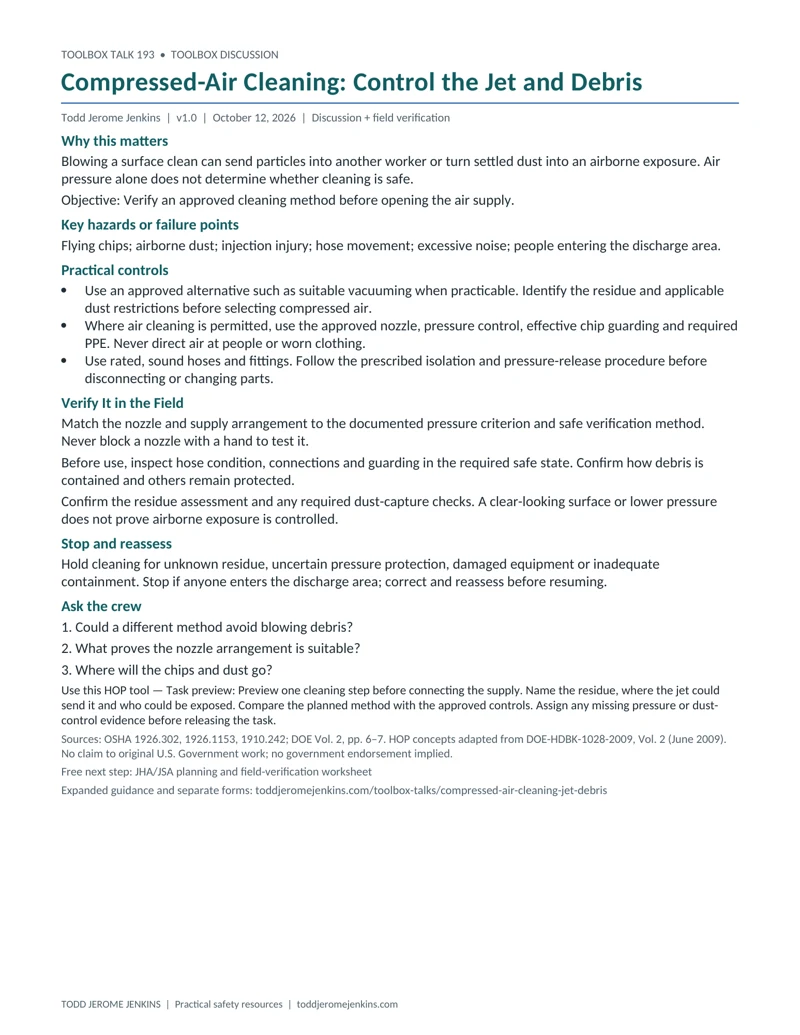
Blowing a surface clean can send particles into another worker or turn settled dust into an airborne exposure. Air pressure alone does not determine whether cleaning is safe.
Learning objective
Verify an approved cleaning method before opening the air supply.
Key hazards or failure points
Flying chips; airborne dust; injection injury; hose movement; excessive noise; people entering the discharge area.
Practical controls
- Use an approved alternative such as suitable vacuuming when practicable. Identify the residue and applicable dust restrictions before selecting compressed air.
- Where air cleaning is permitted, use the approved nozzle, pressure control, effective chip guarding and required PPE. Never direct air at people or worn clothing.
- Use rated, sound hoses and fittings. Follow the prescribed isolation and pressure-release procedure before disconnecting or changing parts.
Verify It in the Field
- Match the nozzle and supply arrangement to the documented pressure criterion and safe verification method. Never block a nozzle with a hand to test it.
- Before use, inspect hose condition, connections and guarding in the required safe state. Confirm how debris is contained and others remain protected.
- Confirm the residue assessment and any required dust-capture checks. A clear-looking surface or lower pressure does not prove airborne exposure is controlled.
Stop and reassess
Hold cleaning for unknown residue, uncertain pressure protection, damaged equipment or inadequate containment. Stop if anyone enters the discharge area; correct and reassess before resuming.
Crew discussion questions
- Could a different method avoid blowing debris?
- What proves the nozzle arrangement is suitable?
- Where will the chips and dust go?
For each required control, record its acceptance source and criterion, safe verification method, responsible verifier, actual result and time. Mark VERIFIED, HOLD/NOT VERIFIED, or N/A with a reason. Complete all required inspections; never enter danger or improvise a test to fill out a form.
Use this HOP tool
Task preview
Preview one cleaning step before connecting the supply. Name the residue, where the jet could send it and who could be exposed. Compare the planned method with the approved controls. Assign any missing pressure or dust-control evidence before releasing the task.
This exercise supports hazard identification or control verification. It does not replace safeguards, required training, specialist decisions or work authorization.
Leader preparation and practical detail
Select the method before the nozzle
Illustrative situation: a crew plans to blow residue off a surface beside another trade. Identify the residue, exposure and disposal method first. Move the task or use suitable capture/cleaning equipment where needed. Putting on glasses does not protect everyone nearby, and lowering pressure does not resolve a hazardous dust cloud. This topic concerns cleaning, not pneumatic-tool operating pressure.
Pressure is only one part of the rule
Construction 1926.302(b)(4) generally requires cleaning air reduced below 30 psi plus effective chip guarding and PPE. Its concrete-form, mill-scale and similar-cleaning exception is narrow, as OSHA’s October 4, 2000 interpretation explains. General-industry 1910.242(b) has no corresponding exception. OSHA’s directive explains dead-ended pressure for that general-industry rule. Use an approved system and authorized test method; do not improvise a blocked-nozzle test.
Dust rules still apply
Construction silica rule 1926.1153(f)(2) restricts compressed-air cleaning where it could contribute to silica exposure: effective dust-cloud capture or demonstrated lack of a feasible alternative is required. The employer must establish applicability and controls before use. This talk does not approve an exception. Document the residue, method decision, nozzle/pressure evidence, containment and correction owner so the next crew does not inherit an unsupported assumption.
Short supervisor field check
- Residue and method assessed
- Pressure criterion verified
- Hoses and connections sound
- Chip guarding and PPE ready
- Dust and bystanders protected
Use the separate sheet to document evidence, unresolved restrictions, correction owner, recheck and required release authority. Rebrief affected workers. This record does not replace specialist inspections, permits or engineering determinations.
Attendance and follow-through
Use the separate attendance record for participants, roles, questions, actions and late-arrival rebriefs. Attendance does not prove competence, functioning controls or authorization. Keep completed records private under employer procedures.
Source acknowledgment
HOP concepts are adapted from DOE-HDBK-1028-2009, Human Performance Improvement Handbook, Volume 2 (June 2009). Todd Jerome Jenkins makes no claim to authorship or copyright ownership of original U.S. Government work. The explanations and exercises are original adaptations; no endorsement by DOE or the U.S. Government is implied. Third-party material credited in the handbook retains its separate ownership.
HOP source: Volume 2/VOLUME 2 TASK PREVIEW.pdf; Printed pp. 6–7. The handbook supplies concepts; task-specific technical references are listed below.
Technical scope and references
Technical sources inspected October 12, 2026; resource edition October 12, 2026. Apply current jurisdictional requirements, the actual task procedure, manufacturer instructions, permits and required competent or qualified decisions. This resource supplies no equipment-specific acceptance criteria.
- OSHA 29 CFR 1926.302 — (b)(4) construction air cleaning, chip guarding and PPE; (b)(5) component pressures.
- OSHA interpretation — Compressed air above 30 psi for cleaning — Air-cleaning portion only; narrow construction exception and effective chip guarding.
- OSHA 29 CFR 1910.242 — (b) general-industry cleaning-air rule.
- OSHA STD 01-13-001 — Reduction of Air Pressure below 30 psi — General-industry dead-ended nozzle pressure interpretation; not a worker test procedure.
- OSHA 29 CFR 1926.1153 — (f)(2) construction silica housekeeping restrictions.
- OSHA interpretation — Cleaning an employee’s body and clothing — Warns against using compressed air on people; distinguishes maritime prohibition from general-industry provision.
- DOE-HDBK-1028-2009 Volume 2 — Task preview — Printed pp. 6–7; historical HOP guidance adapted into an original exercise.
Connect this discussion to your JHA/JSA
Use the JHA/JSA planning and field-verification worksheet to connect this discussion to the actual task, controls and responsible people.
Related Todd Jerome Jenkins articles: How to Conduct a Job Safety Analysis and What Is Human and Organizational Performance?.
Related toolbox talks
- Powered Tools: Check the Tool, Guard and Accessory
- Silica Cleanup: Keep Settled Dust from Becoming Exposure
- Task Preview: Prepare Before the Crew Briefing
Continue the hazard series
Put one verification into practice
Record today’s change and evidence using the free JHA/JSA planning and field-verification worksheet.