Download the free crew talk
The one-page talk, editable Word version, and guidance below are open to everyone. No account required.
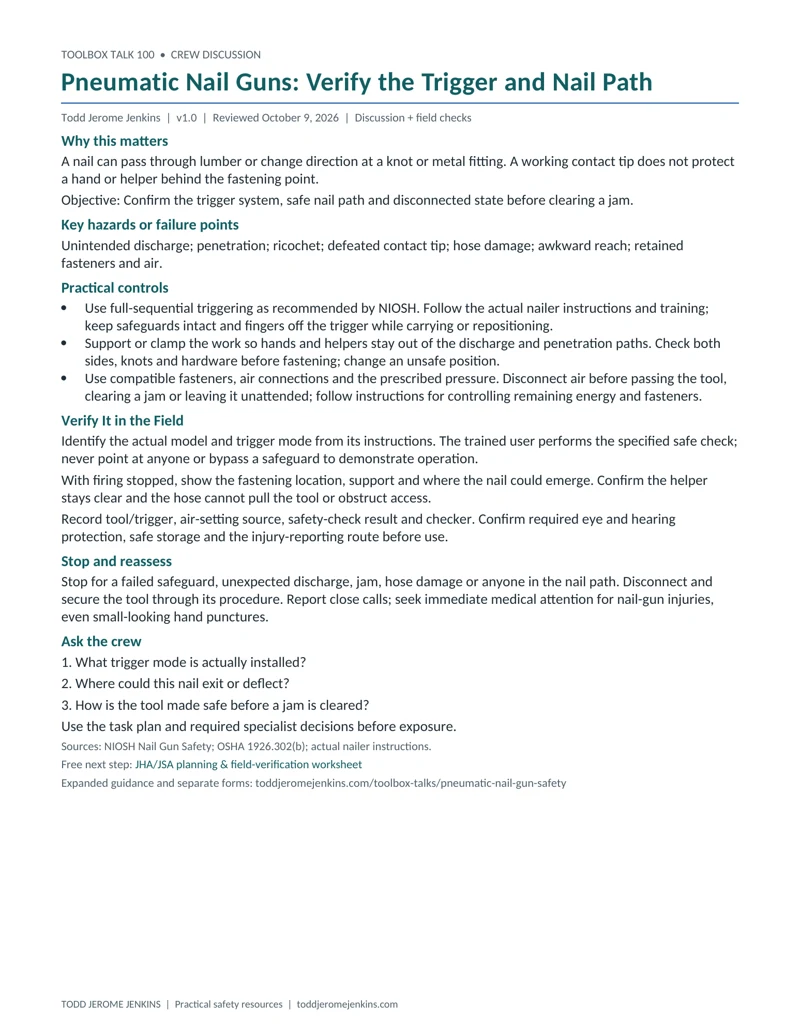
Preview the one-page crew talk
Supporting documents
Included with free Safety & Systems membership.
Supervisor field check
A separate check to verify conditions and controls before work. Includes a one-page PDF and editable Word file.
Attendance sheet
A separate sign-in sheet to record the crew discussion. Includes a one-page PDF and editable Word file.
Need the crew records? Join free to use these supporting documents and the Safety & Systems Academy. No payment details. Email updates are optional.
Get supporting documents — free membershipAlready a member? Use the same link to sign in.
A 5–10 minute crew discussion, plus time to verify the actual controls. The crew talk and Word version are public. Separate supervisor and attendance records are included with free Safety & Systems membership.
Why this matters
A nail can pass through lumber or change direction at a knot or metal fitting. A working contact tip does not protect a hand or helper behind the fastening point.
Learning objective
Confirm the trigger system, safe nail path and disconnected state before clearing a jam.
Key hazards or failure points
Unintended discharge; penetration; ricochet; defeated contact tip; hose damage; awkward reach; retained fasteners and air.
Practical controls
- Use full-sequential triggering as recommended by NIOSH. Follow the actual nailer instructions and training; keep safeguards intact and fingers off the trigger while carrying or repositioning.
- Support or clamp the work so hands and helpers stay out of the discharge and penetration paths. Check both sides, knots and hardware before fastening; change an unsafe position.
- Use compatible fasteners, air connections and the prescribed pressure. Disconnect air before passing the tool, clearing a jam or leaving it unattended; follow instructions for controlling remaining energy and fasteners.
Verify It in the Field
- Identify the actual model and trigger mode from its instructions. The trained user performs the specified safe check; never point at anyone or bypass a safeguard to demonstrate operation.
- With firing stopped, show the fastening location, support and where the nail could emerge. Confirm the helper stays clear and the hose cannot pull the tool or obstruct access.
- Record tool/trigger, air-setting source, safety-check result and checker. Confirm required eye and hearing protection, safe storage and the injury-reporting route before use.
Stop and reassess
Stop for a failed safeguard, unexpected discharge, jam, hose damage or anyone in the nail path. Disconnect and secure the tool through its procedure. Report close calls; seek immediate medical attention for nail-gun injuries, even small-looking hand punctures.
Crew discussion questions
- What trigger mode is actually installed?
- Where could this nail exit or deflect?
- How is the tool made safe before a jam is cleared?
For each required control, record its acceptance source and criterion, safe verification method, responsible checker, actual result and time. Use VERIFIED, HOLD/NOT VERIFIED, or N/A with a reason. A tick alone is not evidence. Complete all applicable task inspections; do not enter danger or improvise a test to fill out a form.
Leader preparation and practical detail
Keep the task boundary clear
The linked JHA covers supported ground-level wall-component fastening with a full-sequential pneumatic nailer. It excludes elevated work, powder-actuated tools and bump firing. This briefing adds nail-path and handoff checks to the general powered-tools talk; it is not operator training.
Identify the mechanism, not just its nickname
The NIOSH/OSHA guide distinguishes full sequential, single sequential, single actuation and contact systems. Full sequential requires the contact tip and trigger to reset for each nail. Verify the actual manual and setting; a nickname such as single shot can be ambiguous. The recommendation reduces unintended firing risk but does not eliminate penetration or ricochet.
Separate recommendation and legal scope
The full-sequential recommendation is guidance, not a claim that federal OSHA universally mandates that trigger. Section 1926.302(b) addresses pneumatic connections, component pressures and other applicable provisions. Its automatic-feed nailer muzzle-safety clause has a stated pressure condition; that condition is not permission to disable safeguards on another tool.
A jam changes the task
Use the actual disconnection, loading and jam-clearing instructions. Neither an idle trigger nor a disconnected compressor establishes the tool’s complete safe state. The NIOSH/OSHA guide supports air disconnection for jams, handoffs, unattended tools and ladder/stair travel. Immediate medical assessment is advised after a nail injury; do not minimize it as a splinter.
Apply this briefing to roofing and siding work
Siding nailers: check the helper’s position before fastening
When one worker holds a siding piece while another fastens it, the helper can be directly behind the intended nail path. Before fastening, the siding lead and tool user should identify the substrate, approved fastener and locations where a nail could exit or deflect. Arrange the product’s permitted support or positioning method so no hand is needed in that path.
This application concerns pneumatic nailers. Apply 1926.302(b) to the air connection and applicable equipment provisions. Match the nailer, fasteners and pressure criteria to the actual instructions; a satisfactory finish appearance is not proof of safe setup. Check safeguards through the prescribed safe method and route the hose so movement cannot pull the tool toward someone.
NIOSH recommends full-sequential triggers; that recommendation does not eliminate penetration or ricochet. Keep fingers off the trigger during repositioning. Establish the tool’s prescribed disconnected safe state before jam clearing or a handoff. Do not transfer these instructions automatically to powder-actuated or other fastening systems.
Record: tool/trigger, material and fastener references, support/hand-position findings, safeguard check, operator and time. Stop for an unexpected discharge, unresolved concealed hazard, a failed safeguard or a helper entering the path. Seek immediate medical attention for nail-gun injuries, even a small-looking puncture.
Record the acceptance source, safe check method, assigned verifier, actual result and time. Hold affected work for an unresolved required control; correct, recheck and rebrief before authorized restart.
Short supervisor field check
- Trigger and instructions identified.
- Safeguards checked safely.
- Work supported and nail paths clear.
- Air supply and hose route checked.
- Disconnection and injury response understood.
Confirm the relevant trained/authorized people, unresolved items, interim protection, correction owner and recheck. Record required release authority and rebrief anyone affected. The separate sheet supports these records; it does not replace a specialist inspection, permit or engineering determination.
Attendance and follow-through
Use the separate attendance sheet for participants, roles, discussion concerns, actions and late-arrival rebriefs. Attendance is not proof of competence, functioning controls or authorization to work. Keep completed records private under employer procedures.
Technical scope and references
Reviewed October 9, 2026 for construction crew preparation. Apply the actual task, jurisdiction and relevant standard provisions. Manufacturer sources below are reference examples, not approval of your equipment. No site-specific design, permit, exposure assessment, product SDS or current model manual was supplied; obtain the applicable documents before work. This discussion does not replace required training.
- NIOSH — Nail Gun Safety — Current public-health guidance; full-sequential recommendation and prompt medical attention.
- NIOSH/OSHA Nail Gun Safety guide, 2011 — Trigger distinctions and safe work procedures; guidance, not a new standard.
- OSHA 1926.302(b) — Construction pneumatic-tool provisions; apply the actual clause and equipment scope.
Connect this discussion to your JHA/JSA
Use the related worked JHA/JSA/AHA example to prepare task steps, hazards and controls. Return to What Changed Today? when the plan or conditions change.
Related Todd Jerome Jenkins article: How to Conduct a Job Safety Analysis.
Related crew discussions
Put one check into practice
Use the free JHA/JSA planning and field-verification worksheet to record today’s change, the required protection and the evidence needed before exposure.