Download the free crew talk
The one-page talk, editable Word version, and guidance below are open to everyone. No account required.
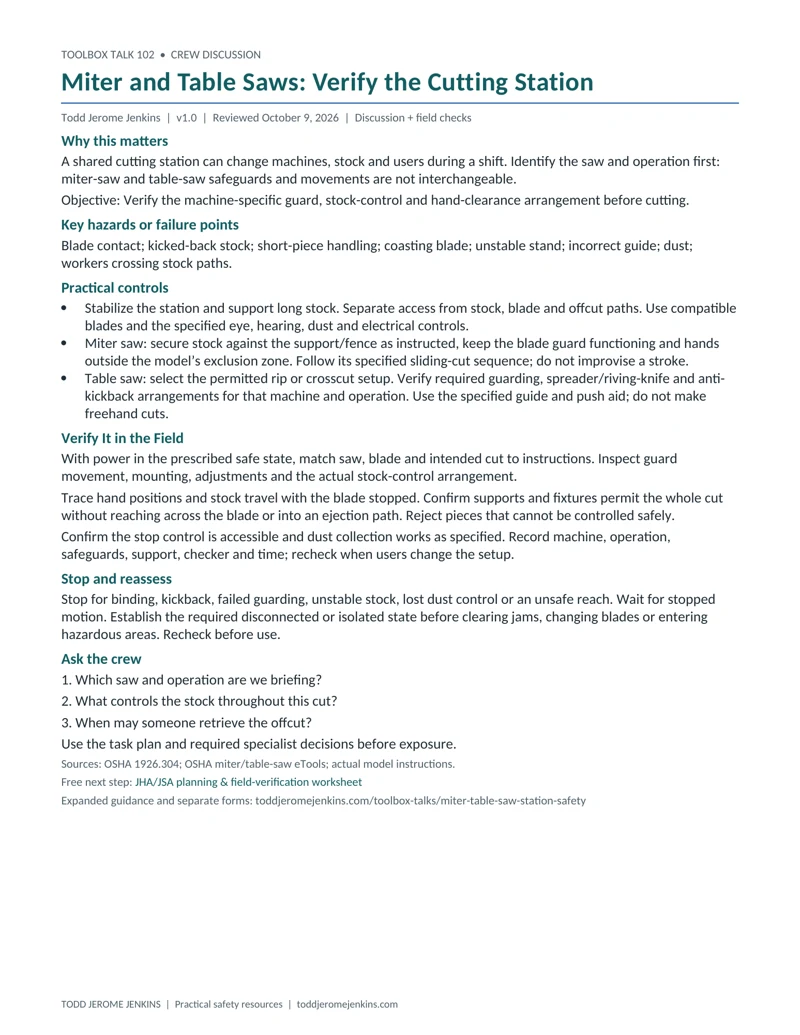
Preview the one-page crew talk
Supporting documents
Included with free Safety & Systems membership.
Supervisor field check
A separate check to verify conditions and controls before work. Includes a one-page PDF and editable Word file.
Attendance sheet
A separate sign-in sheet to record the crew discussion. Includes a one-page PDF and editable Word file.
Need the crew records? Join free to use these supporting documents and the Safety & Systems Academy. No payment details. Email updates are optional.
Get supporting documents — free membershipAlready a member? Use the same link to sign in.
A 5–10 minute crew discussion, plus time to verify the actual controls. The crew talk and Word version are public. Separate supervisor and attendance records are included with free Safety & Systems membership.
Why this matters
A shared cutting station can change machines, stock and users during a shift. Identify the saw and operation first: miter-saw and table-saw safeguards and movements are not interchangeable.
Learning objective
Verify the machine-specific guard, stock-control and hand-clearance arrangement before cutting.
Key hazards or failure points
Blade contact; kicked-back stock; short-piece handling; coasting blade; unstable stand; incorrect guide; dust; workers crossing stock paths.
Practical controls
- Stabilize the station and support long stock. Separate access from stock, blade and offcut paths. Use compatible blades and the specified eye, hearing, dust and electrical controls.
- Miter saw: secure stock against the support/fence as instructed, keep the blade guard functioning and hands outside the model’s exclusion zone. Follow its specified sliding-cut sequence; do not improvise a stroke.
- Table saw: select the permitted rip or crosscut setup. Verify required guarding, spreader/riving-knife and anti-kickback arrangements for that machine and operation. Use the specified guide and push aid; do not make freehand cuts.
Verify It in the Field
- With power in the prescribed safe state, match saw, blade and intended cut to instructions. Inspect guard movement, mounting, adjustments and the actual stock-control arrangement.
- Trace hand positions and stock travel with the blade stopped. Confirm supports and fixtures permit the whole cut without reaching across the blade or into an ejection path. Reject pieces that cannot be controlled safely.
- Confirm the stop control is accessible and dust collection works as specified. Record machine, operation, safeguards, support, checker and time; recheck when users change the setup.
Stop and reassess
Stop for binding, kickback, failed guarding, unstable stock, lost dust control or an unsafe reach. Wait for stopped motion. Establish the required disconnected or isolated state before clearing jams, changing blades or entering hazardous areas. Recheck before use.
Crew discussion questions
- Which saw and operation are we briefing?
- What controls the stock throughout this cut?
- When may someone retrieve the offcut?
For each required control, record its acceptance source and criterion, safe verification method, responsible checker, actual result and time. Use VERIFIED, HOLD/NOT VERIFIED, or N/A with a reason. A tick alone is not evidence. Complete all applicable task inspections; do not enter danger or improvise a test to fill out a form.
Leader preparation and practical detail
Brief one machine at a time
Choose the relevant machine section for today’s short discussion. This page groups station planning, not operating procedures. The linked JHA covers an outdoor sliding miter saw cutting untreated dimensional lumber; it expressly excludes table saws. A table-saw task needs its own analysis.
Separate blade travel from stock feed
On a miter saw, the blade assembly moves through supported stock. On a table saw, stock is guided past the blade. Do not transfer a miter-saw sliding instruction to a table saw. Use the actual model instructions for clamps, guide combinations, small-piece fixtures and hand exclusion; this resource gives no universal clearance or minimum workpiece size.
Retain the required protection
Construction 1926.304 specifies woodworking safeguards, including portable circular saws and hand-fed table saws. OSHA’s table-saw eTool discusses guards, spreaders and anti-kickback devices and cites general-industry 1910.213. Use it as guidance here, not as though every cited provision is a construction rule. The approved machine/operation arrangement must be verified before use; do not remove a guard to make an unplanned cut.
The cut is not finished when the trigger is released
A coasting blade remains hazardous. Follow the model’s required head position and wait for complete stopping before retrieving work or scrap. Use the prescribed energy-control procedure for jams, adjustments and blade changes. Keep cleanup tools and hands out of the blade area while motion or unexpected starting remains possible.
Short supervisor field check
- Machine and operation identified.
- Required guards and controls checked.
- Guides, push aids or clamps suitable.
- Stock travel and hands kept clear.
- Stopping and cleanup arrangements ready.
Confirm the relevant trained/authorized people, unresolved items, interim protection, correction owner and recheck. Record required release authority and rebrief anyone affected. The separate sheet supports these records; it does not replace a specialist inspection, permit or engineering determination.
Attendance and follow-through
Use the separate attendance sheet for participants, roles, discussion concerns, actions and late-arrival rebriefs. Attendance is not proof of competence, functioning controls or authorization to work. Keep completed records private under employer procedures.
Technical scope and references
Reviewed October 9, 2026 for construction crew preparation. Apply the actual task, jurisdiction and relevant standard provisions. Manufacturer sources below are reference examples, not approval of your equipment. No site-specific design, permit, exposure assessment, product SDS or current model manual was supplied; obtain the applicable documents before work. This discussion does not replace required training.
- OSHA 1926.304 — Construction woodworking tool requirements, including table-saw guarding.
- OSHA miter-saw eTool — Machine-specific blade-contact and guarding guidance.
- OSHA table-saw eTool — Guarding, stock support and kickback guidance; cited 1910 provisions have general-industry scope.
- OSHA 1926.300 — Safe tool condition and guarding.
Connect this discussion to your JHA/JSA
Use the related worked JHA/JSA/AHA example to prepare task steps, hazards and controls. Return to What Changed Today? when the plan or conditions change.
Related Todd Jerome Jenkins article: How to Conduct a Job Safety Analysis.
Related crew discussions
Put one check into practice
Use the free JHA/JSA planning and field-verification worksheet to record today’s change, the required protection and the evidence needed before exposure.