Download the free toolbox talk
The one-page talk, editable Word version, and guidance below are open to everyone. No account required.
One-page toolbox talk
Download one-page toolbox talk (PDF, 1 page)Editable one-page toolbox talk (Word)Preview the one-page toolbox talk
Supporting documents
Included with free Safety & Systems membership.
Supervisor field check
A separate check to verify conditions and controls before work. Includes a one-page PDF and editable Word file.
Attendance sheet
A separate sign-in sheet to record the crew discussion. Includes a one-page PDF and editable Word file.
Need the crew records? Join free to use these supporting documents and the Safety & Systems Academy. No payment details. Email updates are optional.
Get supporting documents — free membershipAlready a member? Use the same link to sign in.
Hazard-based toolbox talk 9 of 52, with a practical HOP exercise.
Plan a 5–10 minute toolbox discussion, plus time to verify the actual controls. The one-page toolbox talk and editable Word version are public. Separate supervisor and attendance records are included with free Safety & Systems membership.
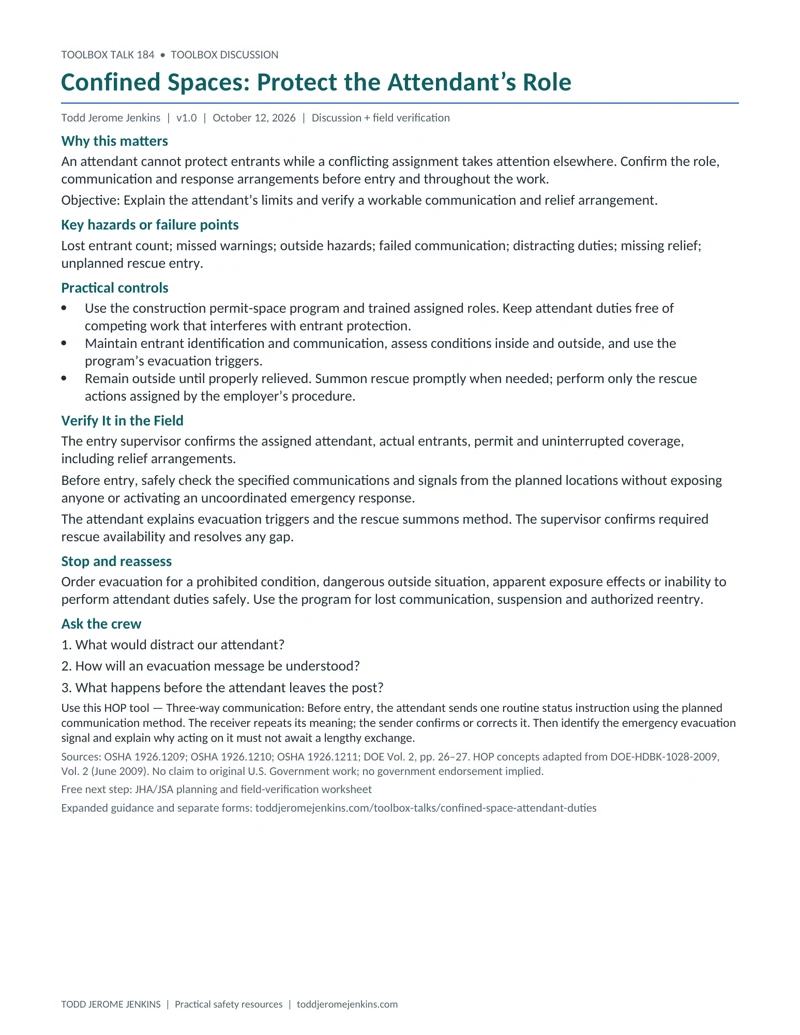
Why this matters
An attendant cannot protect entrants while a conflicting assignment takes attention elsewhere. Confirm the role, communication and response arrangements before entry and throughout the work.
Learning objective
Explain the attendant’s limits and verify a workable communication and relief arrangement.
Key hazards or failure points
Lost entrant count; missed warnings; outside hazards; failed communication; distracting duties; missing relief; unplanned rescue entry.
Practical controls
- Use the construction permit-space program and trained assigned roles. Keep attendant duties free of competing work that interferes with entrant protection.
- Maintain entrant identification and communication, assess conditions inside and outside, and use the program’s evacuation triggers.
- Remain outside until properly relieved. Summon rescue promptly when needed; perform only the rescue actions assigned by the employer’s procedure.
Verify It in the Field
- The entry supervisor confirms the assigned attendant, actual entrants, permit and uninterrupted coverage, including relief arrangements.
- Before entry, safely check the specified communications and signals from the planned locations without exposing anyone or activating an uncoordinated emergency response.
- The attendant explains evacuation triggers and the rescue summons method. The supervisor confirms required rescue availability and resolves any gap.
Stop and reassess
Order evacuation for a prohibited condition, dangerous outside situation, apparent exposure effects or inability to perform attendant duties safely. Use the program for lost communication, suspension and authorized reentry.
Crew discussion questions
- What would distract our attendant?
- How will an evacuation message be understood?
- What happens before the attendant leaves the post?
For each required control, record its acceptance source and criterion, safe verification method, responsible verifier, actual result and time. Mark VERIFIED, HOLD/NOT VERIFIED, or N/A with a reason. Complete all required inspections; never enter danger or improvise a test to fill out a form.
Use this HOP tool
Three-way communication
Before entry, the attendant sends one routine status instruction using the planned communication method. The receiver repeats its meaning; the sender confirms or corrects it. Then identify the emergency evacuation signal and explain why acting on it must not await a lengthy exchange.
This exercise supports hazard identification or control verification. It does not replace safeguards, required training, specialist decisions or work authorization.
Leader preparation and practical detail
Protect attention as a work condition
The construction attendant duties are specified in 1926.1209. A staffing decision that adds deliveries or unrelated observation may prevent their performance. Discuss actual demands with the attendant before entry. If duties cannot be performed effectively and safely, the standard requires the attendant to order evacuation.
Rehearse without delaying escape
Practice a routine status message before entry using closed-loop communication. Emergency evacuation follows the established signal and procedure immediately; do not require a lengthy repeat-back that delays leaving danger. The employer’s program establishes communication methods, monitoring and responses for the particular space.
Rescue has a separate authorization boundary
An attendant is not automatically an entry rescuer. Section 1926.1209 requires the attendant to remain outside until relieved and limits any later rescue entry to the employer’s program and required training and equipment. The entry supervisor verifies rescue availability under 1926.1210; this sheet provides neither rescue training nor entry permission.
Short supervisor field check
- Attendant trained and assigned
- Entrants identifiable
- Communication works
- Relief preserves coverage
- Rescue summons verified
Use the separate sheet to document evidence, unresolved restrictions, correction owner, recheck and required release authority. Rebrief affected workers. This record does not replace specialist inspections, permits or engineering determinations.
Attendance and follow-through
Use the separate attendance record for participants, roles, questions, actions and late-arrival rebriefs. Attendance does not prove competence, functioning controls or authorization. Keep completed records private under employer procedures.
Source acknowledgment
HOP concepts are adapted from DOE-HDBK-1028-2009, Human Performance Improvement Handbook, Volume 2 (June 2009). Todd Jerome Jenkins makes no claim to authorship or copyright ownership of original U.S. Government work. The explanations and exercises are original adaptations; no endorsement by DOE or the U.S. Government is implied. Third-party material credited in the handbook retains its separate ownership.
HOP source: Volume 2/VOLUME 2 EFFECTIVE COMMUNICATION Three-Way Communication.pdf; Printed pp. 26–27. The handbook supplies concepts; task-specific technical references are listed below.
Technical scope and references
Technical sources inspected October 9, 2026; resource edition October 12, 2026. Apply current jurisdictional requirements, the actual task procedure, manufacturer instructions, permits and required competent or qualified decisions. This resource supplies no equipment-specific acceptance criteria.
- OSHA 1926.1209 — Construction attendant duties, evacuation, relief and rescue limits.
- OSHA 1926.1210 — Entry-supervisor verification and rescue availability.
- OSHA 1926.1211 — Construction rescue evaluation and training requirements.
- DOE-HDBK-1028-2009, Volume 2 — Three-way communication — Historical June 2009 guidance, printed pages 26–27. Original task exercise; not a regulatory requirement.
Connect this discussion to your JHA/JSA
Related worked JHA/JSA/AHA example. Use the example to study task steps, hazards and controls; adapt it to the actual work.
Related Todd Jerome Jenkins articles: How to Conduct a Job Safety Analysis and What Is Human and Organizational Performance?.
Related toolbox talks
- Confined Spaces: Verify Entry Readiness
- Three-Way Communication: Close the Loop Before Acting
- Emergency Readiness: Can We Reach Supplies and Call for Help?
Continue the hazard series
- Face Shields and Respirators: When Protection Interferes
- Energy Isolation: Preserve Protection at Shift Change
Put one verification into practice
Record today’s change and evidence using the free JHA/JSA planning and field-verification worksheet.