Download the talk and separate crew records
Free to download without an account. Each PDF is one page. Use the Word version to adapt the record to your task and approved procedures.
Supervisor field check
Download supervisor field check (PDF, 1 page)Editable supervisor field check (Word)Preview the one-page crew talk
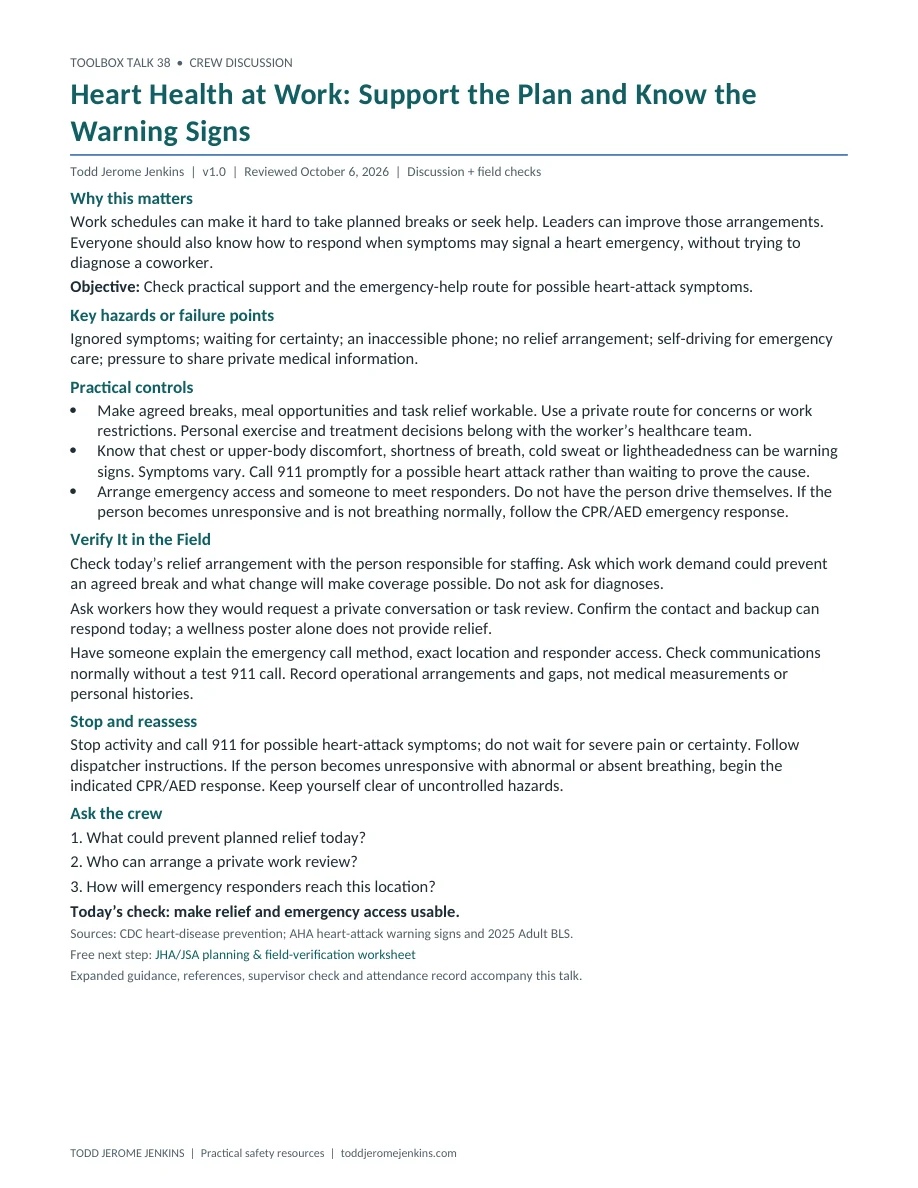
A 5–10 minute crew discussion, plus the time needed for field verification. All six downloads are free without a required signup.
Why this matters
Work schedules can make it hard to take planned breaks or seek help. Leaders can improve those arrangements. Everyone should also know how to respond when symptoms may signal a heart emergency, without trying to diagnose a coworker.
Learning objective: Check practical support and the emergency-help route for possible heart-attack symptoms.
Key hazards or failure points
Ignored symptoms; waiting for certainty; an inaccessible phone; no relief arrangement; self-driving for emergency care; pressure to share private medical information.
Practical controls
- Make agreed breaks, meal opportunities and task relief workable. Use a private route for concerns or work restrictions. Personal exercise and treatment decisions belong with the worker’s healthcare team.
- Know that chest or upper-body discomfort, shortness of breath, cold sweat or lightheadedness can be warning signs. Symptoms vary. Call 911 promptly for a possible heart attack rather than waiting to prove the cause.
- Arrange emergency access and someone to meet responders. Do not have the person drive themselves. If the person becomes unresponsive and is not breathing normally, follow the CPR/AED emergency response.
Verify It in the Field
Check today’s relief arrangement with the person responsible for staffing. Ask which work demand could prevent an agreed break and what change will make coverage possible. Do not ask for diagnoses.
Ask workers how they would request a private conversation or task review. Confirm the contact and backup can respond today; a wellness poster alone does not provide relief.
Have someone explain the emergency call method, exact location and responder access. Check communications normally without a test 911 call. Record operational arrangements and gaps, not medical measurements or personal histories.
Use the separate field check to record the source and criterion, safe method, checker, actual result and time. Mark VERIFIED, HOLD/NOT VERIFIED, or N/A with a reason. Check every required control; the examples below do not clear the whole task.
| Control | Safe verification | Evidence to record |
|---|---|---|
| Usable relief | Confirm coverage with the staffing decision owner. | Arrangement, gap and correction owner. |
| Private support | Confirm the route for work restrictions or concerns. | Available contact and backup. |
| Emergency access | Rehearse location and access details without a test emergency call. | Call method, meeting point and assigned role. |
Stop and reassess
Stop activity and call 911 for possible heart-attack symptoms; do not wait for severe pain or certainty. Follow dispatcher instructions. If the person becomes unresponsive with abnormal or absent breathing, begin the indicated CPR/AED response. Keep yourself clear of uncontrolled hazards.
Crew discussion questions
- What could prevent planned relief today?
- Who can arrange a private work review?
- How will emergency responders reach this location?
Today’s check: make relief and emergency access usable.
A situation to discuss
Illustrative situation: a worker reports chest discomfort and shortness of breath. The crew calls emergency services and follows dispatcher guidance. The leader clears responder access instead of asking the worker to finish the task or prove that the symptoms are serious.
Leader preparation and practical detail
Support voluntary health decisions
CDC describes healthy habits and working with a healthcare team as parts of heart-disease prevention. A crew leader’s practical contribution is to make agreed work arrangements usable and direct personal health questions to qualified care. Do not run weigh-ins, blood-pressure screening or treatment discussions as a condition of attending this talk. [1]
Do not wait for a perfect symptom pattern
Heart-attack symptoms can differ between people and may begin mildly. AHA advises prompt emergency help when warning signs suggest a heart attack, even when the person is unsure. The purpose of the crew reminder is to reduce delay, not to diagnose the cause of discomfort. [2]
Distinguish a heart attack from cardiac arrest
A responsive person with possible heart-attack symptoms needs prompt emergency assessment. CPR is for the appropriate unresponsive/not-breathing-normally situation, with dispatcher guidance and current training. Connect this discussion to the separate CPR/AED readiness talk so equipment access and response roles are checked in advance. [2], [3]
Short supervisor field check
- Relief and meal/rest arrangements checked.
- Private work-review route available.
- Emergency call method and exact location understood.
- Responder access and meeting role identified.
- Follow-up records contain work arrangements, not health information.
Use the separate form to document evidence, restrictions, corrective-action owner, recheck and required restart approval. An unresolved required control means hold the affected work. Missing evidence is not a pass. Complete all task-specific inspections and permits.
Attendance and follow-through
The separate attendance sheet records participants, language support, questions, actions and late-arrival rebriefs. Attendance does not establish competence or prove controls function. Keep completed records private under the employer’s procedures.
Technical scope and references
This is support and emergency-readiness guidance, not screening, diagnosis, exercise prescription or medical clearance. Do not change treatment or assess a worker’s health from this checklist. Use current emergency instructions and qualified healthcare advice. [1], [2], [3], [4]
References checked October 6, 2026. Apply the jurisdiction, task, employer program and equipment instructions that govern the work. No site-specific manual, permit, engineering determination or product SDS has been approved by this general resource.
- Preventing Heart Disease — Healthy food choices, physical activity suited to individual, smoking cessation, less alcohol and clinician-guided management. Do not require crew weigh-ins, blood-pressure checks, treatment changes or medical disclosure.
- Warning Signs of a Heart Attack — Chest/upper-body discomfort, shortness of breath and other symptoms can warrant immediate 911 call; symptoms vary and may be mild. Do not wait for certainty or drive self; emergency team can assess/treat. Not medical diagnosis by supervisor.
- 2025 AHA Guidelines, Part 7: Adult Basic Life Support — Lay rescuer recognizes unresponsiveness plus absent/abnormal breathing, including gasping, without requiring pulse check. Activate emergency response promptly and start CPR. Compression-only appropriate for untrained/unwilling adult lay rescuers; trained rescuers encouraged to include breaths. 100–120/min is published adult rate if included. Briefing is not certification.
- Supporting Mental Health in the Workplace: Checklist for Supervisors — Relieve job stressors through realistic workload/time/resources, support channels and private check-ins. Do not force disclosure. Supervisor supports/refers; does not diagnose. Do not promise absolute confidentiality or guarantee employment outcomes.
Connect this discussion to your JHA/JSA
Use How to Conduct a Job Safety Analysis to connect today’s work steps, hazards and controls. Revisit Pre-Job JHA/JSA: What Changed Today? whenever conditions change.
Related published crew resources: Heat: Conditions Change, Controls Change; Manual Handling: Change the Lift Before You Lift; CPR and AED Readiness: Can We Act Now?.
Put one check into practice
Download the free JHA/JSA planning and field-verification worksheet. For today’s task, record an important control, its source and the evidence needed before exposure. Complete the remaining required checks through your task plan.