Download the talk and separate crew records
Free to download without an account. Each PDF is one page. Use the Word version to adapt the record to your task and approved procedures.
Supervisor field check
Download supervisor field check (PDF, 1 page)Editable supervisor field check (Word)Preview the one-page crew talk
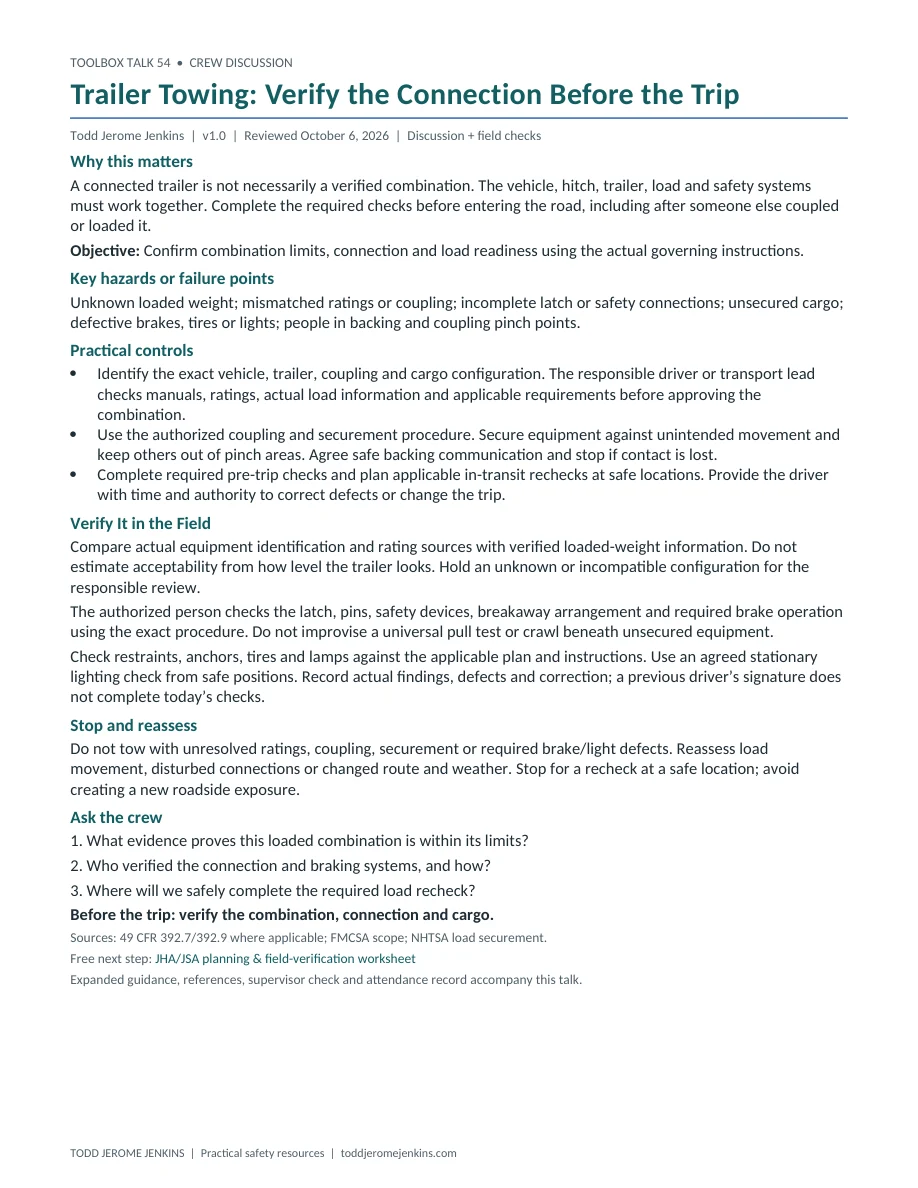
A 5–10 minute crew discussion, plus the time needed for field verification. All six downloads are free without a required signup.
Why this matters
A connected trailer is not necessarily a verified combination. The vehicle, hitch, trailer, load and safety systems must work together. Complete the required checks before entering the road, including after someone else coupled or loaded it.
Learning objective: Confirm combination limits, connection and load readiness using the actual governing instructions.
Key hazards or failure points
Unknown loaded weight; mismatched ratings or coupling; incomplete latch or safety connections; unsecured cargo; defective brakes, tires or lights; people in backing and coupling pinch points.
Practical controls
- Identify the exact vehicle, trailer, coupling and cargo configuration. The responsible driver or transport lead checks manuals, ratings, actual load information and applicable requirements before approving the combination.
- Use the authorized coupling and securement procedure. Secure equipment against unintended movement and keep others out of pinch areas. Agree safe backing communication and stop if contact is lost.
- Complete required pre-trip checks and plan applicable in-transit rechecks at safe locations. Provide the driver with time and authority to correct defects or change the trip.
Verify It in the Field
Compare actual equipment identification and rating sources with verified loaded-weight information. Do not estimate acceptability from how level the trailer looks. Hold an unknown or incompatible configuration for the responsible review.
The authorized person checks the latch, pins, safety devices, breakaway arrangement and required brake operation using the exact procedure. Do not improvise a universal pull test or crawl beneath unsecured equipment.
Check restraints, anchors, tires and lamps against the applicable plan and instructions. Use an agreed stationary lighting check from safe positions. Record actual findings, defects and correction; a previous driver’s signature does not complete today’s checks.
Use the separate field check to record the source and criterion, safe method, checker, actual result and time. Mark VERIFIED, HOLD/NOT VERIFIED, or N/A with a reason. Check every required control; the examples below do not clear the whole task.
| Control | Safe verification | Evidence to record |
|---|---|---|
| Compatible combination | Compare equipment identifiers/ratings and verified load evidence. | Sources, weights, limits and responsible decision. |
| Complete connection | Authorized person performs the exact secured-equipment procedure. | Observed latch/safety/brake results and checker. |
| Cargo and road readiness | Check restraints and required vehicle systems from safe positions. | Findings, defect correction and recheck plan. |
Stop and reassess
Do not tow with unresolved ratings, coupling, securement or required brake/light defects. Reassess load movement, disturbed connections or changed route and weather. Stop for a recheck at a safe location; avoid creating a new roadside exposure.
Crew discussion questions
- What evidence proves this loaded combination is within its limits?
- Who verified the connection and braking systems, and how?
- Where will we safely complete the required load recheck?
Before the trip: verify the combination, connection and cargo.
A situation to discuss
Illustrative situation: a trailer is reassigned to a different tow vehicle. The driver pauses departure until the responsible lead confirms the actual ratings and loaded combination, then completes the prescribed connection and safety-system checks. Similar appearance is not treated as interchangeability.
Leader preparation and practical detail
Determine which requirements apply
Federal motor-carrier applicability depends on the vehicle, use and operation, with relevant exceptions. State rules may also apply. Have the employer or carrier determine the requirements instead of calling all trailer rules OSHA requirements. The referenced inspection and cargo provisions apply to covered commercial motor vehicles. [1], [2], [3]
Use evidence for the loaded combination
Identify every limiting component and obtain the load information needed for the actual arrangement. Follow vehicle, trailer and coupling instructions, the approved securement method and applicable requirements. This page does not invent a tongue-weight percentage, hitch rating, tire pressure or load limit. A physical connection alone is not evidence of compatibility.
Plan rechecks as part of the trip
Cargo and connections can change after departure. Applicable commercial-vehicle rules include pre-departure and in-transit cargo inspection provisions and specific exceptions; use the requirements for the operation. Choose safe places for checks and resolve defects before continuing. NHTSA also advises securing loads and checking the arrangement before travel. [2], [4]
Short supervisor field check
- Authorized driver and exact combination identified.
- Rating and loaded-weight evidence available.
- Coupling and safety systems checked safely.
- Brake, lighting, tire and cargo defects resolved.
- Route, backing communication and rechecks planned.
Use the separate form to document evidence, restrictions, corrective-action owner, recheck and required restart approval. An unresolved required control means hold the affected work. Missing evidence is not a pass. Complete all task-specific inspections and permits.
Attendance and follow-through
The separate attendance sheet records participants, language support, questions, actions and late-arrival rebriefs. Attendance does not establish competence or prove controls function. Keep completed records private under the employer’s procedures.
Technical scope and references
This is a pre-trip briefing, not driver qualification, a coupling procedure or cargo-securement training. Actual manuals and applicable federal/state rules govern. Federal commercial-vehicle provisions do not automatically apply to every personal trailer. [1], [2], [3], [4]
References checked October 6, 2026. Apply the jurisdiction, task, employer program and equipment instructions that govern the work. No site-specific manual, permit, engineering determination or product SDS has been approved by this general resource.
- 49 CFR 392.7 — Equipment, inspection and use — Full operative (a) and (b) read. Driver must be satisfied listed components are working before driving. (b) is specific to intermodal equipment; do not generalize its language.
- 49 CFR 392.9 — Inspection of cargo, cargo securement devices and systems — Full operative (a)/(b) read including cargo distribution, securement, vehicle exit/access, predeparture and in-transit checks, and sealed/impracticable-inspection exception. Avoid universal reinspection interval across vehicles outside scope.
- FMCSA Motor Carrier Safety Planner: Who Must Comply? — Applicability depends on vehicle/use, passengers/hazardous materials, interstate commerce and relevant exceptions; employer/carrier determines applicability. No generic claim all trailer towing is OSHA-regulated.
- NHTSA — Drive Safe: Secure Your Load — Secure cargo, avoid excessive loading, double-check restraint and consider braking/bump effects. State unsecured-load laws apply. Statistics deliberately excluded.
Connect this discussion to your JHA/JSA
Use How to Conduct a Job Safety Analysis to connect today’s work steps, hazards and controls. Revisit Pre-Job JHA/JSA: What Changed Today? whenever conditions change.
Related Todd Jerome Jenkins video: Job Safety Analysis: A Basic Overview.
Related published crew resources: Mobile Equipment: Separate People from Movement; Distracted Driving: Set Up Before Moving; Bad-Weather Driving: Decide Before You Go.
Put one check into practice
Download the free JHA/JSA planning and field-verification worksheet. For today’s task, record an important control, its source and the evidence needed before exposure. Complete the remaining required checks through your task plan.