Download the talk and separate crew records
Free to download without an account. Each PDF is one page. Use the Word version to adapt the record to your task and approved procedures.
Supervisor field check
Download supervisor field check (PDF, 1 page)Editable supervisor field check (Word)Preview the one-page crew talk
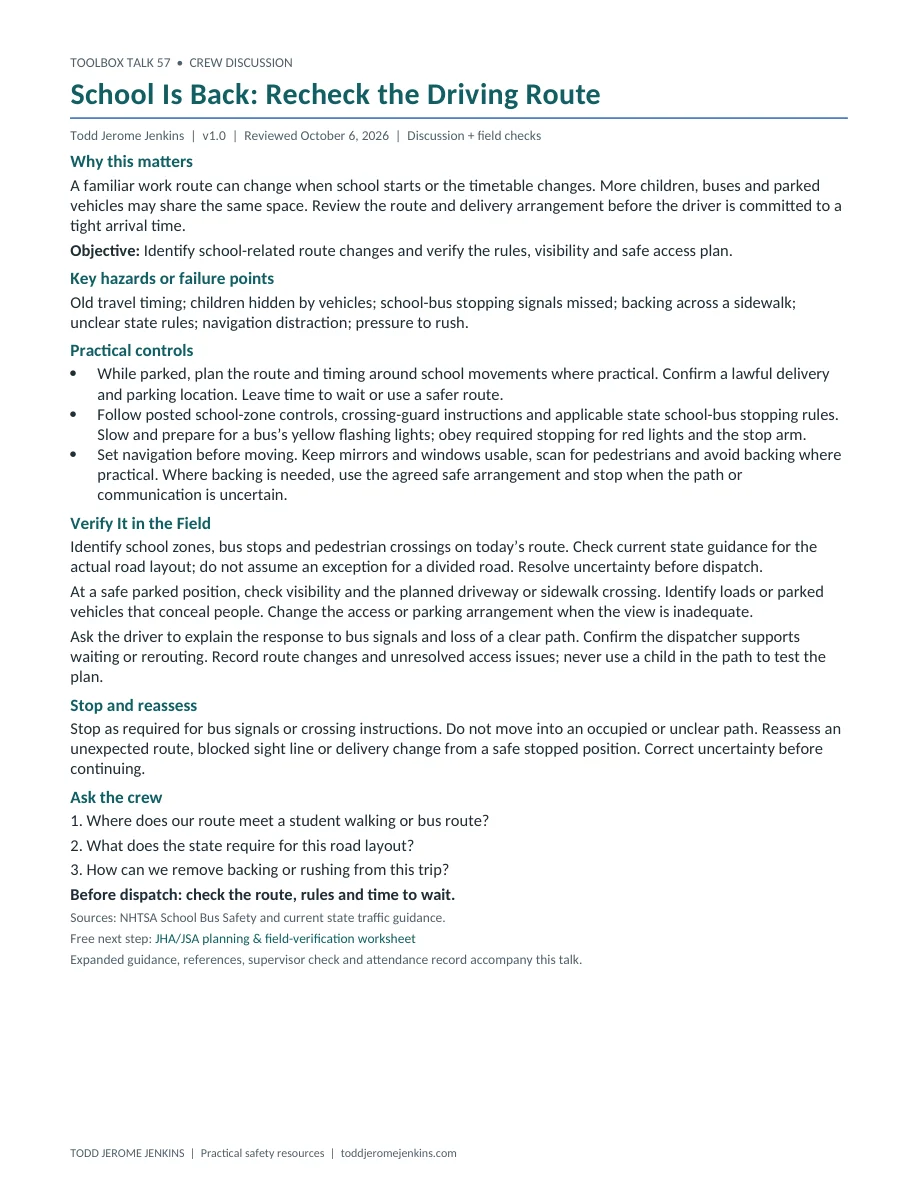
A 5–10 minute crew discussion, plus the time needed for field verification. All six downloads are free without a required signup.
Why this matters
A familiar work route can change when school starts or the timetable changes. More children, buses and parked vehicles may share the same space. Review the route and delivery arrangement before the driver is committed to a tight arrival time.
Learning objective: Identify school-related route changes and verify the rules, visibility and safe access plan.
Key hazards or failure points
Old travel timing; children hidden by vehicles; school-bus stopping signals missed; backing across a sidewalk; unclear state rules; navigation distraction; pressure to rush.
Practical controls
- While parked, plan the route and timing around school movements where practical. Confirm a lawful delivery and parking location. Leave time to wait or use a safer route.
- Follow posted school-zone controls, crossing-guard instructions and applicable state school-bus stopping rules. Slow and prepare for a bus’s yellow flashing lights; obey required stopping for red lights and the stop arm.
- Set navigation before moving. Keep mirrors and windows usable, scan for pedestrians and avoid backing where practical. Where backing is needed, use the agreed safe arrangement and stop when the path or communication is uncertain.
Verify It in the Field
Identify school zones, bus stops and pedestrian crossings on today’s route. Check current state guidance for the actual road layout; do not assume an exception for a divided road. Resolve uncertainty before dispatch.
At a safe parked position, check visibility and the planned driveway or sidewalk crossing. Identify loads or parked vehicles that conceal people. Change the access or parking arrangement when the view is inadequate.
Ask the driver to explain the response to bus signals and loss of a clear path. Confirm the dispatcher supports waiting or rerouting. Record route changes and unresolved access issues; never use a child in the path to test the plan.
Use the separate field check to record the source and criterion, safe method, checker, actual result and time. Mark VERIFIED, HOLD/NOT VERIFIED, or N/A with a reason. Check every required control; the examples below do not clear the whole task.
| Control | Safe verification | Evidence to record |
|---|---|---|
| Understood route/rule | Review locations and current state guidance before moving. | Locations, rule source and timing change. |
| Visible path | Check mirrors, windows and access from safe parked positions. | Obstruction and revised access arrangement. |
| Supported decision | Driver explains stop triggers and dispatcher confirms delay/reroute support. | Agreed limits and contact method. |
Stop and reassess
Stop as required for bus signals or crossing instructions. Do not move into an occupied or unclear path. Reassess an unexpected route, blocked sight line or delivery change from a safe stopped position. Correct uncertainty before continuing.
Crew discussion questions
- Where does our route meet a student walking or bus route?
- What does the state require for this road layout?
- How can we remove backing or rushing from this trip?
Before dispatch: check the route, rules and time to wait.
A situation to discuss
Illustrative situation: a delivery that was easy during summer now coincides with school dismissal. The driver and dispatcher adjust the arrival time and choose a lawful access point that avoids backing across the busy sidewalk. The driver is not expected to recover the delay by rushing.
Leader preparation and practical detail
Check the route as it is used today
School-related exposure extends beyond marked school zones. Consider bus stops, residential pickup points and the driveway used for a delivery. A schedule change can alter the pedestrian movement even when the road layout is unchanged. Use current observations and official information while parked; do not search for rules while driving.
Know the applicable stopping rule
NHTSA explains school-bus warning signals and the need to protect children boarding or leaving. State laws govern the exact stopping requirements and road-layout exceptions. Verify those rules for the route rather than applying a remembered exception from another state. This talk supplies no national school-zone speed or stopping distance. [1]
Give the driver room to choose safely
A safe dispatch arrangement allows waiting, rerouting or a changed delivery point when sight lines or pedestrian movements make the original plan unsuitable. Confirm who can approve the change and how the driver reports it from a safe stop. Poor visibility and changing weather can add to the route problem, so combine this check with the weather-driving resource. [2]
Short supervisor field check
- Route and school movement times reviewed.
- Current state rules and posted controls identified.
- Visibility and vehicle readiness checked.
- Delivery/backing arrangement protects pedestrians.
- Driver has time and authority to wait or reroute.
Use the separate form to document evidence, restrictions, corrective-action owner, recheck and required restart approval. An unresolved required control means hold the affected work. Missing evidence is not a pass. Complete all task-specific inspections and permits.
Attendance and follow-through
The separate attendance sheet records participants, language support, questions, actions and late-arrival rebriefs. Attendance does not establish competence or prove controls function. Keep completed records private under the employer’s procedures.
Technical scope and references
This is work-driver route planning, not a statement of every state traffic rule. Follow current state law, posted controls, crossing instructions and employer vehicle procedures. The NHTSA guidance does not supply a universal school-zone speed or divided-road exception. [1], [2]
References checked October 6, 2026. Apply the jurisdiction, task, employer program and equipment instructions that govern the work. No site-specific manual, permit, engineering determination or product SDS has been approved by this general resource.
- NHTSA — School Bus Safety — Full driver section read: slow/prepare on yellow lights; stop for red/stop arm; attend surroundings and children. State bus laws govern exact stopping rules and divided-road exceptions. No invented national school-zone speed/distance.
- NHTSA — Driving in Severe Weather — Full page read: reduced speed/increased spacing, official road conditions, no flooded/closed roads, pedestrians, emergency communication. No safe water depth; do not use agency danger examples as thresholds.
Connect this discussion to your JHA/JSA
Use How to Conduct a Job Safety Analysis to connect today’s work steps, hazards and controls. Revisit Pre-Job JHA/JSA: What Changed Today? whenever conditions change.
Related published crew resources: Mobile Equipment: Separate People from Movement; Work Zones: Verify the Traffic Setup; Distracted Driving: Set Up Before Moving; Bad-Weather Driving: Decide Before You Go.
Put one check into practice
Download the free JHA/JSA planning and field-verification worksheet. For today’s task, record an important control, its source and the evidence needed before exposure. Complete the remaining required checks through your task plan.