Download the talk and separate crew records
Free to download without an account. Each PDF is one page. Use the Word version to adapt the record to your task and approved procedures.
Supervisor field check
Download supervisor field check (PDF, 1 page)Editable supervisor field check (Word)Preview the one-page crew talk
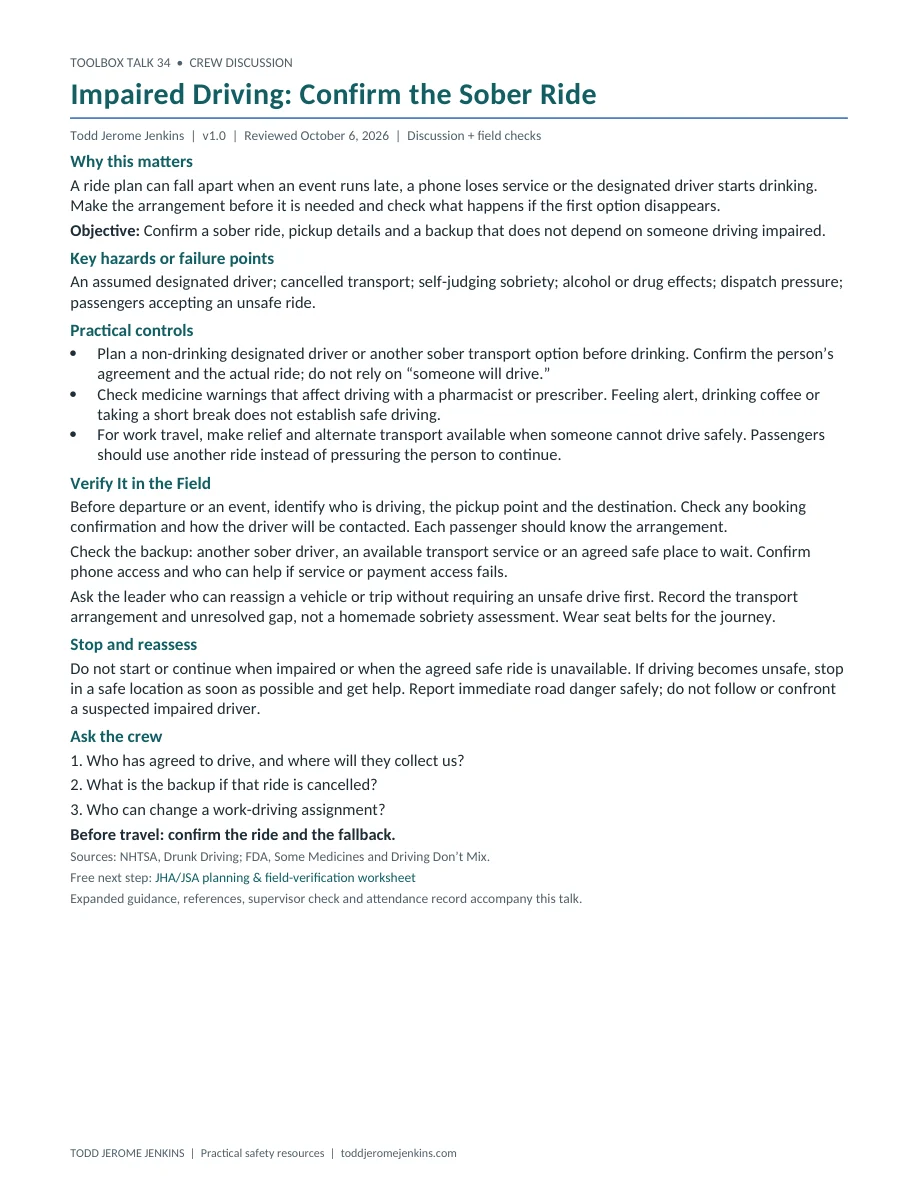
A 5–10 minute crew discussion, plus the time needed for field verification. All six downloads are free without a required signup.
Why this matters
A ride plan can fall apart when an event runs late, a phone loses service or the designated driver starts drinking. Make the arrangement before it is needed and check what happens if the first option disappears.
Learning objective: Confirm a sober ride, pickup details and a backup that does not depend on someone driving impaired.
Key hazards or failure points
An assumed designated driver; cancelled transport; self-judging sobriety; alcohol or drug effects; dispatch pressure; passengers accepting an unsafe ride.
Practical controls
- Plan a non-drinking designated driver or another sober transport option before drinking. Confirm the person’s agreement and the actual ride; do not rely on “someone will drive.”
- Check medicine warnings that affect driving with a pharmacist or prescriber. Feeling alert, drinking coffee or taking a short break does not establish safe driving.
- For work travel, make relief and alternate transport available when someone cannot drive safely. Passengers should use another ride instead of pressuring the person to continue.
Verify It in the Field
Before departure or an event, identify who is driving, the pickup point and the destination. Check any booking confirmation and how the driver will be contacted. Each passenger should know the arrangement.
Check the backup: another sober driver, an available transport service or an agreed safe place to wait. Confirm phone access and who can help if service or payment access fails.
Ask the leader who can reassign a vehicle or trip without requiring an unsafe drive first. Record the transport arrangement and unresolved gap, not a homemade sobriety assessment. Wear seat belts for the journey.
Use the separate field check to record the source and criterion, safe method, checker, actual result and time. Mark VERIFIED, HOLD/NOT VERIFIED, or N/A with a reason. Check every required control; the examples below do not clear the whole task.
| Control | Safe verification | Evidence to record |
|---|---|---|
| Confirmed ride | Check the driver’s agreement or booking and pickup details. | Ride, place and contact method. |
| Backup access | Confirm the fallback person/service and safe waiting location. | Available option and help contact. |
| Work reassignment | Ask the responsible leader who takes an unsafe-to-drive assignment. | Revised trip assignment and unresolved restrictions. |
Stop and reassess
Do not start or continue when impaired or when the agreed safe ride is unavailable. If driving becomes unsafe, stop in a safe location as soon as possible and get help. Report immediate road danger safely; do not follow or confront a suspected impaired driver.
Crew discussion questions
- Who has agreed to drive, and where will they collect us?
- What is the backup if that ride is cancelled?
- Who can change a work-driving assignment?
Before travel: confirm the ride and the fallback.
A situation to discuss
Illustrative situation: a crew finishes an evening event and its booked ride is cancelled. The agreed backup contact arranges another ride while the group waits in a safe location. The plan does not depend on deciding which person looks least affected.
Leader preparation and practical detail
Plan before judgment is affected
NHTSA advises arranging a non-drinking driver or other sober transport before drinking. Appearance and a person’s own sense of sobriety are unreliable ways to decide whether driving is safe. This talk intentionally gives no number-of-drinks rule, waiting period or field test. [1]
Make the fallback usable
A useful backup has an available person or service, a contact method and a safe place to wait. For employer-arranged travel, discuss delays and approval arrangements beforehand so workers do not feel stranded when the first plan fails. Recheck the plan when the destination, group size or finish time changes.
Respond without confrontation
If someone cannot drive safely, offer a concrete alternative and involve the designated leader or safe help route. Do not create a physical confrontation over keys. An unresponsive person or someone having difficulty breathing needs emergency medical help rather than a transport-only solution. Medicine warnings require their own review, even when no alcohol is involved. [2]
Short supervisor field check
- Driver or transport arrangement confirmed.
- Pickup, destination and contact method agreed.
- Backup and safe waiting point usable.
- Work-trip relief authority clear.
- Passengers know the plan and the no-driving trigger.
Use the separate form to document evidence, restrictions, corrective-action owner, recheck and required restart approval. An unresolved required control means hold the affected work. Missing evidence is not a pass. Complete all task-specific inspections and permits.
Attendance and follow-through
The separate attendance sheet records participants, language support, questions, actions and late-arrival rebriefs. Attendance does not establish competence or prove controls function. Keep completed records private under the employer’s procedures.
Technical scope and references
This is prevention and transport planning, not an impairment test or legal driving clearance. Traffic laws and employer vehicle rules depend on the jurisdiction and operation. No universal legal alcohol threshold is supplied. FDA guidance does not mean everyone taking medicine is impaired. [1], [2]
References checked October 6, 2026. Apply the jurisdiction, task, employer program and equipment instructions that govern the work. No site-specific manual, permit, engineering determination or product SDS has been approved by this general resource.
- Drunk Driving — Self-perceived sobriety and appearance do not establish safe driving. Plan non-drinking designated driver or sober transport before drinking. Use seat belts. Report impaired road users safely to law enforcement. No BAC, number-of-drinks, waiting-period or self-test clearance rule proposed.
- Some Medicines and Driving Don’t Mix — Some prescription and OTC medicines can affect driving/machinery, sometimes into next day. Antihistamines can affect performance without felt drowsiness. Read actual label and ask health professional about task risks; clinician determines changes to treatment.
Connect this discussion to your JHA/JSA
Use How to Conduct a Job Safety Analysis to connect today’s work steps, hazards and controls. Revisit Pre-Job JHA/JSA: What Changed Today? whenever conditions change.
Related published crew resources: Distracted Driving: Set Up Before Moving; Medication and Safe Work: Check Before the Task.
Put one check into practice
Download the free JHA/JSA planning and field-verification worksheet. For today’s task, record an important control, its source and the evidence needed before exposure. Complete the remaining required checks through your task plan.