Download the talk and separate crew records
Free to download without an account. Each PDF is one page. Use the Word version to adapt the record to your task and approved procedures.
Supervisor field check
Download supervisor field check (PDF, 1 page)Editable supervisor field check (Word)Preview the one-page crew talk
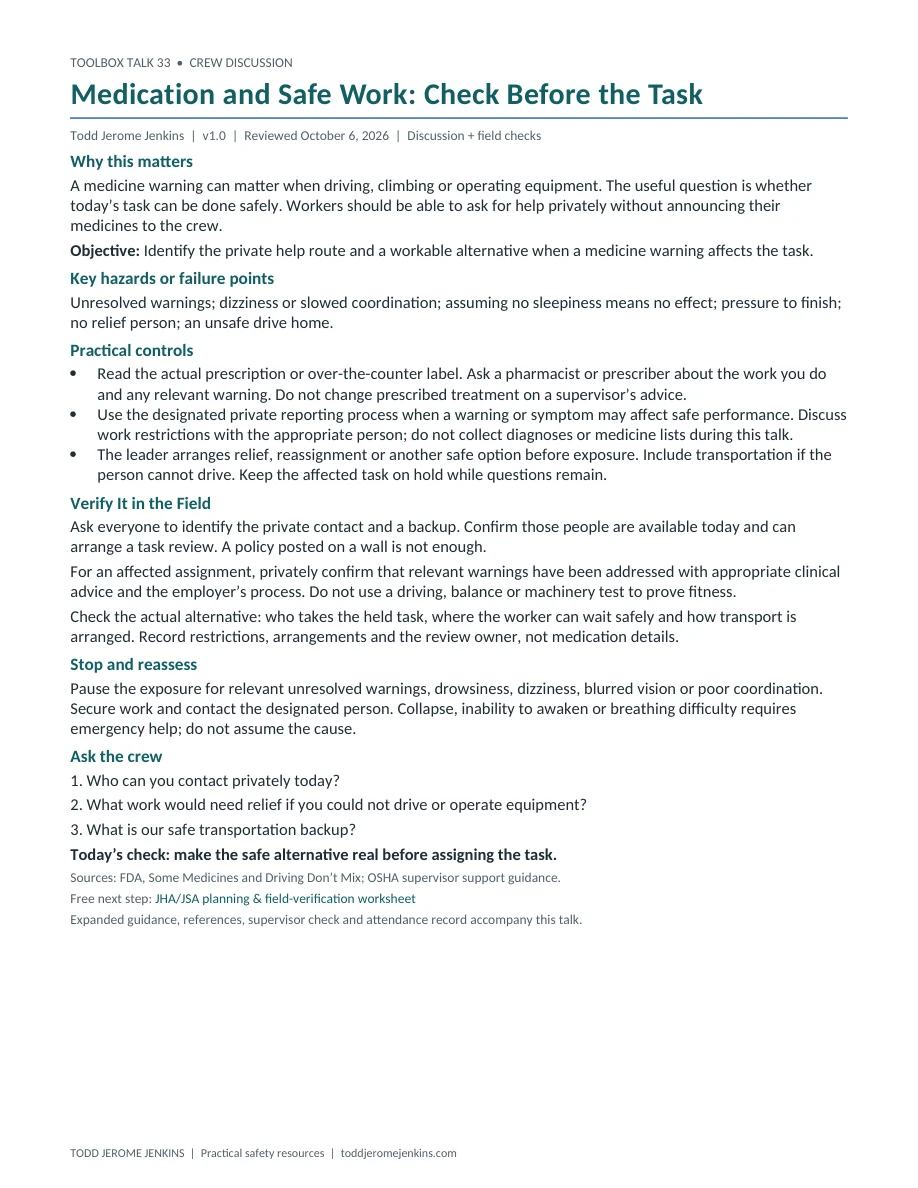
A 5–10 minute crew discussion, plus the time needed for field verification. All six downloads are free without a required signup.
Why this matters
A medicine warning can matter when driving, climbing or operating equipment. The useful question is whether today’s task can be done safely. Workers should be able to ask for help privately without announcing their medicines to the crew.
Learning objective: Identify the private help route and a workable alternative when a medicine warning affects the task.
Key hazards or failure points
Unresolved warnings; dizziness or slowed coordination; assuming no sleepiness means no effect; pressure to finish; no relief person; an unsafe drive home.
Practical controls
- Read the actual prescription or over-the-counter label. Ask a pharmacist or prescriber about the work you do and any relevant warning. Do not change prescribed treatment on a supervisor’s advice.
- Use the designated private reporting process when a warning or symptom may affect safe performance. Discuss work restrictions with the appropriate person; do not collect diagnoses or medicine lists during this talk.
- The leader arranges relief, reassignment or another safe option before exposure. Include transportation if the person cannot drive. Keep the affected task on hold while questions remain.
Verify It in the Field
Ask everyone to identify the private contact and a backup. Confirm those people are available today and can arrange a task review. A policy posted on a wall is not enough.
For an affected assignment, privately confirm that relevant warnings have been addressed with appropriate clinical advice and the employer’s process. Do not use a driving, balance or machinery test to prove fitness.
Check the actual alternative: who takes the held task, where the worker can wait safely and how transport is arranged. Record restrictions, arrangements and the review owner, not medication details.
Use the separate field check to record the source and criterion, safe method, checker, actual result and time. Mark VERIFIED, HOLD/NOT VERIFIED, or N/A with a reason. Check every required control; the examples below do not clear the whole task.
| Control | Safe verification | Evidence to record |
|---|---|---|
| Private help route | Confirm primary and alternate contacts are available. | Contact and task-review owner; no health details. |
| Exposure held | Check the revised assignment with the responsible leader. | Held task and safe alternative. |
| Safe transport | Confirm the actual ride and waiting point if driving is restricted. | Arrangement and responsible person. |
Stop and reassess
Pause the exposure for relevant unresolved warnings, drowsiness, dizziness, blurred vision or poor coordination. Secure work and contact the designated person. Collapse, inability to awaken or breathing difficulty requires emergency help; do not assume the cause.
Crew discussion questions
- Who can you contact privately today?
- What work would need relief if you could not drive or operate equipment?
- What is our safe transportation backup?
Today’s check: make the safe alternative real before assigning the task.
A situation to discuss
Illustrative situation: a worker asks privately about a new medicine warning before an equipment assignment. The leader holds that assignment, arranges other work through the employer’s process and helps the worker reach the appropriate health professional. Nobody needs to discuss the medicine at the crew briefing.
Leader preparation and practical detail
A warning belongs in the task decision
FDA explains that some medicines affect driving or machinery use, sometimes into the next day. Some effects can occur without feeling sleepy. Read the actual label and discuss the actual activity with the pharmacist or prescriber. This resource cannot clear a particular medicine, combination or worker for a task. [1]
Give the private route authority
Name the person who can arrange a work review and a substitute if that person is absent. The route should lead to a decision about exposure, not an instruction to keep going until someone is available. The employer’s appropriate medical and employment processes govern any assessment. Crew notes should contain work arrangements rather than personal health information.
Verify the handoff
When work changes hands, confirm the replacement worker is trained and authorized for that task. Make the revised assignment clear to the affected crew. If transport is needed, agree the pickup and waiting arrangements before releasing the worker from the work area. These are practical planning checks; they do not establish medical fitness.
Short supervisor field check
- Private contact and backup available.
- Relevant work restrictions addressed through the appropriate process.
- Affected exposure held until resolved.
- Relief or reassignment and transport confirmed.
- Only work arrangements recorded; follow-up owner named.
Use the separate form to document evidence, restrictions, corrective-action owner, recheck and required restart approval. An unresolved required control means hold the affected work. Missing evidence is not a pass. Complete all task-specific inspections and permits.
Attendance and follow-through
The separate attendance sheet records participants, language support, questions, actions and late-arrival rebriefs. Attendance does not establish competence or prove controls function. Keep completed records private under the employer’s procedures.
Technical scope and references
This talk supports task planning and private referral. It does not diagnose impairment, direct treatment or determine fitness for duty. FDA provides medicine guidance; OSHA’s supervisor checklist is supportive leadership guidance. Apply the employer’s appropriate private process and clinician advice. [1], [2]
References checked October 6, 2026. Apply the jurisdiction, task, employer program and equipment instructions that govern the work. No site-specific manual, permit, engineering determination or product SDS has been approved by this general resource.
- Some Medicines and Driving Don’t Mix — Some prescription and OTC medicines can affect driving/machinery, sometimes into next day. Antihistamines can affect performance without felt drowsiness. Read actual label and ask health professional about task risks; clinician determines changes to treatment.
- Supporting Mental Health in the Workplace: Checklist for Supervisors — Relieve job stressors through realistic workload/time/resources, support channels and private check-ins. Do not force disclosure. Supervisor supports/refers; does not diagnose. Do not promise absolute confidentiality or guarantee employment outcomes.
Connect this discussion to your JHA/JSA
Use How to Conduct a Job Safety Analysis to connect today’s work steps, hazards and controls. Revisit Pre-Job JHA/JSA: What Changed Today? whenever conditions change.
Related published crew resources: New to the Job: Show the Work Before You Start; Distracted Driving: Set Up Before Moving.
Put one check into practice
Download the free JHA/JSA planning and field-verification worksheet. For today’s task, record an important control, its source and the evidence needed before exposure. Complete the remaining required checks through your task plan.