Download the free crew talk
The one-page talk, editable Word version, and guidance below are open to everyone. No account required.
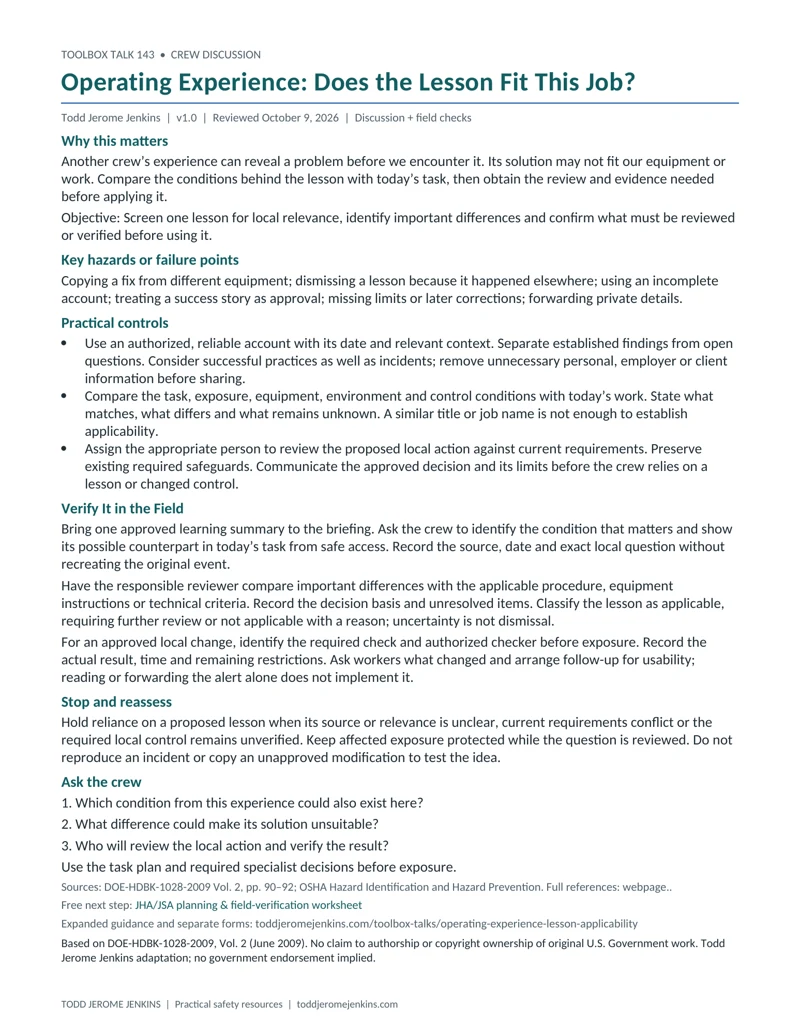
Preview the one-page crew talk
Supporting documents
Included with free Safety & Systems membership.
Supervisor field check
A separate check to verify conditions and controls before work. Includes a one-page PDF and editable Word file.
Attendance sheet
A separate sign-in sheet to record the crew discussion. Includes a one-page PDF and editable Word file.
Need the crew records? Join free to use these supporting documents and the Safety & Systems Academy. No payment details. Email updates are optional.
Get supporting documents — free membershipAlready a member? Use the same link to sign in.
Human Performance weekly series: lesson 20 of 52.
A 5–10 minute crew discussion, plus time to verify the actual controls. The crew talk and Word version are public. Separate supervisor and attendance records are included with free Safety & Systems membership.
Why this matters
Another crew’s experience can reveal a problem before we encounter it. Its solution may not fit our equipment or work. Compare the conditions behind the lesson with today’s task, then obtain the review and evidence needed before applying it.
Learning objective
Screen one lesson for local relevance, identify important differences and confirm what must be reviewed or verified before using it.
Key hazards or failure points
Copying a fix from different equipment; dismissing a lesson because it happened elsewhere; using an incomplete account; treating a success story as approval; missing limits or later corrections; forwarding private details.
Practical controls
- Use an authorized, reliable account with its date and relevant context. Separate established findings from open questions. Consider successful practices as well as incidents; remove unnecessary personal, employer or client information before sharing.
- Compare the task, exposure, equipment, environment and control conditions with today’s work. State what matches, what differs and what remains unknown. A similar title or job name is not enough to establish applicability.
- Assign the appropriate person to review the proposed local action against current requirements. Preserve existing required safeguards. Communicate the approved decision and its limits before the crew relies on a lesson or changed control.
Verify It in the Field
- Bring one approved learning summary to the briefing. Ask the crew to identify the condition that matters and show its possible counterpart in today’s task from safe access. Record the source, date and exact local question without recreating the original event.
- Have the responsible reviewer compare important differences with the applicable procedure, equipment instructions or technical criteria. Record the decision basis and unresolved items. Classify the lesson as applicable, requiring further review or not applicable with a reason; uncertainty is not dismissal.
- For an approved local change, identify the required check and authorized checker before exposure. Record the actual result, time and remaining restrictions. Ask workers what changed and arrange follow-up for usability; reading or forwarding the alert alone does not implement it.
Stop and reassess
Hold reliance on a proposed lesson when its source or relevance is unclear, current requirements conflict or the required local control remains unverified. Keep affected exposure protected while the question is reviewed. Do not reproduce an incident or copy an unapproved modification to test the idea.
Crew discussion questions
- Which condition from this experience could also exist here?
- What difference could make its solution unsuitable?
- Who will review the local action and verify the result?
For each required control, record its acceptance source and criterion, safe verification method, responsible checker, actual result and time. Use VERIFIED, HOLD/NOT VERIFIED, or N/A with a reason. A tick alone is not evidence. Complete all applicable task inspections; do not enter danger or improvise a test to fill out a form.
Leader preparation and practical detail
A familiar hazard can need a different solution
Illustrative situation: an alert describes a guarding improvement on one machine model. The local crew recognizes a similar exposure, but the equipment and operating sequence differ. Record the potential relevance and obtain the required engineering or manufacturer-supported review before changing the local machine. The external example can prompt a question; it does not establish compatibility, a safe installation or permission to modify equipment. Maintain the required protection while the local decision is made.
Do not dismiss a useful condition because the industry differs
Illustrative situation: a lesson from another industry concerns an important status change that failed to reach the next shift. The hardware is different, but the communication condition may be relevant. Examine whether a comparable gap exists in local turnover, then use the applicable local process to improve and check it. Be precise about what transfers: a question about the work arrangement may transfer even when the original technical solution does not.
Check success stories with the same care
Illustrative situation: another crew reports that revised staging made a task easier. Before adopting it, check local access, loading restrictions, adjacent work and the equipment-specific arrangement through the appropriate technical sources. A positive result elsewhere does not answer those questions. This lesson screens experience for fit before adoption; Learning from Incidents: Verify the Fix covers the later verification of a corrective control.
Short supervisor field check
- Reliable learning source, date, context and sharing permission established.
- Local similarities, differences and unknowns recorded.
- Applicability decision has a responsible reviewer and documented basis.
- Any local change approved against current applicable requirements.
- Required field result and later usability feedback recorded and communicated.
Confirm the relevant trained/authorized people, unresolved items, interim protection, correction owner and recheck. Record required release authority and rebrief anyone affected. The separate sheet supports these records; it does not replace a specialist inspection, permit or engineering determination.
Attendance and follow-through
Use the separate attendance sheet for participants, roles, discussion concerns, actions and late-arrival rebriefs. Attendance is not proof of competence, functioning controls or authorization to work. Keep completed records private under employer procedures.
Source acknowledgment
This resource draws on the U.S. Department of Energy’s DOE-HDBK-1028-2009, Human Performance Improvement Handbook, Volume 2 (June 2009). Todd Jerome Jenkins makes no claim of authorship or copyright ownership in the original U.S. Government work. New explanations, examples, exercises and layouts are Todd Jerome Jenkins adaptations. No endorsement by DOE or the U.S. Government is implied. Third-party material credited in the handbook remains attributed to its source; this notice does not claim rights in that material.
Source excerpt: Volume 2/VOLUME 2 OPERATING EXPERIENCE.pdf; Printed pp. 90, 91, 92. The June 2009 handbook supplies concepts; this lesson uses original explanations and exercises.
Technical scope and references
References reviewed October 9, 2026. DOE human-performance tools and OSHA recommended practices support preparation and discussion; they do not establish universal technical acceptance criteria. Apply the current task procedure, manufacturer instructions, permit and required competent or qualified decisions. A successful exercise does not replace required training, technical verification or work authorization.
- DOE-HDBK-1028-2009, Volume 2 — Operating Experience, printed pp. 90–92 — June 2009 illustrative concept source. Broad precursor-event claims and historical DOE program-order requirements are not carried into this general crew lesson.
- OSHA Recommended Practices — Hazard Identification and Assessment — Current guidance on internal/external information, worker input and relevant hazard review.
- OSHA Recommended Practices — Hazard Prevention and Control — Current guidance on evaluating controls used elsewhere, selecting suitable local measures and checking effectiveness.
Connect this discussion to your JHA/JSA
Use the JHA/JSA planning and field-verification worksheet to record the actual task steps, hazards, responsible roles and controls. No task-specific worked example is linked for this topic yet. Return to What Changed Today? when the plan or conditions change.
Related Todd Jerome Jenkins articles: How to Conduct a Job Safety Analysis and What Is Human and Organizational Performance?.
Related crew discussions
Continue the weekly series
Put one check into practice
Use the free JHA/JSA planning and field-verification worksheet to record today’s change, the required protection and the evidence needed before exposure.
Next weekly lesson
Lesson 21: Reporting Concerns: Practice a Useful First Response