Download the free crew talk
The one-page talk, editable Word version, and guidance below are open to everyone. No account required.
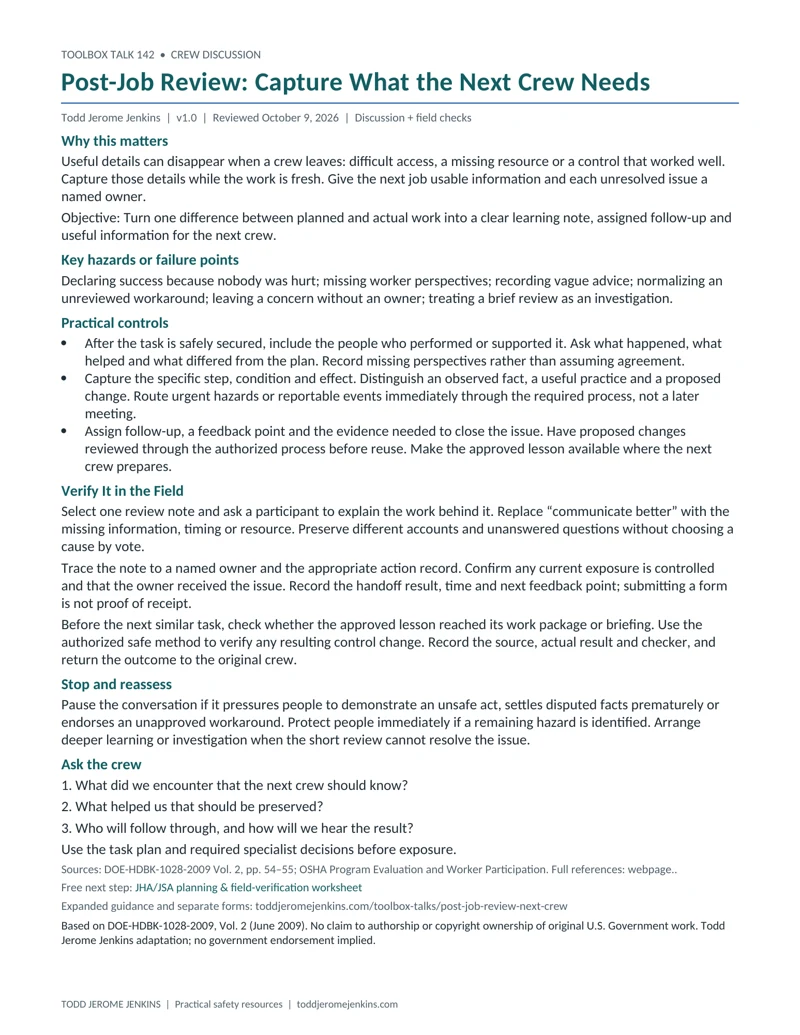
Preview the one-page crew talk
Supporting documents
Included with free Safety & Systems membership.
Supervisor field check
A separate check to verify conditions and controls before work. Includes a one-page PDF and editable Word file.
Attendance sheet
A separate sign-in sheet to record the crew discussion. Includes a one-page PDF and editable Word file.
Need the crew records? Join free to use these supporting documents and the Safety & Systems Academy. No payment details. Email updates are optional.
Get supporting documents — free membershipAlready a member? Use the same link to sign in.
Human Performance weekly series: lesson 19 of 52.
A 5–10 minute crew discussion, plus time to verify the actual controls. The crew talk and Word version are public. Separate supervisor and attendance records are included with free Safety & Systems membership.
Why this matters
Useful details can disappear when a crew leaves: difficult access, a missing resource or a control that worked well. Capture those details while the work is fresh. Give the next job usable information and each unresolved issue a named owner.
Learning objective
Turn one difference between planned and actual work into a clear learning note, assigned follow-up and useful information for the next crew.
Key hazards or failure points
Declaring success because nobody was hurt; missing worker perspectives; recording vague advice; normalizing an unreviewed workaround; leaving a concern without an owner; treating a brief review as an investigation.
Practical controls
- After the task is safely secured, include the people who performed or supported it. Ask what happened, what helped and what differed from the plan. Record missing perspectives rather than assuming agreement.
- Capture the specific step, condition and effect. Distinguish an observed fact, a useful practice and a proposed change. Route urgent hazards or reportable events immediately through the required process, not a later meeting.
- Assign follow-up, a feedback point and the evidence needed to close the issue. Have proposed changes reviewed through the authorized process before reuse. Make the approved lesson available where the next crew prepares.
Verify It in the Field
- Select one review note and ask a participant to explain the work behind it. Replace “communicate better” with the missing information, timing or resource. Preserve different accounts and unanswered questions without choosing a cause by vote.
- Trace the note to a named owner and the appropriate action record. Confirm any current exposure is controlled and that the owner received the issue. Record the handoff result, time and next feedback point; submitting a form is not proof of receipt.
- Before the next similar task, check whether the approved lesson reached its work package or briefing. Use the authorized safe method to verify any resulting control change. Record the source, actual result and checker, and return the outcome to the original crew.
Stop and reassess
Pause the conversation if it pressures people to demonstrate an unsafe act, settles disputed facts prematurely or endorses an unapproved workaround. Protect people immediately if a remaining hazard is identified. Arrange deeper learning or investigation when the short review cannot resolve the issue.
Crew discussion questions
- What did we encounter that the next crew should know?
- What helped us that should be preserved?
- Who will follow through, and how will we hear the result?
For each required control, record its acceptance source and criterion, safe verification method, responsible checker, actual result and time. Use VERIFIED, HOLD/NOT VERIFIED, or N/A with a reason. A tick alone is not evidence. Complete all applicable task inspections; do not enter danger or improvise a test to fill out a form.
Leader preparation and practical detail
Capture the resource that made work succeed
Illustrative situation: a crew finishes smoothly because a support person arranged a needed tool before the critical step. A review that records only “good teamwork” misses the usable detail. Identify the tool, the point at which it was needed and the planning arrangement that made it available. Check whether that support will exist on the next shift. Learning from successful work should preserve the conditions that helped, without claiming that one uneventful task proves all controls effective.
Record a workaround without approving it
Illustrative situation: workers describe an awkward adjustment that helped them finish when the planned access was unavailable. Ask about the actual condition and why the adjustment seemed necessary. Do not publicly convert that account into an approved method for the next crew. Address any current exposure and refer the work design, access or procedure problem to the proper owner. Keep proposed solutions distinct from authorized changes, then verify the selected correction before the next affected task.
Choose the right follow-up depth
A short post-job review captures timely feedback; it does not provide every perspective or establish incident causes. Repeated difficulty, conflicting accounts or an issue spanning several teams may deserve a facilitated Learning Team or another structured review. An incident may separately require formal investigation and reporting. Tell participants what will happen next and when feedback will return. OSHA program-evaluation guidance supports worker input and follow-through, but it does not prescribe this named meeting format.
Short supervisor field check
- Task safely secured and relevant participants or missing perspectives identified.
- Specific work facts, useful practices and proposed changes kept distinct.
- Urgent hazards and required reports routed without waiting for review closure.
- Follow-up owner receives the issue and agrees the feedback point.
- Approved learning reaches the next task and resulting control is verified.
Confirm the relevant trained/authorized people, unresolved items, interim protection, correction owner and recheck. Record required release authority and rebrief anyone affected. The separate sheet supports these records; it does not replace a specialist inspection, permit or engineering determination.
Attendance and follow-through
Use the separate attendance sheet for participants, roles, discussion concerns, actions and late-arrival rebriefs. Attendance is not proof of competence, functioning controls or authorization to work. Keep completed records private under employer procedures.
Source acknowledgment
This resource draws on the U.S. Department of Energy’s DOE-HDBK-1028-2009, Human Performance Improvement Handbook, Volume 2 (June 2009). Todd Jerome Jenkins makes no claim of authorship or copyright ownership in the original U.S. Government work. New explanations, examples, exercises and layouts are Todd Jerome Jenkins adaptations. No endorsement by DOE or the U.S. Government is implied. Third-party material credited in the handbook remains attributed to its source; this notice does not claim rights in that material.
Source excerpt: Volume 2/VOLUME 2 POST-JOB REVIEW — IN THE FIELD.pdf; Printed pp. 54, 55. The June 2009 handbook supplies concepts; this lesson uses original explanations and exercises.
Technical scope and references
References reviewed October 9, 2026. DOE human-performance tools and OSHA recommended practices support preparation and discussion; they do not establish universal technical acceptance criteria. Apply the current task procedure, manufacturer instructions, permit and required competent or qualified decisions. A successful exercise does not replace required training, technical verification or work authorization.
- DOE-HDBK-1028-2009, Volume 2 — Post-Job Review in the Field, printed pp. 54–55 — June 2009 illustrative guidance on brief feedback, useful practices, improvement opportunities and follow-up.
- OSHA Recommended Practices — Program Evaluation and Improvement — Current guidance on worker input, action on shortcomings and sharing evaluation results; not a requirement for this specific meeting format.
- OSHA Recommended Practices — Worker Participation — Guidance on receiving worker input and giving feedback on action taken.
Connect this discussion to your JHA/JSA
Use the JHA/JSA planning and field-verification worksheet to record the actual task steps, hazards, responsible roles and controls. No task-specific worked example is linked for this topic yet. Return to What Changed Today? when the plan or conditions change.
Related Todd Jerome Jenkins articles: How to Conduct a Job Safety Analysis and What Is Human and Organizational Performance?.
Related crew discussions
Continue the weekly series
- Lesson 18: Work Turnover: Transfer the State, Not Just the Story
- Lesson 20: Operating Experience: Does the Lesson Fit This Job?
Put one check into practice
Use the free JHA/JSA planning and field-verification worksheet to record today’s change, the required protection and the evidence needed before exposure.