Download the free crew talk
The one-page talk, editable Word version, and guidance below are open to everyone. No account required.
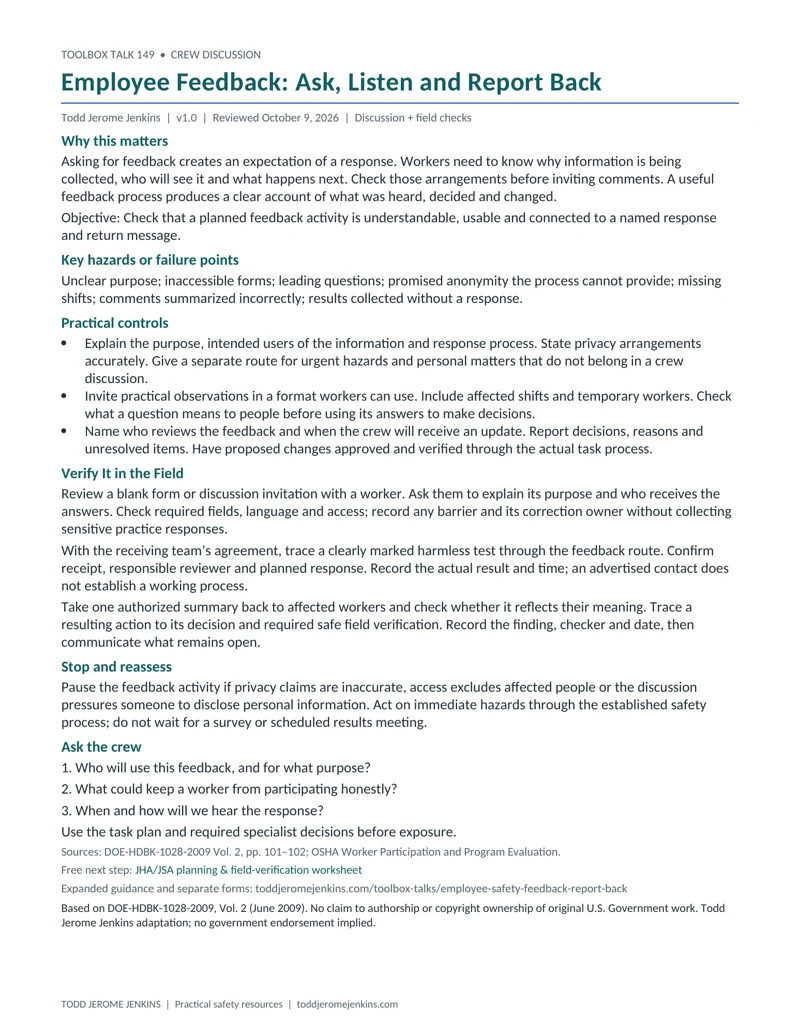
Preview the one-page crew talk
Supporting documents
Included with free Safety & Systems membership.
Supervisor field check
A separate check to verify conditions and controls before work. Includes a one-page PDF and editable Word file.
Attendance sheet
A separate sign-in sheet to record the crew discussion. Includes a one-page PDF and editable Word file.
Need the crew records? Join free to use these supporting documents and the Safety & Systems Academy. No payment details. Email updates are optional.
Get supporting documents — free membershipAlready a member? Use the same link to sign in.
Human Performance weekly series: lesson 26 of 52.
A 5–10 minute crew discussion, plus time to verify the actual controls. The crew talk and Word version are public. Separate supervisor and attendance records are included with free Safety & Systems membership.
Why this matters
Asking for feedback creates an expectation of a response. Workers need to know why information is being collected, who will see it and what happens next. Check those arrangements before inviting comments. A useful feedback process produces a clear account of what was heard, decided and changed.
Learning objective
Check that a planned feedback activity is understandable, usable and connected to a named response and return message.
Key hazards or failure points
Unclear purpose; inaccessible forms; leading questions; promised anonymity the process cannot provide; missing shifts; comments summarized incorrectly; results collected without a response.
Practical controls
- Explain the purpose, intended users of the information and response process. State privacy arrangements accurately. Give a separate route for urgent hazards and personal matters that do not belong in a crew discussion.
- Invite practical observations in a format workers can use. Include affected shifts and temporary workers. Check what a question means to people before using its answers to make decisions.
- Name who reviews the feedback and when the crew will receive an update. Report decisions, reasons and unresolved items. Have proposed changes approved and verified through the actual task process.
Verify It in the Field
- Review a blank form or discussion invitation with a worker. Ask them to explain its purpose and who receives the answers. Check required fields, language and access; record any barrier and its correction owner without collecting sensitive practice responses.
- With the receiving team’s agreement, trace a clearly marked harmless test through the feedback route. Confirm receipt, responsible reviewer and planned response. Record the actual result and time; an advertised contact does not establish a working process.
- Take one authorized summary back to affected workers and check whether it reflects their meaning. Trace a resulting action to its decision and required safe field verification. Record the finding, checker and date, then communicate what remains open.
Stop and reassess
Pause the feedback activity if privacy claims are inaccurate, access excludes affected people or the discussion pressures someone to disclose personal information. Act on immediate hazards through the established safety process; do not wait for a survey or scheduled results meeting.
Crew discussion questions
- Who will use this feedback, and for what purpose?
- What could keep a worker from participating honestly?
- When and how will we hear the response?
For each required control, record its acceptance source and criterion, safe verification method, responsible checker, actual result and time. Use VERIFIED, HOLD/NOT VERIFIED, or N/A with a reason. A tick alone is not evidence. Complete all applicable task inspections; do not enter danger or improvise a test to fill out a form.
Leader preparation and practical detail
Check the invitation before collecting answers
Illustrative situation: a form is described as anonymous but requires a named account. Before use, the responsible process owner verifies what identifying information the system collects and who can access it. Correct the invitation and provide an appropriate alternative where needed. Do not promise anonymity, confidentiality or immunity simply to encourage participation. This lesson checks the collection and response process; it does not create a validated survey or authorize collecting medical, personnel or client information.
Confirm the meaning of the summary
Illustrative situation: workers report that a procedure is difficult to obtain on night shift. The summary calls this a need for more training. Return the proposed interpretation to the affected workers and ask what was missed. The needed improvement may involve document access or support coverage. Preserve differing accounts and record the actual task difficulty before selecting a response. Do not use a majority answer to dismiss a specific serious concern or declare a required control adequate.
Return an honest update when the solution is pending
A response can explain that technical review is still underway, provided it names the owner, current restrictions and next update. Avoid announcing that an issue is resolved when only a request has been submitted. Use Speak Up for Safety for immediate hazard reporting; this lesson addresses an organized invitation for feedback and the quality of its return message. The organization should explain what it learned, what it will change and what it still needs to understand.
Short supervisor field check
- Purpose, audience and actual privacy arrangements explained.
- Questions and participation method understandable and accessible.
- Affected groups included; urgent and private routes identified.
- Reviewer receives input and owns the response date.
- Summary meaning checked; decisions and verified results returned.
Confirm the relevant trained/authorized people, unresolved items, interim protection, correction owner and recheck. Record required release authority and rebrief anyone affected. The separate sheet supports these records; it does not replace a specialist inspection, permit or engineering determination.
Attendance and follow-through
Use the separate attendance sheet for participants, roles, discussion concerns, actions and late-arrival rebriefs. Attendance is not proof of competence, functioning controls or authorization to work. Keep completed records private under employer procedures.
Source acknowledgment
This resource draws on the U.S. Department of Energy’s DOE-HDBK-1028-2009, Human Performance Improvement Handbook, Volume 2 (June 2009). Todd Jerome Jenkins makes no claim of authorship or copyright ownership in the original U.S. Government work. New explanations, examples, exercises and layouts are Todd Jerome Jenkins adaptations. No endorsement by DOE or the U.S. Government is implied. Third-party material credited in the handbook remains attributed to its source; this notice does not claim rights in that material.
Source excerpt: Volume 2/VOLUME 2 EMPLOYEE SURVEYS.pdf; Printed pp. 101, 102. The June 2009 handbook supplies concepts; this lesson uses original explanations and exercises.
Technical scope and references
References reviewed October 9, 2026. DOE human-performance tools and OSHA recommended practices support preparation and discussion; they do not establish universal technical acceptance criteria. Apply the current task procedure, manufacturer instructions, permit and required competent or qualified decisions. A successful exercise does not replace required training, technical verification or work authorization.
- DOE-HDBK-1028-2009, Volume 2 — Employee Surveys, printed pp. 101–102 — June 2009 illustrative guidance on explaining purpose, interpreting feedback and reporting results. No historical survey questions or validated-instrument claim reproduced.
- OSHA — Worker Participation — Current recommended practices on accessible input, response and feedback, participation barriers and protection against retaliation.
- OSHA — Program Evaluation and Improvement — Current recommended practices on involving workers and sharing results of program review.
Connect this discussion to your JHA/JSA
Use the JHA/JSA planning and field-verification worksheet to record the actual task steps, hazards, responsible roles and controls. No task-specific worked example is linked for this topic yet. Return to What Changed Today? when the plan or conditions change.
Related Todd Jerome Jenkins articles: How to Conduct a Job Safety Analysis and What Is Human and Organizational Performance?.
Related crew discussions
- Reporting Concerns: Practice a Useful First Response
- Safety Climate: What Do Our Everyday Responses Tell Us?
Continue the weekly series
- Lesson 25: Safety Climate: What Do Our Everyday Responses Tell Us?
- Lesson 27: Choose the Gap to Fix First
Put one check into practice
Use the free JHA/JSA planning and field-verification worksheet to record today’s change, the required protection and the evidence needed before exposure.