Download the free crew talk
The one-page talk, editable Word version, and guidance below are open to everyone. No account required.
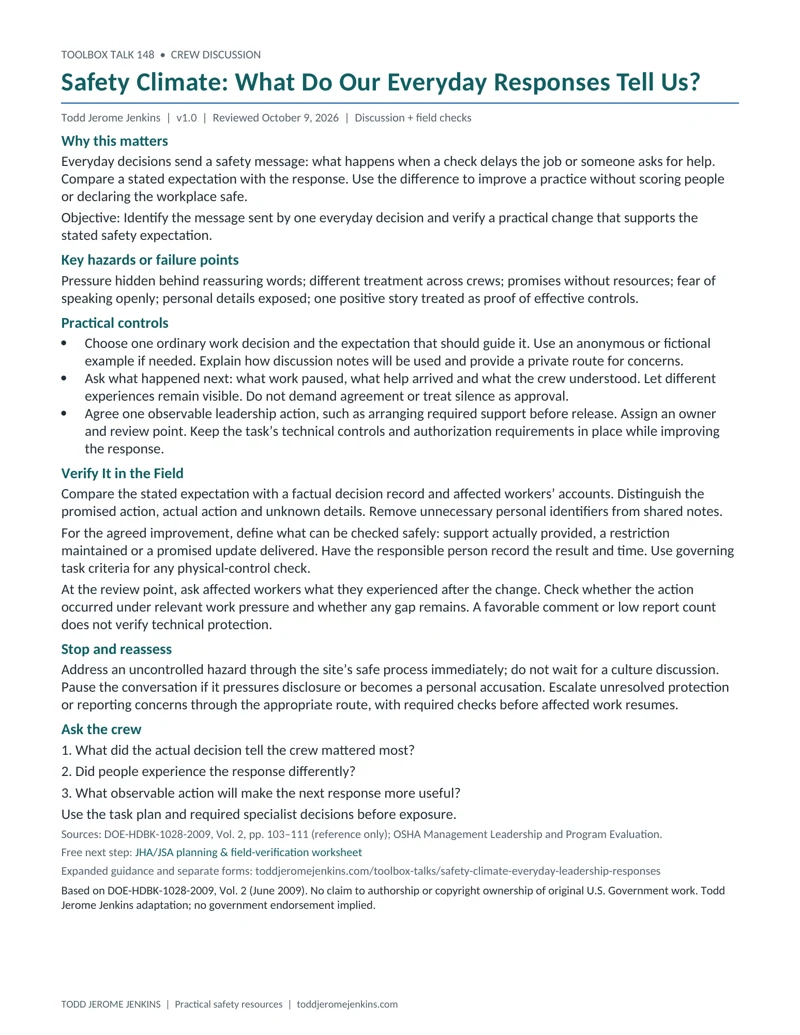
Preview the one-page crew talk
Supporting documents
Included with free Safety & Systems membership.
Supervisor field check
A separate check to verify conditions and controls before work. Includes a one-page PDF and editable Word file.
Attendance sheet
A separate sign-in sheet to record the crew discussion. Includes a one-page PDF and editable Word file.
Need the crew records? Join free to use these supporting documents and the Safety & Systems Academy. No payment details. Email updates are optional.
Get supporting documents — free membershipAlready a member? Use the same link to sign in.
Human Performance weekly series: lesson 25 of 52.
A 5–10 minute crew discussion, plus time to verify the actual controls. The crew talk and Word version are public. Separate supervisor and attendance records are included with free Safety & Systems membership.
Why this matters
Everyday decisions send a safety message: what happens when a check delays the job or someone asks for help. Compare a stated expectation with the response. Use the difference to improve a practice without scoring people or declaring the workplace safe.
Learning objective
Identify the message sent by one everyday decision and verify a practical change that supports the stated safety expectation.
Key hazards or failure points
Pressure hidden behind reassuring words; different treatment across crews; promises without resources; fear of speaking openly; personal details exposed; one positive story treated as proof of effective controls.
Practical controls
- Choose one ordinary work decision and the expectation that should guide it. Use an anonymous or fictional example if needed. Explain how discussion notes will be used and provide a private route for concerns.
- Ask what happened next: what work paused, what help arrived and what the crew understood. Let different experiences remain visible. Do not demand agreement or treat silence as approval.
- Agree one observable leadership action, such as arranging required support before release. Assign an owner and review point. Keep the task’s technical controls and authorization requirements in place while improving the response.
Verify It in the Field
- Compare the stated expectation with a factual decision record and affected workers’ accounts. Distinguish the promised action, actual action and unknown details. Remove unnecessary personal identifiers from shared notes.
- For the agreed improvement, define what can be checked safely: support actually provided, a restriction maintained or a promised update delivered. Have the responsible person record the result and time. Use governing task criteria for any physical-control check.
- At the review point, ask affected workers what they experienced after the change. Check whether the action occurred under relevant work pressure and whether any gap remains. A favorable comment or low report count does not verify technical protection.
Stop and reassess
Address an uncontrolled hazard through the site’s safe process immediately; do not wait for a culture discussion. Pause the conversation if it pressures disclosure or becomes a personal accusation. Escalate unresolved protection or reporting concerns through the appropriate route, with required checks before affected work resumes.
Crew discussion questions
- What did the actual decision tell the crew mattered most?
- Did people experience the response differently?
- What observable action will make the next response more useful?
For each required control, record its acceptance source and criterion, safe verification method, responsible checker, actual result and time. Use VERIFIED, HOLD/NOT VERIFIED, or N/A with a reason. A tick alone is not evidence. Complete all applicable task inspections; do not enter danger or improvise a test to fill out a form.
Leader preparation and practical detail
A delayed job tests the stated expectation
Illustrative situation: a required check cannot be completed before the planned start. A leader can say the check matters while continuing to press for immediate release, or arrange the necessary support and maintain the hold. Examine the actual decision and what workers experienced. If the message and practice differ, choose a specific correction in planning, resources or communication. Do not use the discussion to excuse skipping the requirement.
Hear different experiences without declaring a winner
The day crew may receive quick support while another shift struggles to contact the same decision maker. Both accounts can be useful. Identify the different conditions and obtain additional evidence before drawing a conclusion. Avoid names and private details in a public crew record, and offer an appropriate route for sensitive concerns. No one should have to disclose a personal case to participate in this exercise.
Treat the discussion as a lead for improvement
This is an original discussion exercise, not the archived safety-climate survey and not a validated measurement instrument. One meeting cannot establish an organization-wide climate score or prove that controls work. Use the identified issue to guide a specific improvement and later check. OSHA’s program-evaluation guidance includes worker opinions among several information sources; combine useful input with direct control evidence and appropriate broader assessment when needed.
Short supervisor field check
- Specific decision and stated expectation are identified.
- Participation and private reporting options avoid forced disclosure.
- Facts, differing experiences and unknowns remain distinct.
- Improvement has an owner, observable result and review point.
- Follow-up checks actual action without claiming a climate score or safe workplace.
Confirm the relevant trained/authorized people, unresolved items, interim protection, correction owner and recheck. Record required release authority and rebrief anyone affected. The separate sheet supports these records; it does not replace a specialist inspection, permit or engineering determination.
Attendance and follow-through
Use the separate attendance sheet for participants, roles, discussion concerns, actions and late-arrival rebriefs. Attendance is not proof of competence, functioning controls or authorization to work. Keep completed records private under employer procedures.
Source acknowledgment
This resource draws on the U.S. Department of Energy’s DOE-HDBK-1028-2009, Human Performance Improvement Handbook, Volume 2 (June 2009). Todd Jerome Jenkins makes no claim of authorship or copyright ownership in the original U.S. Government work. New explanations, examples, exercises and layouts are Todd Jerome Jenkins adaptations. No endorsement by DOE or the U.S. Government is implied. Third-party material credited in the handbook remains attributed to its source; this notice does not claim rights in that material.
Source excerpt: Volume 2/VOLUME 2 EMPLOYEE SURVEYS Orginizational Safety Climate Assessment Survey.pdf; Printed pp. 103, 104, 105, 106, 107, 108, 109, 110, 111. The June 2009 handbook supplies concepts; this lesson uses original explanations and exercises.
Technical scope and references
References reviewed October 9, 2026. DOE human-performance tools and OSHA recommended practices support preparation and discussion; they do not establish universal technical acceptance criteria. Apply the current task procedure, manufacturer instructions, permit and required competent or qualified decisions. A successful exercise does not replace required training, technical verification or work authorization.
- DOE-HDBK-1028-2009, Volume 2 — Organizational Safety Climate Assessment Survey — June 2009, printed pages 103–111, inspected as reference-only context. Source credits a Naval Post-Graduate School survey adaptation. No survey statements, response scale, scoring or validation claim is reproduced.
- OSHA — Management Leadership — Recommended practices, action items 1, 3 and 4: visible decisions, resources and communication that support stated safety commitments.
- OSHA — Program Evaluation and Improvement — Recommended practices: worker input and multiple indicators inform evaluation; supports follow-up on actual program improvements. Does not validate this discussion as a survey.
Connect this discussion to your JHA/JSA
Use the JHA/JSA planning and field-verification worksheet to record the actual task steps, hazards, responsible roles and controls. No task-specific worked example is linked for this topic yet. Return to What Changed Today? when the plan or conditions change.
Related Todd Jerome Jenkins articles: How to Conduct a Job Safety Analysis and What Is Human and Organizational Performance?.
Related crew discussions
Continue the weekly series
Put one check into practice
Use the free JHA/JSA planning and field-verification worksheet to record today’s change, the required protection and the evidence needed before exposure.