Download the free crew talk
The one-page talk, editable Word version, and guidance below are open to everyone. No account required.
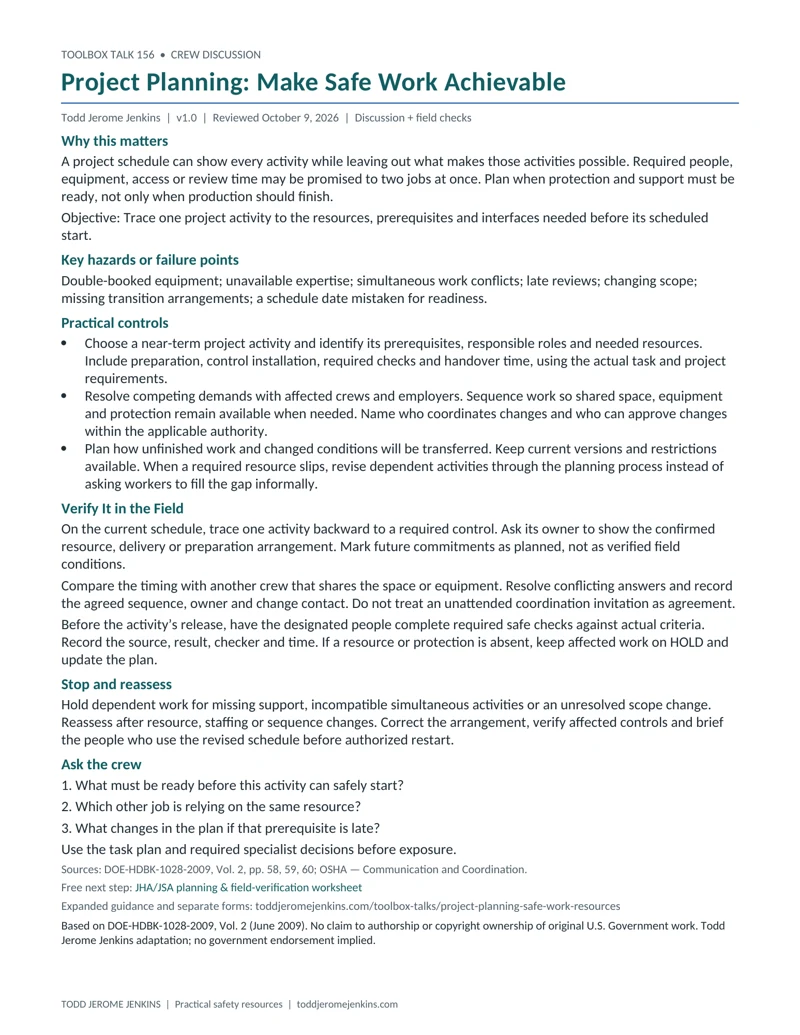
Preview the one-page crew talk
Supporting documents
Included with free Safety & Systems membership.
Supervisor field check
A separate check to verify conditions and controls before work. Includes a one-page PDF and editable Word file.
Attendance sheet
A separate sign-in sheet to record the crew discussion. Includes a one-page PDF and editable Word file.
Need the crew records? Join free to use these supporting documents and the Safety & Systems Academy. No payment details. Email updates are optional.
Get supporting documents — free membershipAlready a member? Use the same link to sign in.
Human Performance weekly series: lesson 33 of 52.
A 5–10 minute crew discussion, plus time to verify the actual controls. The crew talk and Word version are public. Separate supervisor and attendance records are included with free Safety & Systems membership.
Why this matters
A project schedule can show every activity while leaving out what makes those activities possible. Required people, equipment, access or review time may be promised to two jobs at once. Plan when protection and support must be ready, not only when production should finish.
Learning objective
Trace one project activity to the resources, prerequisites and interfaces needed before its scheduled start.
Key hazards or failure points
Double-booked equipment; unavailable expertise; simultaneous work conflicts; late reviews; changing scope; missing transition arrangements; a schedule date mistaken for readiness.
Practical controls
- Choose a near-term project activity and identify its prerequisites, responsible roles and needed resources. Include preparation, control installation, required checks and handover time, using the actual task and project requirements.
- Resolve competing demands with affected crews and employers. Sequence work so shared space, equipment and protection remain available when needed. Name who coordinates changes and who can approve changes within the applicable authority.
- Plan how unfinished work and changed conditions will be transferred. Keep current versions and restrictions available. When a required resource slips, revise dependent activities through the planning process instead of asking workers to fill the gap informally.
Verify It in the Field
- On the current schedule, trace one activity backward to a required control. Ask its owner to show the confirmed resource, delivery or preparation arrangement. Mark future commitments as planned, not as verified field conditions.
- Compare the timing with another crew that shares the space or equipment. Resolve conflicting answers and record the agreed sequence, owner and change contact. Do not treat an unattended coordination invitation as agreement.
- Before the activity’s release, have the designated people complete required safe checks against actual criteria. Record the source, result, checker and time. If a resource or protection is absent, keep affected work on HOLD and update the plan.
Stop and reassess
Hold dependent work for missing support, incompatible simultaneous activities or an unresolved scope change. Reassess after resource, staffing or sequence changes. Correct the arrangement, verify affected controls and brief the people who use the revised schedule before authorized restart.
Crew discussion questions
- What must be ready before this activity can safely start?
- Which other job is relying on the same resource?
- What changes in the plan if that prerequisite is late?
For each required control, record its acceptance source and criterion, safe verification method, responsible checker, actual result and time. Use VERIFIED, HOLD/NOT VERIFIED, or N/A with a reason. A tick alone is not evidence. Complete all applicable task inspections; do not enter danger or improvise a test to fill out a form.
Leader preparation and practical detail
Trace a dependency rather than reading the whole schedule
Illustrative situation: one access platform is allocated to two crews. A date on each schedule does not resolve the conflict. The project planner brings the affected people together to change sequence or arrange a suitable alternative. The receiving crew still completes the required equipment and task checks before exposure.
Plan the transition as well as the endpoint
HSE organisational-change guidance highlights risks during a transition, including altered responsibilities and support. Apply that idea carefully to a project handoff: identify who maintains protection while one crew leaves and another prepares. This is guidance, not a claim that every project must use a particular change form.
Preserve the difference between planning and release
This lesson builds a workable sequence and resource arrangement. The Project Review lesson tests a proposed release against unresolved interfaces. The field briefing checks the actual conditions. A project plan may schedule each of those steps, but completing the plan does not complete them.
Short supervisor field check
- Activity prerequisites and resources identified.
- Shared demands and sequence reconciled.
- Control owners and completion points assigned.
- Actual readiness distinguished from commitments.
- Changes, restrictions and handover communicated.
Confirm the relevant trained/authorized people, unresolved items, interim protection, correction owner and recheck. Record required release authority and rebrief anyone affected. The separate sheet supports these records; it does not replace a specialist inspection, permit or engineering determination.
Attendance and follow-through
Use the separate attendance sheet for participants, roles, discussion concerns, actions and late-arrival rebriefs. Attendance is not proof of competence, functioning controls or authorization to work. Keep completed records private under employer procedures.
Source acknowledgment
This resource draws on the U.S. Department of Energy’s DOE-HDBK-1028-2009, Human Performance Improvement Handbook, Volume 2 (June 2009). Todd Jerome Jenkins makes no claim of authorship or copyright ownership in the original U.S. Government work. New explanations, examples, exercises and layouts are Todd Jerome Jenkins adaptations. No endorsement by DOE or the U.S. Government is implied. Third-party material credited in the handbook remains attributed to its source; this notice does not claim rights in that material.
Source excerpt: Volume 2/VOLUME 2 PROJECT PLANNING.pdf; Printed pp. 58, 59, 60. The June 2009 handbook supplies concepts; this lesson uses original explanations and exercises.
Technical scope and references
References reviewed October 9, 2026. DOE human-performance tools and OSHA recommended practices support preparation and discussion; they do not establish universal technical acceptance criteria. Apply the current task procedure, manufacturer instructions, permit and required competent or qualified decisions. A successful exercise does not replace required training, technical verification or work authorization.
- DOE-HDBK-1028-2009, Volume 2 — Planning resources and interfaces — June 2009 illustrative guidance; Printed pp. 58, 59, 60. Original ZIP excerpt inspected in full; no claim of universal mandated process.
- OSHA — Communication and Coordination — Recommended practices: exchange hazard information and coordinate scheduling and responsibilities across employers.
- HSE — Organisational Change — UK regulator guidance: assess transition risks, role transfer and resource changes; not a US legal requirement.
Connect this discussion to your JHA/JSA
Use the JHA/JSA planning and field-verification worksheet to record the actual task steps, hazards, responsible roles and controls. No task-specific worked example is linked for this topic yet. Return to What Changed Today? when the plan or conditions change.
Related Todd Jerome Jenkins articles: How to Conduct a Job Safety Analysis and What Is Human and Organizational Performance?.
Related crew discussions
Continue the weekly series
- Lesson 32: Technical Task Briefing: Clarify the Deliverable Before Work
- Lesson 34: Project Review: Resolve Interfaces Before Release
Put one check into practice
Use the free JHA/JSA planning and field-verification worksheet to record today’s change, the required protection and the evidence needed before exposure.