Download the talk and separate crew records
Free to download without an account. Each PDF is one page. Use the Word version to adapt the record to your task and approved procedures.
Supervisor field check
Download supervisor field check (PDF, 1 page)Editable supervisor field check (Word)Preview the one-page crew talk
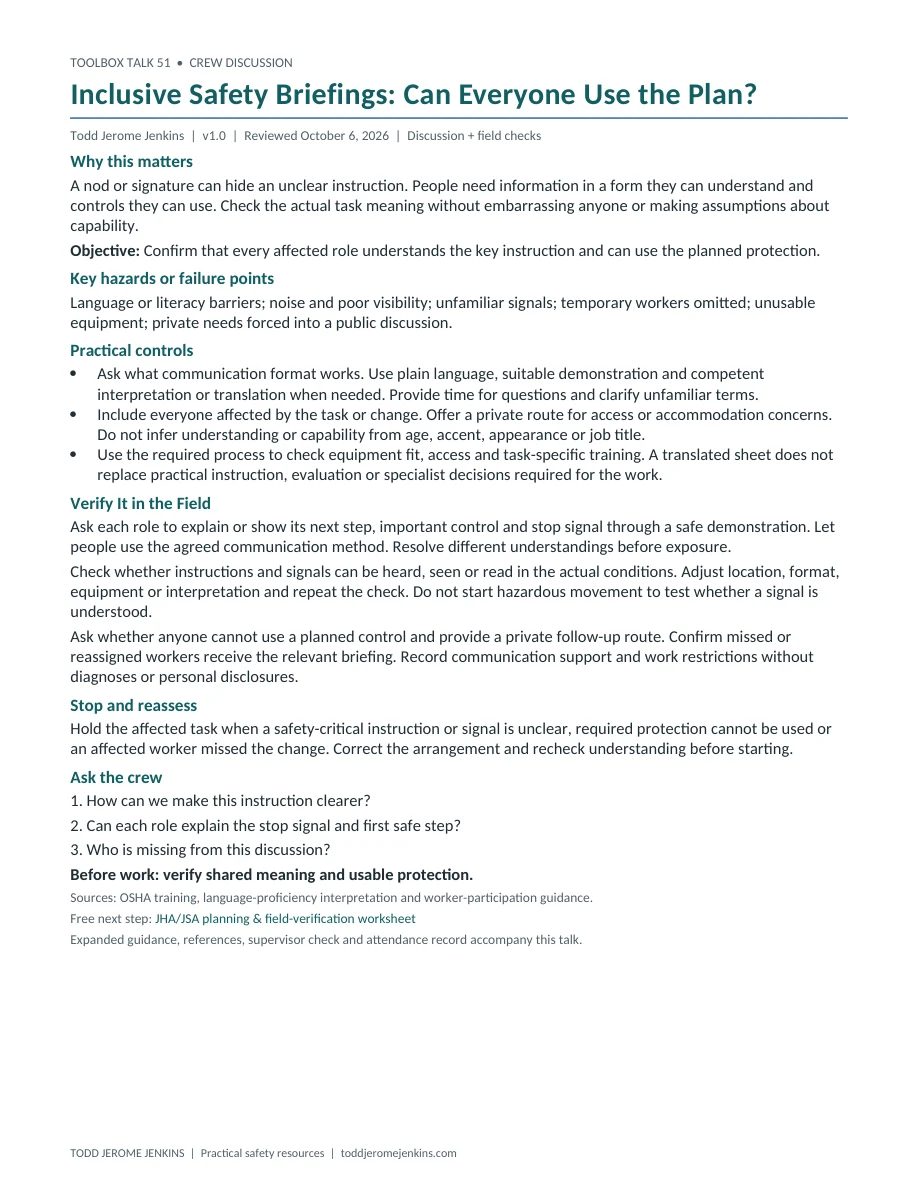
A 5–10 minute crew discussion, plus the time needed for field verification. All six downloads are free without a required signup.
Why this matters
A nod or signature can hide an unclear instruction. People need information in a form they can understand and controls they can use. Check the actual task meaning without embarrassing anyone or making assumptions about capability.
Learning objective: Confirm that every affected role understands the key instruction and can use the planned protection.
Key hazards or failure points
Language or literacy barriers; noise and poor visibility; unfamiliar signals; temporary workers omitted; unusable equipment; private needs forced into a public discussion.
Practical controls
- Ask what communication format works. Use plain language, suitable demonstration and competent interpretation or translation when needed. Provide time for questions and clarify unfamiliar terms.
- Include everyone affected by the task or change. Offer a private route for access or accommodation concerns. Do not infer understanding or capability from age, accent, appearance or job title.
- Use the required process to check equipment fit, access and task-specific training. A translated sheet does not replace practical instruction, evaluation or specialist decisions required for the work.
Verify It in the Field
Ask each role to explain or show its next step, important control and stop signal through a safe demonstration. Let people use the agreed communication method. Resolve different understandings before exposure.
Check whether instructions and signals can be heard, seen or read in the actual conditions. Adjust location, format, equipment or interpretation and repeat the check. Do not start hazardous movement to test whether a signal is understood.
Ask whether anyone cannot use a planned control and provide a private follow-up route. Confirm missed or reassigned workers receive the relevant briefing. Record communication support and work restrictions without diagnoses or personal disclosures.
Use the separate field check to record the source and criterion, safe method, checker, actual result and time. Mark VERIFIED, HOLD/NOT VERIFIED, or N/A with a reason. Check every required control; the examples below do not clear the whole task.
| Control | Safe verification | Evidence to record |
|---|---|---|
| Shared understanding | Each role explains its key action/control through a safe method. | Meaning confirmed and remaining instruction gap. |
| Usable communication | Check signals and instructions under actual conditions without exposure. | Format, conditions and result. |
| Complete participation | Match affected roles and changes with the briefing record. | Rebriefs, support provided and private follow-up owner. |
Stop and reassess
Hold the affected task when a safety-critical instruction or signal is unclear, required protection cannot be used or an affected worker missed the change. Correct the arrangement and recheck understanding before starting.
Crew discussion questions
- How can we make this instruction clearer?
- Can each role explain the stop signal and first safe step?
- Who is missing from this discussion?
Before work: verify shared meaning and usable protection.
A situation to discuss
Illustrative situation: the translated task sheet is accurate, but a new worker does not recognize the radio stop signal. The crew agrees a reliable method and rehearses it without movement. The leader rechecks the meaning before the task begins.
Leader preparation and practical detail
Check meaning rather than fluency
Ask people to explain the specific action and protection in their own words or demonstrate safely. The point is to discover what the briefing failed to make clear, not to test confidence or English fluency. OSHA’s construction interpretation explains that understandable training and a reliable communication system matter; English itself is not a universal requirement. [1], [2]
Include the people affected by the change
A briefing can miss temporary workers, another employer’s crew, late arrivals or someone changing roles. Identify who is exposed or responsible for a control and ensure the relevant information reaches them. Remove participation barriers such as inaccessible timing, unexplained terms or a format people cannot use. [3]
Keep personal needs private
Workers should be able to raise a problem using the protection without having to explain a diagnosis to the crew. Route individual concerns through the appropriate process and check the resulting task arrangement. A general briefing does not replace fit testing, operator evaluation, accommodation decisions or required technical training.
Short supervisor field check
- All affected roles included.
- Language, literacy and access barriers addressed.
- Safe demonstration confirms task meaning.
- Required controls usable under actual conditions.
- Private concern route and rebrief process known.
Use the separate form to document evidence, restrictions, corrective-action owner, recheck and required restart approval. An unresolved required control means hold the affected work. Missing evidence is not a pass. Complete all task-specific inspections and permits.
Attendance and follow-through
The separate attendance sheet records participants, language support, questions, actions and late-arrival rebriefs. Attendance does not establish competence or prove controls function. Keep completed records private under the employer’s procedures.
Technical scope and references
This is communication and participation guidance. It is not a capability judgment or a substitute for required training, evaluation, fit testing or accommodation assessment. Apply the specific standards and employer processes relevant to the work. [1], [2], [3]
References checked October 6, 2026. Apply the jurisdiction, task, employer program and equipment instructions that govern the work. No site-specific manual, permit, engineering determination or product SDS has been approved by this general resource.
- OSHA Recommended Practices — Education and Training — Recommended practices. Topic-specific mandatory training still applies.
- OSHA interpretation — English language proficiency at construction sites — Construction interpretation, read alongside applicable specific standards; no substitute for competent translation or required training.
- OSHA Recommended Practices — Worker Participation — Recommended program practice; legal anti-retaliation protections separately discussed on page. Do not claim unlimited statutory refusal rights.
Connect this discussion to your JHA/JSA
Use How to Conduct a Job Safety Analysis to connect today’s work steps, hazards and controls. Revisit Pre-Job JHA/JSA: What Changed Today? whenever conditions change.
Related Todd Jerome Jenkins article: Learning Teams in Workplace Safety.
Related Todd Jerome Jenkins video: Job Safety Analysis: A Basic Overview.
Related published crew resources: New to the Job: Show the Work Before You Start; Human Performance: Make the Next Step Clearer; Learning Teams: Ask What Makes Work Difficult.
Put one check into practice
Download the free JHA/JSA planning and field-verification worksheet. For today’s task, record an important control, its source and the evidence needed before exposure. Complete the remaining required checks through your task plan.