Download the free crew talk
The one-page talk, editable Word version, and guidance below are open to everyone. No account required.
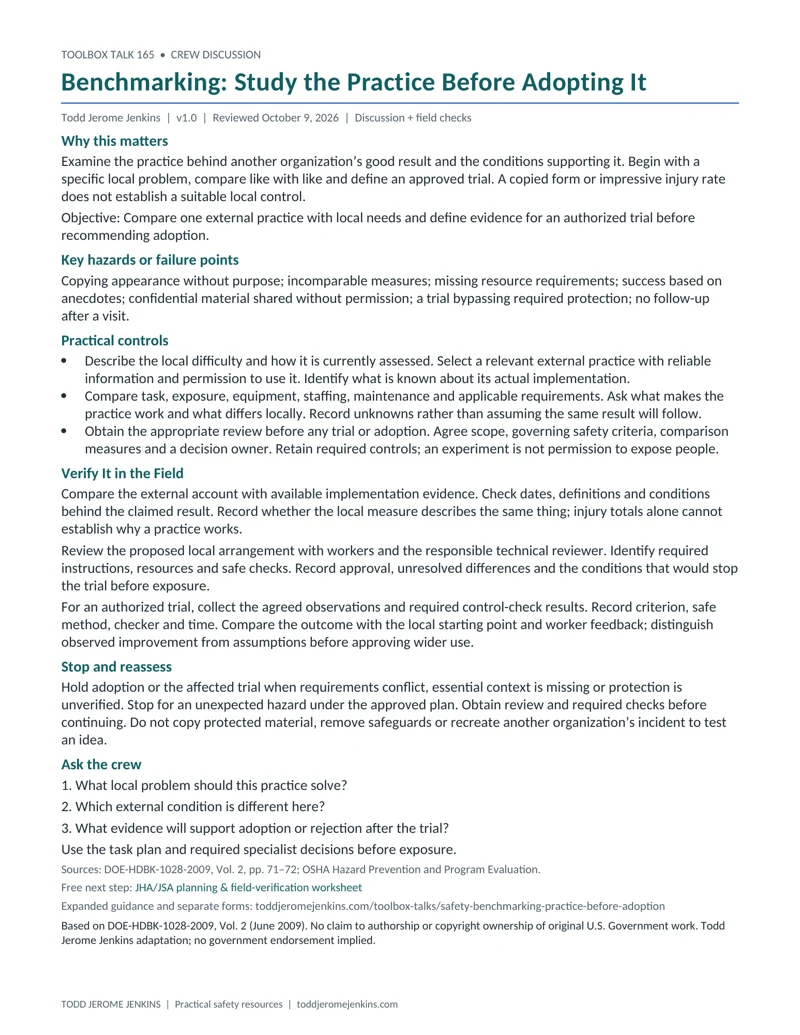
Preview the one-page crew talk
Supporting documents
Included with free Safety & Systems membership.
Supervisor field check
A separate check to verify conditions and controls before work. Includes a one-page PDF and editable Word file.
Attendance sheet
A separate sign-in sheet to record the crew discussion. Includes a one-page PDF and editable Word file.
Need the crew records? Join free to use these supporting documents and the Safety & Systems Academy. No payment details. Email updates are optional.
Get supporting documents — free membershipAlready a member? Use the same link to sign in.
Human Performance weekly series: lesson 42 of 52.
A 5–10 minute crew discussion, plus time to verify the actual controls. The crew talk and Word version are public. Separate supervisor and attendance records are included with free Safety & Systems membership.
Why this matters
Examine the practice behind another organization’s good result and the conditions supporting it. Begin with a specific local problem, compare like with like and define an approved trial. A copied form or impressive injury rate does not establish a suitable local control.
Learning objective
Compare one external practice with local needs and define evidence for an authorized trial before recommending adoption.
Key hazards or failure points
Copying appearance without purpose; incomparable measures; missing resource requirements; success based on anecdotes; confidential material shared without permission; a trial bypassing required protection; no follow-up after a visit.
Practical controls
- Describe the local difficulty and how it is currently assessed. Select a relevant external practice with reliable information and permission to use it. Identify what is known about its actual implementation.
- Compare task, exposure, equipment, staffing, maintenance and applicable requirements. Ask what makes the practice work and what differs locally. Record unknowns rather than assuming the same result will follow.
- Obtain the appropriate review before any trial or adoption. Agree scope, governing safety criteria, comparison measures and a decision owner. Retain required controls; an experiment is not permission to expose people.
Verify It in the Field
- Compare the external account with available implementation evidence. Check dates, definitions and conditions behind the claimed result. Record whether the local measure describes the same thing; injury totals alone cannot establish why a practice works.
- Review the proposed local arrangement with workers and the responsible technical reviewer. Identify required instructions, resources and safe checks. Record approval, unresolved differences and the conditions that would stop the trial before exposure.
- For an authorized trial, collect the agreed observations and required control-check results. Record criterion, safe method, checker and time. Compare the outcome with the local starting point and worker feedback; distinguish observed improvement from assumptions before approving wider use.
Stop and reassess
Hold adoption or the affected trial when requirements conflict, essential context is missing or protection is unverified. Stop for an unexpected hazard under the approved plan. Obtain review and required checks before continuing. Do not copy protected material, remove safeguards or recreate another organization’s incident to test an idea.
Crew discussion questions
- What local problem should this practice solve?
- Which external condition is different here?
- What evidence will support adoption or rejection after the trial?
For each required control, record its acceptance source and criterion, safe verification method, responsible checker, actual result and time. Use VERIFIED, HOLD/NOT VERIFIED, or N/A with a reason. A tick alone is not evidence. Complete all applicable task inspections; do not enter danger or improvise a test to fill out a form.
Leader preparation and practical detail
Study the arrangement behind the attractive form
Illustrative situation: another site completes a readiness checklist quickly. A visit reveals that its tools are staged together and a specialist is available at the start of each shift. Copying the checklist alone would omit the support that makes it usable. Compare the underlying task and resources, then decide what local change is practical and authorized. The useful output may be a planning improvement rather than a new form.
Make the comparison understandable
If one organization counts all open corrective actions and another counts only overdue actions, their totals answer different questions. Record the definition, period, work scope and exclusions before comparing results. Seek evidence about how the practice operates rather than ranking organizations from a single number. Use the Operating Experience lesson when screening an individual event or alert; benchmarking studies a selected ongoing practice and its implementation.
Define a trial that preserves protection
Agree who approves the trial, what is being assessed and what result would support adoption. Begin with a paper review or other safe method when that can resolve the question. Any field trial needs the task’s required technical review, safeguards, competence and release process. Collect useful observations, ask workers about new difficulties and communicate the decision. A trial that reveals poor fit is valuable information; it is not a reason to hide the finding.
Short supervisor field check
- Specific local problem and starting evidence are defined.
- External practice and supporting information are credible and authorized.
- Important differences and comparable measures are documented.
- Trial has approval, required protection and stop criteria.
- Results and worker feedback support a recorded adoption decision.
Confirm the relevant trained/authorized people, unresolved items, interim protection, correction owner and recheck. Record required release authority and rebrief anyone affected. The separate sheet supports these records; it does not replace a specialist inspection, permit or engineering determination.
Attendance and follow-through
Use the separate attendance sheet for participants, roles, discussion concerns, actions and late-arrival rebriefs. Attendance is not proof of competence, functioning controls or authorization to work. Keep completed records private under employer procedures.
Source acknowledgment
This resource draws on the U.S. Department of Energy’s DOE-HDBK-1028-2009, Human Performance Improvement Handbook, Volume 2 (June 2009). Todd Jerome Jenkins makes no claim of authorship or copyright ownership in the original U.S. Government work. New explanations, examples, exercises and layouts are Todd Jerome Jenkins adaptations. No endorsement by DOE or the U.S. Government is implied. Third-party material credited in the handbook remains attributed to its source; this notice does not claim rights in that material.
Source excerpt: Volume 2/VOLUME 2 BENCHMARKING.pdf; Printed pp. 71, 72. The June 2009 handbook supplies concepts; this lesson uses original explanations and exercises.
Technical scope and references
References reviewed October 9, 2026. DOE human-performance tools and OSHA recommended practices support preparation and discussion; they do not establish universal technical acceptance criteria. Apply the current task procedure, manufacturer instructions, permit and required competent or qualified decisions. A successful exercise does not replace required training, technical verification or work authorization.
- DOE-HDBK-1028-2009, Volume 2 — Benchmarking — June 2009 guidance, printed pages 71–72: define a local problem, study comparable processes, use authorized exchange and account for differences before implementation. Original trial/evidence exercise; no unsupported best-in-class designation.
- OSHA — Hazard Prevention and Control — Recommended practices, action items 1, 2 and 6: evaluate controls used elsewhere, assess local suitability and verify effectiveness.
- OSHA — Program Evaluation and Improvement — Recommended practices: define useful indicators, compare information appropriately and involve workers in evaluating improvements.
Connect this discussion to your JHA/JSA
Use the JHA/JSA planning and field-verification worksheet to record the actual task steps, hazards, responsible roles and controls. No task-specific worked example is linked for this topic yet. Return to What Changed Today? when the plan or conditions change.
Related Todd Jerome Jenkins articles: How to Conduct a Job Safety Analysis and What Is Human and Organizational Performance?.
Related crew discussions
- Operating Experience: Does the Lesson Fit This Job?
- Problem Solving: Test the Explanation Before the Fix
Continue the weekly series
- Lesson 41: Change Management: Verify Readiness Before the Switch
- Lesson 43: Build the Job to Tolerate a Mistake
Put one check into practice
Use the free JHA/JSA planning and field-verification worksheet to record today’s change, the required protection and the evidence needed before exposure.