Download the free crew talk
The one-page talk, editable Word version, and guidance below are open to everyone. No account required.
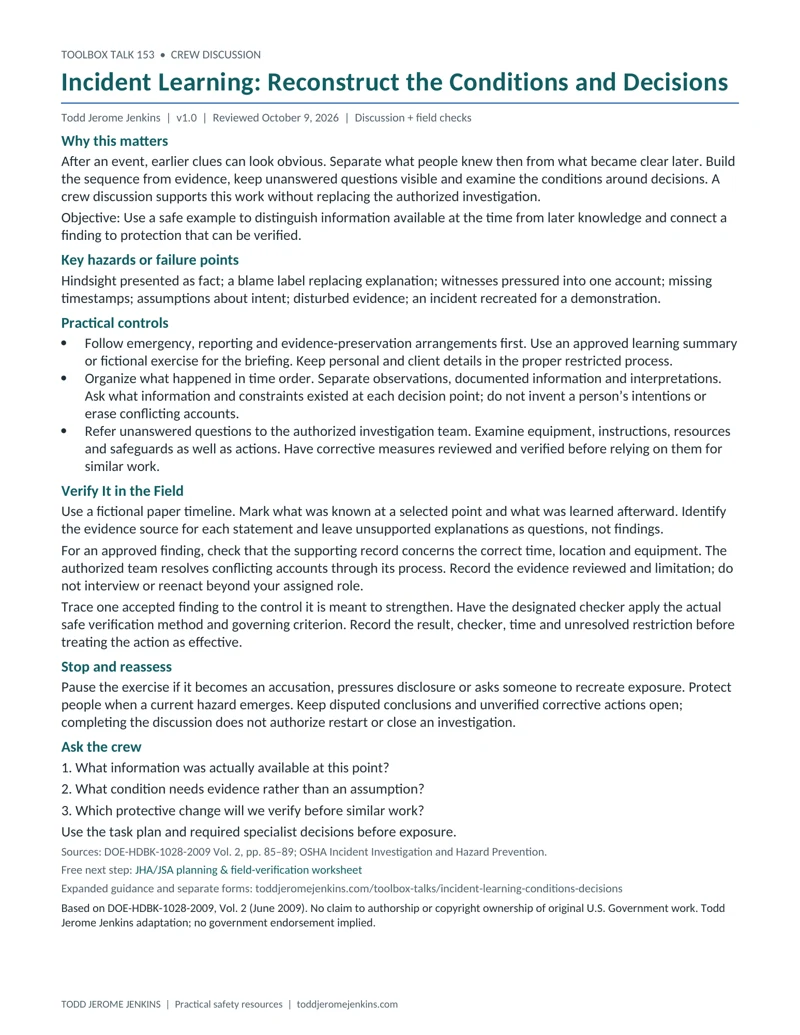
Preview the one-page crew talk
Supporting documents
Included with free Safety & Systems membership.
Supervisor field check
A separate check to verify conditions and controls before work. Includes a one-page PDF and editable Word file.
Attendance sheet
A separate sign-in sheet to record the crew discussion. Includes a one-page PDF and editable Word file.
Need the crew records? Join free to use these supporting documents and the Safety & Systems Academy. No payment details. Email updates are optional.
Get supporting documents — free membershipAlready a member? Use the same link to sign in.
Human Performance weekly series: lesson 30 of 52.
A 5–10 minute crew discussion, plus time to verify the actual controls. The crew talk and Word version are public. Separate supervisor and attendance records are included with free Safety & Systems membership.
Why this matters
After an event, earlier clues can look obvious. Separate what people knew then from what became clear later. Build the sequence from evidence, keep unanswered questions visible and examine the conditions around decisions. A crew discussion supports this work without replacing the authorized investigation.
Learning objective
Use a safe example to distinguish information available at the time from later knowledge and connect a finding to protection that can be verified.
Key hazards or failure points
Hindsight presented as fact; a blame label replacing explanation; witnesses pressured into one account; missing timestamps; assumptions about intent; disturbed evidence; an incident recreated for a demonstration.
Practical controls
- Follow emergency, reporting and evidence-preservation arrangements first. Use an approved learning summary or fictional exercise for the briefing. Keep personal and client details in the proper restricted process.
- Organize what happened in time order. Separate observations, documented information and interpretations. Ask what information and constraints existed at each decision point; do not invent a person’s intentions or erase conflicting accounts.
- Refer unanswered questions to the authorized investigation team. Examine equipment, instructions, resources and safeguards as well as actions. Have corrective measures reviewed and verified before relying on them for similar work.
Verify It in the Field
- Use a fictional paper timeline. Mark what was known at a selected point and what was learned afterward. Identify the evidence source for each statement and leave unsupported explanations as questions, not findings.
- For an approved finding, check that the supporting record concerns the correct time, location and equipment. The authorized team resolves conflicting accounts through its process. Record the evidence reviewed and limitation; do not interview or reenact beyond your assigned role.
- Trace one accepted finding to the control it is meant to strengthen. Have the designated checker apply the actual safe verification method and governing criterion. Record the result, checker, time and unresolved restriction before treating the action as effective.
Stop and reassess
Pause the exercise if it becomes an accusation, pressures disclosure or asks someone to recreate exposure. Protect people when a current hazard emerges. Keep disputed conclusions and unverified corrective actions open; completing the discussion does not authorize restart or close an investigation.
Crew discussion questions
- What information was actually available at this point?
- What condition needs evidence rather than an assumption?
- Which protective change will we verify before similar work?
For each required control, record its acceptance source and criterion, safe verification method, responsible checker, actual result and time. Use VERIFIED, HOLD/NOT VERIFIED, or N/A with a reason. A tick alone is not evidence. Complete all applicable task inspections; do not enter danger or improvise a test to fill out a form.
Leader preparation and practical detail
Build the timeline without supplying the answer
Illustrative situation: a final report shows that a status message arrived after a worker had already made a decision. A discussion that assumes the message was available beforehand changes the meaning of the decision. Preserve the sequence and identify the source and timing of each statement. A paper exercise can demonstrate this distinction without asking workers to reenact the event. Where records disagree, the authorized investigation team resolves the uncertainty; the briefing should not manufacture a complete story.
Understand the conditions without assuming every action was reasonable
Examine what the person could perceive, the instruction available, the resources provided and the competing demands documented at the time. Do not infer intent, excuse a missing control or predetermine a misconduct finding. OSHA encourages investigation beyond immediate causes and fault labels. A useful explanation can include several contributing conditions. This resource does not adopt the archive’s universal claims about human error or prescribe interviewing people before reviewing evidence; use the organization’s qualified investigation process.
Connect the explanation to a changed protection
Illustrative situation: an investigation identifies delayed status information, but the proposed response only tells workers to pay more attention. Ask which approved change will make the needed information available at the decision point and how its operation will be checked. The existing Learning from Incidents talk covers verifying corrective actions in greater detail. This lesson concentrates on building the evidence and context that support a useful finding; it does not replace formal investigation, required reporting or restart approval.
Short supervisor field check
- Approved summary or fictional exercise protects privacy and evidence.
- Timeline separates information available then from later knowledge.
- Evidence, interpretation and unresolved accounts kept distinct.
- Questions routed to the authorized investigation team.
- Accepted finding linked to an approved control and actual verification result.
Confirm the relevant trained/authorized people, unresolved items, interim protection, correction owner and recheck. Record required release authority and rebrief anyone affected. The separate sheet supports these records; it does not replace a specialist inspection, permit or engineering determination.
Attendance and follow-through
Use the separate attendance sheet for participants, roles, discussion concerns, actions and late-arrival rebriefs. Attendance is not proof of competence, functioning controls or authorization to work. Keep completed records private under employer procedures.
Source acknowledgment
This resource draws on the U.S. Department of Energy’s DOE-HDBK-1028-2009, Human Performance Improvement Handbook, Volume 2 (June 2009). Todd Jerome Jenkins makes no claim of authorship or copyright ownership in the original U.S. Government work. New explanations, examples, exercises and layouts are Todd Jerome Jenkins adaptations. No endorsement by DOE or the U.S. Government is implied. Third-party material credited in the handbook remains attributed to its source; this notice does not claim rights in that material.
Source excerpt: Volume 2/VOLUME 2 INVESTIGATING EVENTS TRIGGERED BY HUMAN ERROR.pdf; Printed pp. 85, 86, 87, 88, 89. The June 2009 handbook supplies concepts; this lesson uses original explanations and exercises.
Technical scope and references
References reviewed October 9, 2026. DOE human-performance tools and OSHA recommended practices support preparation and discussion; they do not establish universal technical acceptance criteria. Apply the current task procedure, manufacturer instructions, permit and required competent or qualified decisions. A successful exercise does not replace required training, technical verification or work authorization.
- DOE-HDBK-1028-2009, Volume 2 — Investigating Events Triggered by Human Error, printed pp. 85–89 — June 2009 historical context source. Original questions and scenarios; source diagram, categorical human-error claims and prescribed interview-before-evidence sequence not reproduced.
- OSHA — Incident Investigation — Current guidance on examining underlying conditions, worker/management perspectives and corrective action beyond fault labels.
- OSHA — Hazard Prevention and Control — Current recommended practices supporting approved corrective controls and verification of effectiveness.
Connect this discussion to your JHA/JSA
Use the JHA/JSA planning and field-verification worksheet to record the actual task steps, hazards, responsible roles and controls. No task-specific worked example is linked for this topic yet. Return to What Changed Today? when the plan or conditions change.
Related Todd Jerome Jenkins articles: How to Conduct a Job Safety Analysis and What Is Human and Organizational Performance?.
Related crew discussions
Continue the weekly series
- Lesson 29: Safety Indicators: What Are the Conditions Telling Us?
- Lesson 31: Planning Questions: What Could Make This Plan Wrong?
Put one check into practice
Use the free JHA/JSA planning and field-verification worksheet to record today’s change, the required protection and the evidence needed before exposure.