Download the free crew talk
The one-page talk, editable Word version, and guidance below are open to everyone. No account required.
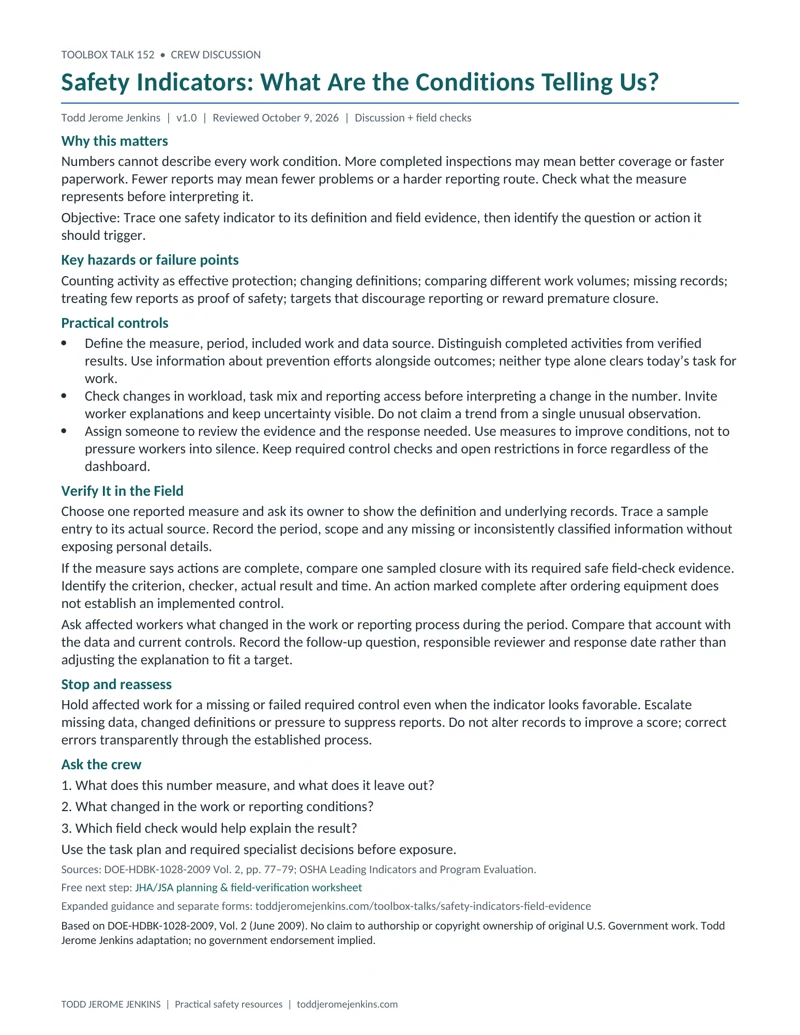
Preview the one-page crew talk
Supporting documents
Included with free Safety & Systems membership.
Supervisor field check
A separate check to verify conditions and controls before work. Includes a one-page PDF and editable Word file.
Attendance sheet
A separate sign-in sheet to record the crew discussion. Includes a one-page PDF and editable Word file.
Need the crew records? Join free to use these supporting documents and the Safety & Systems Academy. No payment details. Email updates are optional.
Get supporting documents — free membershipAlready a member? Use the same link to sign in.
Human Performance weekly series: lesson 29 of 52.
A 5–10 minute crew discussion, plus time to verify the actual controls. The crew talk and Word version are public. Separate supervisor and attendance records are included with free Safety & Systems membership.
Why this matters
Numbers cannot describe every work condition. More completed inspections may mean better coverage or faster paperwork. Fewer reports may mean fewer problems or a harder reporting route. Check what the measure represents before interpreting it.
Learning objective
Trace one safety indicator to its definition and field evidence, then identify the question or action it should trigger.
Key hazards or failure points
Counting activity as effective protection; changing definitions; comparing different work volumes; missing records; treating few reports as proof of safety; targets that discourage reporting or reward premature closure.
Practical controls
- Define the measure, period, included work and data source. Distinguish completed activities from verified results. Use information about prevention efforts alongside outcomes; neither type alone clears today’s task for work.
- Check changes in workload, task mix and reporting access before interpreting a change in the number. Invite worker explanations and keep uncertainty visible. Do not claim a trend from a single unusual observation.
- Assign someone to review the evidence and the response needed. Use measures to improve conditions, not to pressure workers into silence. Keep required control checks and open restrictions in force regardless of the dashboard.
Verify It in the Field
- Choose one reported measure and ask its owner to show the definition and underlying records. Trace a sample entry to its actual source. Record the period, scope and any missing or inconsistently classified information without exposing personal details.
- If the measure says actions are complete, compare one sampled closure with its required safe field-check evidence. Identify the criterion, checker, actual result and time. An action marked complete after ordering equipment does not establish an implemented control.
- Ask affected workers what changed in the work or reporting process during the period. Compare that account with the data and current controls. Record the follow-up question, responsible reviewer and response date rather than adjusting the explanation to fit a target.
Stop and reassess
Hold affected work for a missing or failed required control even when the indicator looks favorable. Escalate missing data, changed definitions or pressure to suppress reports. Do not alter records to improve a score; correct errors transparently through the established process.
Crew discussion questions
- What does this number measure, and what does it leave out?
- What changed in the work or reporting conditions?
- Which field check would help explain the result?
For each required control, record its acceptance source and criterion, safe verification method, responsible checker, actual result and time. Use VERIFIED, HOLD/NOT VERIFIED, or N/A with a reason. A tick alone is not evidence. Complete all applicable task inspections; do not enter danger or improvise a test to fill out a form.
Leader preparation and practical detail
An improved total can hide an unfinished control
Illustrative situation: the completed-action count rises because several equipment orders are marked closed. The receiving crew still lacks the equipment and its required checks. Define whether the measure counts administrative progress or controls actually implemented. Both may be useful when labeled correctly, but they answer different questions. Trace a sample to the field result before presenting it as evidence of protection. Do not infer that all actions are effective from one favorable sample.
Study a change in reports before celebrating or blaming
Illustrative situation: reports drop after the submission form becomes harder to access. The count alone cannot show whether exposure changed. Examine the reporting route, work performed and worker accounts. Conversely, an increase may reflect greater access or trust as well as more problems. These are possibilities to investigate, not automatic conclusions. Keep protecting people and responding to individual concerns while the data owner examines the wider picture.
Treat indicators as prompts for decisions
OSHA distinguishes measures of prevention activity from past outcomes and recommends using both. Choose a measure because it helps answer an important work question, then check data quality and field meaning. Complex or sparse data may require statistical help; this briefing supplies no trend threshold, scoring scale or predictive guarantee. The aim is a useful response, such as verifying overdue controls or improving a reporting process, rather than meeting a number without improving conditions.
Short supervisor field check
- Measure definition, period, scope and owner identified.
- Sample entry traceable to an accurate underlying record.
- Workload, task mix and reporting changes considered.
- Sampled control result checked separately from activity counts.
- Response assigned without discouraging reporting or premature closure.
Confirm the relevant trained/authorized people, unresolved items, interim protection, correction owner and recheck. Record required release authority and rebrief anyone affected. The separate sheet supports these records; it does not replace a specialist inspection, permit or engineering determination.
Attendance and follow-through
Use the separate attendance sheet for participants, roles, discussion concerns, actions and late-arrival rebriefs. Attendance is not proof of competence, functioning controls or authorization to work. Keep completed records private under employer procedures.
Source acknowledgment
This resource draws on the U.S. Department of Energy’s DOE-HDBK-1028-2009, Human Performance Improvement Handbook, Volume 2 (June 2009). Todd Jerome Jenkins makes no claim of authorship or copyright ownership in the original U.S. Government work. New explanations, examples, exercises and layouts are Todd Jerome Jenkins adaptations. No endorsement by DOE or the U.S. Government is implied. Third-party material credited in the handbook remains attributed to its source; this notice does not claim rights in that material.
Source excerpt: Volume 2/VOLUME 2 PERFORMANCE INDICATORS.pdf; Printed pp. 77, 78, 79. The June 2009 handbook supplies concepts; this lesson uses original explanations and exercises.
Technical scope and references
References reviewed October 9, 2026. DOE human-performance tools and OSHA recommended practices support preparation and discussion; they do not establish universal technical acceptance criteria. Apply the current task procedure, manufacturer instructions, permit and required competent or qualified decisions. A successful exercise does not replace required training, technical verification or work authorization.
- DOE-HDBK-1028-2009, Volume 2 — Performance Indicators, printed pp. 77–79 — June 2009 illustrative measurement guidance. Historical rates, fixed scoring examples and deterministic predictions omitted.
- OSHA — Leading Indicators — Current overview of preventive indicators and past-outcome measures; indicators do not replace task-level verification.
- OSHA — Program Evaluation and Improvement — Current recommended practices on collecting, reviewing and sharing indicators with worker involvement.
Connect this discussion to your JHA/JSA
Use the JHA/JSA planning and field-verification worksheet to record the actual task steps, hazards, responsible roles and controls. No task-specific worked example is linked for this topic yet. Return to What Changed Today? when the plan or conditions change.
Related Todd Jerome Jenkins articles: How to Conduct a Job Safety Analysis and What Is Human and Organizational Performance?.
Related crew discussions
Continue the weekly series
- Lesson 28: Self-Assessment: Compare the Plan with Real Work
- Lesson 30: Incident Learning: Reconstruct the Conditions and Decisions
Put one check into practice
Use the free JHA/JSA planning and field-verification worksheet to record today’s change, the required protection and the evidence needed before exposure.