Download the free crew talk
The one-page talk, editable Word version, and guidance below are open to everyone. No account required.
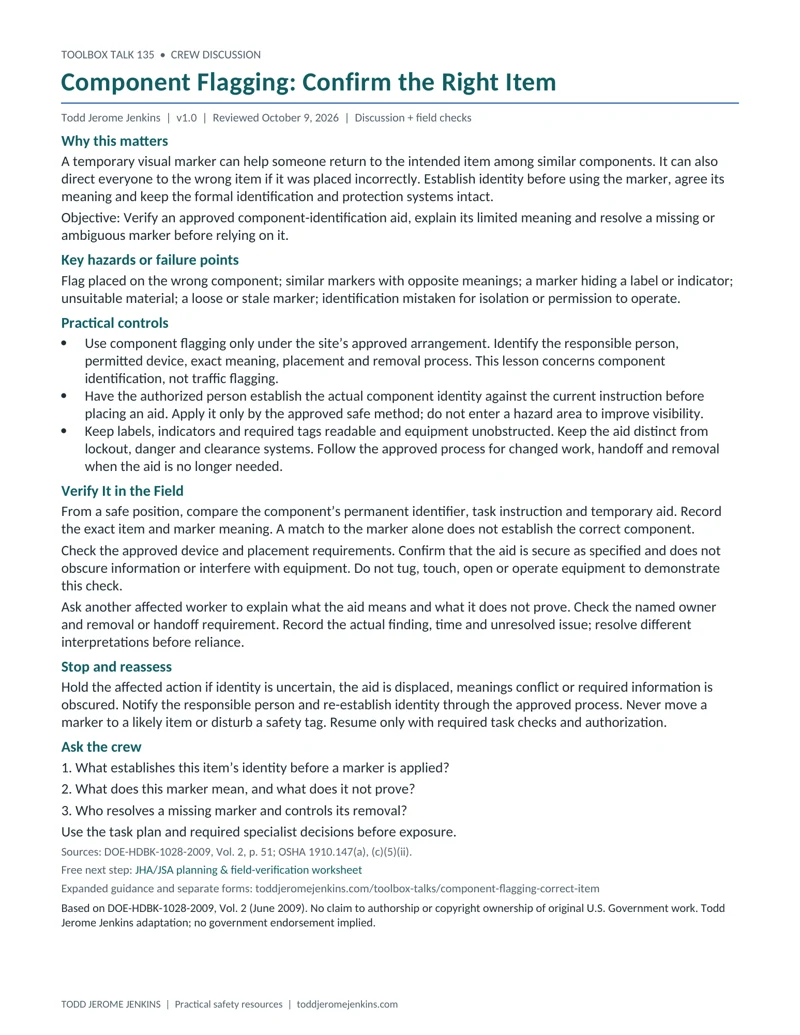
Preview the one-page crew talk
Supporting documents
Included with free Safety & Systems membership.
Supervisor field check
A separate check to verify conditions and controls before work. Includes a one-page PDF and editable Word file.
Attendance sheet
A separate sign-in sheet to record the crew discussion. Includes a one-page PDF and editable Word file.
Need the crew records? Join free to use these supporting documents and the Safety & Systems Academy. No payment details. Email updates are optional.
Get supporting documents — free membershipAlready a member? Use the same link to sign in.
Human Performance weekly series: lesson 12 of 52.
A 5–10 minute crew discussion, plus time to verify the actual controls. The crew talk and Word version are public. Separate supervisor and attendance records are included with free Safety & Systems membership.
Why this matters
A temporary visual marker can help someone return to the intended item among similar components. It can also direct everyone to the wrong item if it was placed incorrectly. Establish identity before using the marker, agree its meaning and keep the formal identification and protection systems intact.
Learning objective
Verify an approved component-identification aid, explain its limited meaning and resolve a missing or ambiguous marker before relying on it.
Key hazards or failure points
Flag placed on the wrong component; similar markers with opposite meanings; a marker hiding a label or indicator; unsuitable material; a loose or stale marker; identification mistaken for isolation or permission to operate.
Practical controls
- Use component flagging only under the site’s approved arrangement. Identify the responsible person, permitted device, exact meaning, placement and removal process. This lesson concerns component identification, not traffic flagging.
- Have the authorized person establish the actual component identity against the current instruction before placing an aid. Apply it only by the approved safe method; do not enter a hazard area to improve visibility.
- Keep labels, indicators and required tags readable and equipment unobstructed. Keep the aid distinct from lockout, danger and clearance systems. Follow the approved process for changed work, handoff and removal when the aid is no longer needed.
Verify It in the Field
- From a safe position, compare the component’s permanent identifier, task instruction and temporary aid. Record the exact item and marker meaning. A match to the marker alone does not establish the correct component.
- Check the approved device and placement requirements. Confirm that the aid is secure as specified and does not obscure information or interfere with equipment. Do not tug, touch, open or operate equipment to demonstrate this check.
- Ask another affected worker to explain what the aid means and what it does not prove. Check the named owner and removal or handoff requirement. Record the actual finding, time and unresolved issue; resolve different interpretations before reliance.
Stop and reassess
Hold the affected action if identity is uncertain, the aid is displaced, meanings conflict or required information is obscured. Notify the responsible person and re-establish identity through the approved process. Never move a marker to a likely item or disturb a safety tag. Resume only with required task checks and authorization.
Crew discussion questions
- What establishes this item’s identity before a marker is applied?
- What does this marker mean, and what does it not prove?
- Who resolves a missing marker and controls its removal?
For each required control, record its acceptance source and criterion, safe verification method, responsible checker, actual result and time. Use VERIFIED, HOLD/NOT VERIFIED, or N/A with a reason. A tick alone is not evidence. Complete all applicable task inspections; do not enter danger or improvise a test to fill out a form.
Leader preparation and practical detail
Two similar components, one misplaced aid
Illustrative situation: a temporary marker appears on the neighboring item. Keep the action held while the designated person compares permanent identification with the current task instruction. Do not treat the earlier installer’s confidence as evidence of a match. After authorized correction, repeat the identity check and tell the affected crew what changed. Preserve the underlying concern for review: indistinguishable labels or a poor work layout may need a more durable improvement.
Keep identification separate from energy control
Component flagging supports recognition; it does not establish deenergization, isolation, clearance or permission to operate. For general-industry servicing covered by OSHA 1910.147, paragraph (c)(5)(ii) reserves lockout/tagout devices for energy control and prohibits their use for other purposes. Do not borrow those devices as identification aids. That standard excludes construction; use the applicable industry requirements and employer program. Required locks and tags remain under their own authorized placement and removal process.
Check the aid through its whole use
An aid can become misleading when a task changes or a crew leaves. Establish who checks it during handoff and who removes it through the approved process. Review whether its material, attachment and location suit the equipment and environment without creating interference. Do not assume tape, ribbon or a placard is suitable simply because it is readily available. The site and equipment requirements determine what may be used.
Short supervisor field check
- Site-approved flagging purpose, device and responsible person identified.
- Permanent identifier and current instruction establish the correct item.
- Placement is safe, secure as specified and does not interfere.
- Meaning is shared and distinct from required protection or tags.
- Handoff, removal and discrepancy response are assigned.
Confirm the relevant trained/authorized people, unresolved items, interim protection, correction owner and recheck. Record required release authority and rebrief anyone affected. The separate sheet supports these records; it does not replace a specialist inspection, permit or engineering determination.
Attendance and follow-through
Use the separate attendance sheet for participants, roles, discussion concerns, actions and late-arrival rebriefs. Attendance is not proof of competence, functioning controls or authorization to work. Keep completed records private under employer procedures.
Source acknowledgment
This resource draws on the U.S. Department of Energy’s DOE-HDBK-1028-2009, Human Performance Improvement Handbook, Volume 2 (June 2009). Todd Jerome Jenkins makes no claim of authorship or copyright ownership in the original U.S. Government work. New explanations, examples, exercises and layouts are Todd Jerome Jenkins adaptations. No endorsement by DOE or the U.S. Government is implied. Third-party material credited in the handbook remains attributed to its source; this notice does not claim rights in that material.
Source excerpt: Volume 2/VOLUME 2 FLAGGING.pdf; Printed pp. 51. The June 2009 handbook supplies concepts; this lesson uses original explanations and exercises.
Technical scope and references
References reviewed October 9, 2026. DOE human-performance tools and OSHA recommended practices support preparation and discussion; they do not establish universal technical acceptance criteria. Apply the current task procedure, manufacturer instructions, permit and required competent or qualified decisions. A successful exercise does not replace required training, technical verification or work authorization.
- DOE-HDBK-1028-2009, Volume 2 — Flagging — June 2009 illustrative guidance, printed page 51: confirm identity before applying an approved aid, avoid interference or ambiguous meanings, and manage removal. No generic device list or touching practice is reproduced.
- OSHA — 29 CFR 1910.147 — Sections (a)(1)(ii)(A) and (c)(5)(ii): construction exclusion and exclusive energy-control purpose of lockout/tagout devices. This limited general-industry example is not a flagging approval or isolation procedure.
Connect this discussion to your JHA/JSA
Use the JHA/JSA planning and field-verification worksheet to record the actual task steps, hazards, responsible roles and controls. No task-specific worked example is linked for this topic yet. Return to What Changed Today? when the plan or conditions change.
Related Todd Jerome Jenkins articles: How to Conduct a Job Safety Analysis and What Is Human and Organizational Performance?.
Related crew discussions
- Self-Checking: Confirm the Item, Action and Result
- Similar-Sounding Identifiers: Say Exactly Which One
Continue the weekly series
- Lesson 11: Procedure Use: Stop When the Instructions Do Not Fit
- Lesson 13: Peer Checking: Agree the Action Before It Happens
Put one check into practice
Use the free JHA/JSA planning and field-verification worksheet to record today’s change, the required protection and the evidence needed before exposure.