Download the free crew talk
The one-page talk, editable Word version, and guidance below are open to everyone. No account required.
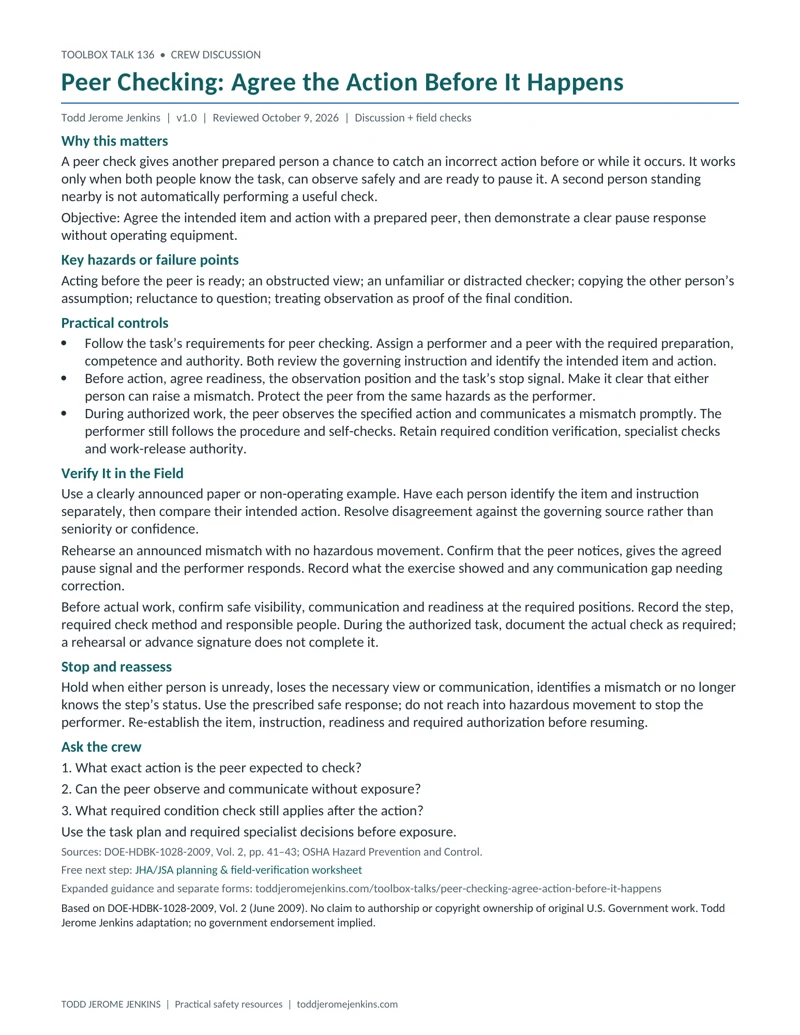
Preview the one-page crew talk
Supporting documents
Included with free Safety & Systems membership.
Supervisor field check
A separate check to verify conditions and controls before work. Includes a one-page PDF and editable Word file.
Attendance sheet
A separate sign-in sheet to record the crew discussion. Includes a one-page PDF and editable Word file.
Need the crew records? Join free to use these supporting documents and the Safety & Systems Academy. No payment details. Email updates are optional.
Get supporting documents — free membershipAlready a member? Use the same link to sign in.
Human Performance weekly series: lesson 13 of 52.
A 5–10 minute crew discussion, plus time to verify the actual controls. The crew talk and Word version are public. Separate supervisor and attendance records are included with free Safety & Systems membership.
Why this matters
A peer check gives another prepared person a chance to catch an incorrect action before or while it occurs. It works only when both people know the task, can observe safely and are ready to pause it. A second person standing nearby is not automatically performing a useful check.
Learning objective
Agree the intended item and action with a prepared peer, then demonstrate a clear pause response without operating equipment.
Key hazards or failure points
Acting before the peer is ready; an obstructed view; an unfamiliar or distracted checker; copying the other person’s assumption; reluctance to question; treating observation as proof of the final condition.
Practical controls
- Follow the task’s requirements for peer checking. Assign a performer and a peer with the required preparation, competence and authority. Both review the governing instruction and identify the intended item and action.
- Before action, agree readiness, the observation position and the task’s stop signal. Make it clear that either person can raise a mismatch. Protect the peer from the same hazards as the performer.
- During authorized work, the peer observes the specified action and communicates a mismatch promptly. The performer still follows the procedure and self-checks. Retain required condition verification, specialist checks and work-release authority.
Verify It in the Field
- Use a clearly announced paper or non-operating example. Have each person identify the item and instruction separately, then compare their intended action. Resolve disagreement against the governing source rather than seniority or confidence.
- Rehearse an announced mismatch with no hazardous movement. Confirm that the peer notices, gives the agreed pause signal and the performer responds. Record what the exercise showed and any communication gap needing correction.
- Before actual work, confirm safe visibility, communication and readiness at the required positions. Record the step, required check method and responsible people. During the authorized task, document the actual check as required; a rehearsal or advance signature does not complete it.
Stop and reassess
Hold when either person is unready, loses the necessary view or communication, identifies a mismatch or no longer knows the step’s status. Use the prescribed safe response; do not reach into hazardous movement to stop the performer. Re-establish the item, instruction, readiness and required authorization before resuming.
Crew discussion questions
- What exact action is the peer expected to check?
- Can the peer observe and communicate without exposure?
- What required condition check still applies after the action?
For each required control, record its acceptance source and criterion, safe verification method, responsible checker, actual result and time. Use VERIFIED, HOLD/NOT VERIFIED, or N/A with a reason. A tick alone is not evidence. Complete all applicable task inspections; do not enter danger or improvise a test to fill out a form.
Leader preparation and practical detail
The peer has a view but no task understanding
Illustrative situation: someone is assigned to watch a consequential action but cannot explain the intended sequence or possible mismatch. Address the preparation gap before work. The required peer needs enough task knowledge to recognize what would make the action wrong and the authority to intervene. A familiar face or job title alone is insufficient. Use the employer’s training and role requirements; this discussion does not qualify a new checker.
Practice the pause without creating a hazard
Use a photograph, paper identifier or inert training arrangement. Agree in advance that the exercise contains a mismatch and requests no operational action. Check whether the peer identifies it and whether the performer pauses. Do not inject a surprise fault into live work or direct someone to physically grab a moving control. For real work, the prescribed stop and safe-state response governs.
An observed action and a verified condition answer different questions
Peer checking focuses on whether the intended action is performed. Concurrent or independent verification, where specified, confirms a required condition through its prescribed method. Watching an action does not necessarily establish what condition resulted. Keep both requirements when the procedure calls for them. A successful peer check also does not remove the performer’s own responsibility to follow the instruction, or permit either person to authorize a step outside their role.
Short supervisor field check
- Performer and peer meet task-specific competence and role requirements.
- Both identify the intended item and action from governing instructions.
- Safe position, visibility, communication and readiness are confirmed.
- Non-operating rehearsal demonstrates effective mismatch and pause response.
- Actual peer check is recorded as required; remaining verification is retained.
Confirm the relevant trained/authorized people, unresolved items, interim protection, correction owner and recheck. Record required release authority and rebrief anyone affected. The separate sheet supports these records; it does not replace a specialist inspection, permit or engineering determination.
Attendance and follow-through
Use the separate attendance sheet for participants, roles, discussion concerns, actions and late-arrival rebriefs. Attendance is not proof of competence, functioning controls or authorization to work. Keep completed records private under employer procedures.
Source acknowledgment
This resource draws on the U.S. Department of Energy’s DOE-HDBK-1028-2009, Human Performance Improvement Handbook, Volume 2 (June 2009). Todd Jerome Jenkins makes no claim of authorship or copyright ownership in the original U.S. Government work. New explanations, examples, exercises and layouts are Todd Jerome Jenkins adaptations. No endorsement by DOE or the U.S. Government is implied. Third-party material credited in the handbook remains attributed to its source; this notice does not claim rights in that material.
Source excerpt: Volume 2/VOLUME 2 CHECKING AND VERIFICATION PRACTICES Peer-Checking.pdf; Printed pp. 41, 42, 43. The June 2009 handbook supplies concepts; this lesson uses original explanations and exercises.
Technical scope and references
References reviewed October 9, 2026. DOE human-performance tools and OSHA recommended practices support preparation and discussion; they do not establish universal technical acceptance criteria. Apply the current task procedure, manufacturer instructions, permit and required competent or qualified decisions. A successful exercise does not replace required training, technical verification or work authorization.
- DOE-HDBK-1028-2009, Volume 2 — Checking and Verification; Peer-Checking — June 2009 guidance, printed pages 41–43: action-focused checking before and during work, separate self-checks, readiness, observation and intervention. Shared introduction counted once; source distinctions retained without ranking reliability or imposing a universal requirement.
- OSHA — Hazard Prevention and Control — Recommended practices, action items 3 and 6: assign responsible people and verify implementation. Does not establish a generic peer-check mandate.
Connect this discussion to your JHA/JSA
Use the JHA/JSA planning and field-verification worksheet to record the actual task steps, hazards, responsible roles and controls. No task-specific worked example is linked for this topic yet. Return to What Changed Today? when the plan or conditions change.
Related Todd Jerome Jenkins articles: How to Conduct a Job Safety Analysis and What Is Human and Organizational Performance?.
Related crew discussions
- Self-Checking: Confirm the Item, Action and Result
- Three-Way Communication: Close the Loop Before Acting
Continue the weekly series
- Lesson 12: Component Flagging: Confirm the Right Item
- Lesson 14: Concurrent Verification: Two People, One Confirmed Condition
Put one check into practice
Use the free JHA/JSA planning and field-verification worksheet to record today’s change, the required protection and the evidence needed before exposure.