Download the free crew talk
The one-page talk, editable Word version, and guidance below are open to everyone. No account required.
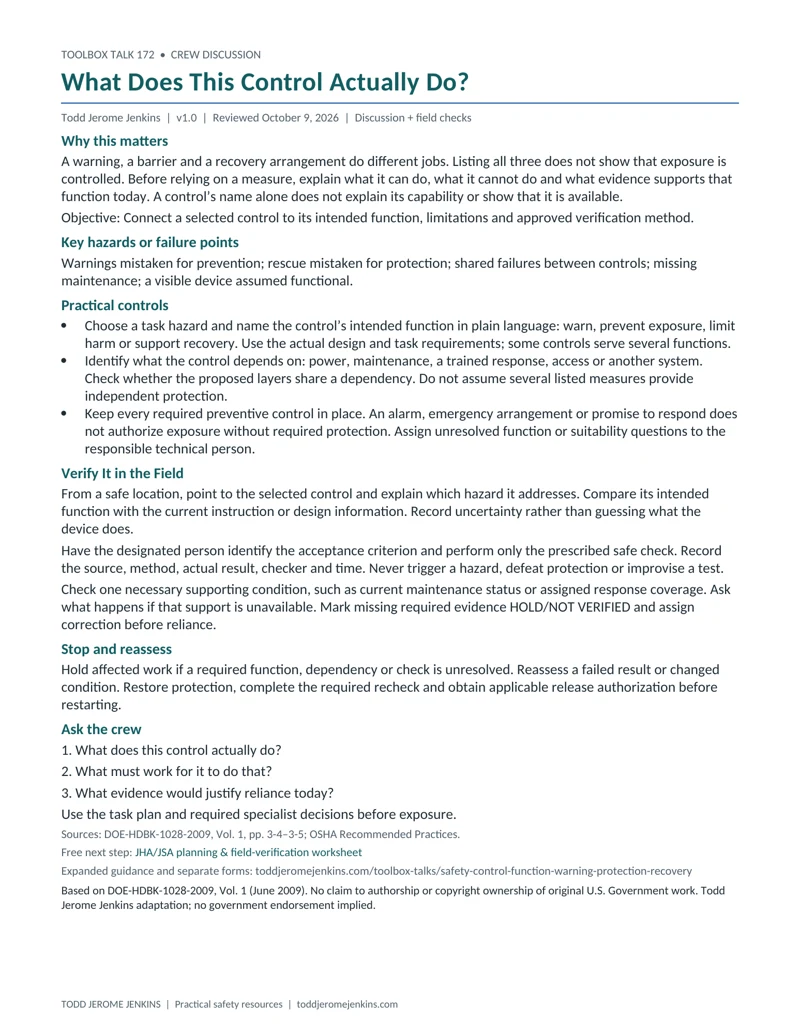
Preview the one-page crew talk
Supporting documents
Included with free Safety & Systems membership.
Supervisor field check
A separate check to verify conditions and controls before work. Includes a one-page PDF and editable Word file.
Attendance sheet
A separate sign-in sheet to record the crew discussion. Includes a one-page PDF and editable Word file.
Need the crew records? Join free to use these supporting documents and the Safety & Systems Academy. No payment details. Email updates are optional.
Get supporting documents — free membershipAlready a member? Use the same link to sign in.
Human Performance weekly series: lesson 49 of 52.
A 5–10 minute crew discussion, plus time to verify the actual controls. The crew talk and Word version are public. Separate supervisor and attendance records are included with free Safety & Systems membership.
Why this matters
A warning, a barrier and a recovery arrangement do different jobs. Listing all three does not show that exposure is controlled. Before relying on a measure, explain what it can do, what it cannot do and what evidence supports that function today. A control’s name alone does not explain its capability or show that it is available.
Learning objective
Connect a selected control to its intended function, limitations and approved verification method.
Key hazards or failure points
Warnings mistaken for prevention; rescue mistaken for protection; shared failures between controls; missing maintenance; a visible device assumed functional.
Practical controls
- Choose a task hazard and name the control’s intended function in plain language: warn, prevent exposure, limit harm or support recovery. Use the actual design and task requirements; some controls serve several functions.
- Identify what the control depends on: power, maintenance, a trained response, access or another system. Check whether the proposed layers share a dependency. Do not assume several listed measures provide independent protection.
- Keep every required preventive control in place. An alarm, emergency arrangement or promise to respond does not authorize exposure without required protection. Assign unresolved function or suitability questions to the responsible technical person.
Verify It in the Field
- From a safe location, point to the selected control and explain which hazard it addresses. Compare its intended function with the current instruction or design information. Record uncertainty rather than guessing what the device does.
- Have the designated person identify the acceptance criterion and perform only the prescribed safe check. Record the source, method, actual result, checker and time. Never trigger a hazard, defeat protection or improvise a test.
- Check one necessary supporting condition, such as current maintenance status or assigned response coverage. Ask what happens if that support is unavailable. Mark missing required evidence HOLD/NOT VERIFIED and assign correction before reliance.
Stop and reassess
Hold affected work if a required function, dependency or check is unresolved. Reassess a failed result or changed condition. Restore protection, complete the required recheck and obtain applicable release authorization before restarting.
Crew discussion questions
- What does this control actually do?
- What must work for it to do that?
- What evidence would justify reliance today?
For each required control, record its acceptance source and criterion, safe verification method, responsible checker, actual result and time. Use VERIFIED, HOLD/NOT VERIFIED, or N/A with a reason. A tick alone is not evidence. Complete all applicable task inspections; do not enter danger or improvise a test to fill out a form.
Leader preparation and practical detail
A warning is only one part of the arrangement
Illustrative situation: a crew points to a warning device when asked what prevents contact with a hazard. Ask the responsible person to explain the complete protective arrangement. The warning may prompt action, but its presence does not establish that a required barrier or separation is in place. Identify the actual requirement before deciding whether the task can proceed.
Function and hierarchy answer different questions
Function describes what a measure is meant to accomplish; the hierarchy helps select more effective ways to address exposure. This exercise does not replace hazard assessment or rank unfamiliar devices. Ask the relevant technical owner about capabilities and dependencies. Do not calculate reliability from the number of layers or assume that controls sharing a power source or human response are independent.
Verify continuing support
Physical controls can need inspection, upkeep and testing. Use the applicable manufacturer instructions, engineering information and employer process to determine who checks what and how. A toolbox discussion cannot supply missing test criteria. Link the checklist-evidence talk for recording the result; this lesson first establishes what result matters and why.
Short supervisor field check
- Hazard and control function identified.
- Limits and shared dependencies understood.
- Governing criterion and checker assigned.
- Safe check and actual finding recorded.
- Unverified protection held until authorized release.
Confirm the relevant trained/authorized people, unresolved items, interim protection, correction owner and recheck. Record required release authority and rebrief anyone affected. The separate sheet supports these records; it does not replace a specialist inspection, permit or engineering determination.
Attendance and follow-through
Use the separate attendance sheet for participants, roles, discussion concerns, actions and late-arrival rebriefs. Attendance is not proof of competence, functioning controls or authorization to work. Keep completed records private under employer procedures.
Source acknowledgment
This resource draws on the U.S. Department of Energy’s DOE-HDBK-1028-2009, Human Performance Improvement Handbook, Volume 1 (June 2009). Todd Jerome Jenkins makes no claim of authorship or copyright ownership in the original U.S. Government work. New explanations, examples, exercises and layouts are Todd Jerome Jenkins adaptations. No endorsement by DOE or the U.S. Government is implied. Third-party material credited in the handbook remains attributed to its source; this notice does not claim rights in that material.
Source excerpt: Volume 1/VOLUME 1 CHAPTER 3 – MANAGING CONTROLS.pdf; Chapter 3, printed pp. 3-4 through 3-5 (PDF pages 4–5). The June 2009 handbook supplies concepts; this lesson uses original explanations and exercises.
Technical scope and references
References reviewed October 9, 2026. DOE human-performance tools and OSHA recommended practices support preparation and discussion; they do not establish universal technical acceptance criteria. Apply the current task procedure, manufacturer instructions, permit and required competent or qualified decisions. A successful exercise does not replace required training, technical verification or work authorization.
- DOE-HDBK-1028-2009, Volume 1 — Chapter 3, printed pp. 3-4 through 3-5 (PDF pages 4–5); June 2009 conceptual background only. Selected original excerpt pages read and visually inspected, not whole chapters.
- OSHA — Hazard Prevention and Control — Recommended practices, action items 1–3 and 6: select suitable controls, assign implementation and verify continuing effectiveness. No equipment-specific test criteria.
Connect this discussion to your JHA/JSA
Use the JHA/JSA planning and field-verification worksheet to record the actual task steps, hazards, responsible roles and controls. No task-specific worked example is linked for this topic yet. Return to What Changed Today? when the plan or conditions change.
Related Todd Jerome Jenkins articles: How to Conduct a Job Safety Analysis and What Is Human and Organizational Performance?.
Related crew discussions
- Safety Checklists: Show the Evidence Before the Tick
- Two Controls, One Weak Point: Trace the Shared Dependency
Continue the weekly series
- Lesson 48: Two Controls, One Weak Point: Trace the Shared Dependency
- Lesson 50: Confusing Controls: Fix the Design Trap
Put one check into practice
Use the free JHA/JSA planning and field-verification worksheet to record today’s change, the required protection and the evidence needed before exposure.