Download the free crew talk
The one-page talk, editable Word version, and guidance below are open to everyone. No account required.
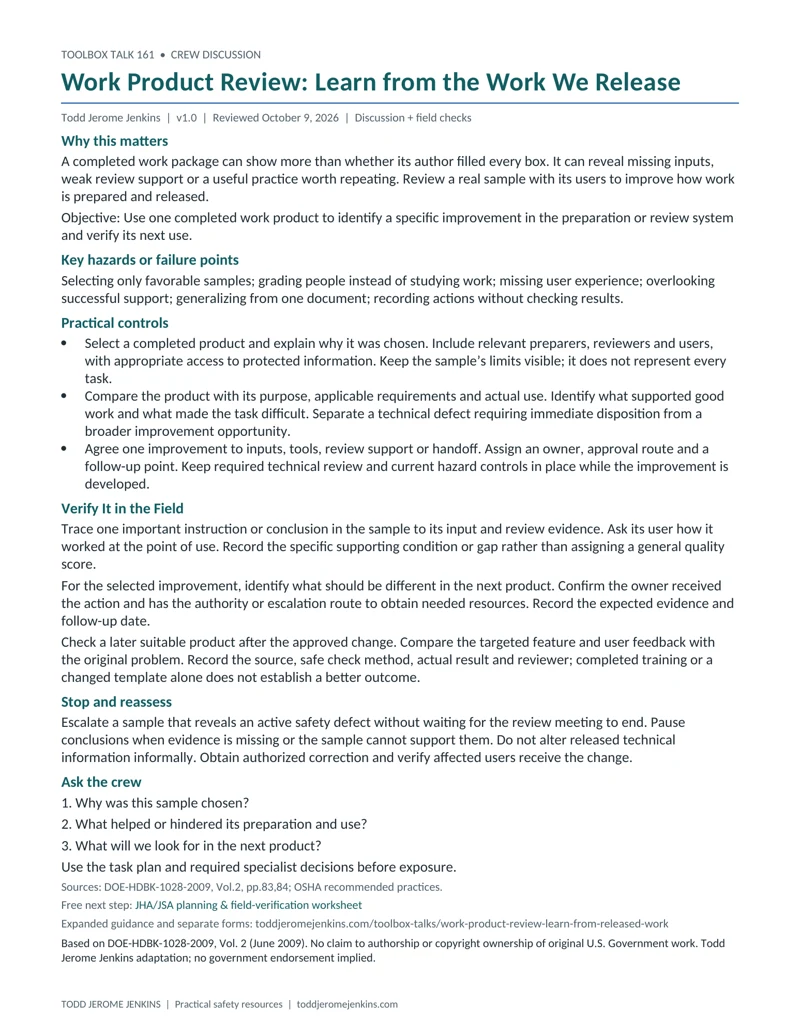
Preview the one-page crew talk
Supporting documents
Included with free Safety & Systems membership.
Supervisor field check
A separate check to verify conditions and controls before work. Includes a one-page PDF and editable Word file.
Attendance sheet
A separate sign-in sheet to record the crew discussion. Includes a one-page PDF and editable Word file.
Need the crew records? Join free to use these supporting documents and the Safety & Systems Academy. No payment details. Email updates are optional.
Get supporting documents — free membershipAlready a member? Use the same link to sign in.
Human Performance weekly series: lesson 38 of 52.
A 5–10 minute crew discussion, plus time to verify the actual controls. The crew talk and Word version are public. Separate supervisor and attendance records are included with free Safety & Systems membership.
Why this matters
A completed work package can show more than whether its author filled every box. It can reveal missing inputs, weak review support or a useful practice worth repeating. Review a real sample with its users to improve how work is prepared and released.
Learning objective
Use one completed work product to identify a specific improvement in the preparation or review system and verify its next use.
Key hazards or failure points
Selecting only favorable samples; grading people instead of studying work; missing user experience; overlooking successful support; generalizing from one document; recording actions without checking results.
Practical controls
- Select a completed product and explain why it was chosen. Include relevant preparers, reviewers and users, with appropriate access to protected information. Keep the sample’s limits visible; it does not represent every task.
- Compare the product with its purpose, applicable requirements and actual use. Identify what supported good work and what made the task difficult. Separate a technical defect requiring immediate disposition from a broader improvement opportunity.
- Agree one improvement to inputs, tools, review support or handoff. Assign an owner, approval route and a follow-up point. Keep required technical review and current hazard controls in place while the improvement is developed.
Verify It in the Field
- Trace one important instruction or conclusion in the sample to its input and review evidence. Ask its user how it worked at the point of use. Record the specific supporting condition or gap rather than assigning a general quality score.
- For the selected improvement, identify what should be different in the next product. Confirm the owner received the action and has the authority or escalation route to obtain needed resources. Record the expected evidence and follow-up date.
- Check a later suitable product after the approved change. Compare the targeted feature and user feedback with the original problem. Record the source, safe check method, actual result and reviewer; completed training or a changed template alone does not establish a better outcome.
Stop and reassess
Escalate a sample that reveals an active safety defect without waiting for the review meeting to end. Pause conclusions when evidence is missing or the sample cannot support them. Do not alter released technical information informally. Obtain authorized correction and verify affected users receive the change.
Crew discussion questions
- Why was this sample chosen?
- What helped or hindered its preparation and use?
- What will we look for in the next product?
For each required control, record its acceptance source and criterion, safe verification method, responsible checker, actual result and time. Use VERIFIED, HOLD/NOT VERIFIED, or N/A with a reason. A tick alone is not evidence. Complete all applicable task inspections; do not enter danger or improvise a test to fill out a form.
Leader preparation and practical detail
Learning from a sample has a different purpose
Technical peer review checks a product before release. This leader-supported review uses selected completed products to study preparation, review and delivery conditions. TBT142 captures fresh feedback after a task; this lesson can look across products and over time. Sampling does not replace required acceptance checks.
Preserve what made the work usable
Illustrative situation: a package succeeded because a planner obtained clear photographs and verified identifiers early. Record that enabling condition, not simply an excellent grade. Determine whether the next planner has the same support. Equally, a missing input may reflect an unavailable system or unresolved interface rather than an individual’s lack of care.
Bound the conclusion
One example can identify a question worth investigating but cannot establish an organization-wide failure rate. Explain sample selection and seek additional evidence where warranted. OSHA program-evaluation guidance supports worker involvement and checking whether improvements work; it does not mandate a letter grade, quota or ranking of employees.
Short supervisor field check
- Sample purpose and limits recorded.
- Relevant preparers, reviewers and users involved.
- Product evidence and actual use compared.
- Urgent defects separately controlled and routed.
- Approved improvement checked in a later product.
Confirm the relevant trained/authorized people, unresolved items, interim protection, correction owner and recheck. Record required release authority and rebrief anyone affected. The separate sheet supports these records; it does not replace a specialist inspection, permit or engineering determination.
Attendance and follow-through
Use the separate attendance sheet for participants, roles, discussion concerns, actions and late-arrival rebriefs. Attendance is not proof of competence, functioning controls or authorization to work. Keep completed records private under employer procedures.
Source acknowledgment
This resource draws on the U.S. Department of Energy’s DOE-HDBK-1028-2009, Human Performance Improvement Handbook, Volume 2 (June 2009). Todd Jerome Jenkins makes no claim of authorship or copyright ownership in the original U.S. Government work. New explanations, examples, exercises and layouts are Todd Jerome Jenkins adaptations. No endorsement by DOE or the U.S. Government is implied. Third-party material credited in the handbook remains attributed to its source; this notice does not claim rights in that material.
Source excerpt: Volume 2/VOLUME 2 WORK PRODUCT REVIEW.pdf; Printed pp. 83, 84. The June 2009 handbook supplies concepts; this lesson uses original explanations and exercises.
Technical scope and references
References reviewed October 9, 2026. DOE human-performance tools and OSHA recommended practices support preparation and discussion; they do not establish universal technical acceptance criteria. Apply the current task procedure, manufacturer instructions, permit and required competent or qualified decisions. A successful exercise does not replace required training, technical verification or work authorization.
- DOE-HDBK-1028-2009, Volume 2 — Use completed products to improve the work system — June 2009 illustrative guidance; printed pages 83, 84. Historical concepts, not universal mandates.
- OSHA Recommended Practices — Program Evaluation and Improvement — Current recommended practices; supports assigned responsibilities, worker input and evidence-based follow-through. Not a technical acceptance standard.
Connect this discussion to your JHA/JSA
Use the JHA/JSA planning and field-verification worksheet to record the actual task steps, hazards, responsible roles and controls. No task-specific worked example is linked for this topic yet. Return to What Changed Today? when the plan or conditions change.
Related Todd Jerome Jenkins articles: How to Conduct a Job Safety Analysis and What Is Human and Organizational Performance?.
Related crew discussions
- Peer Review: Check the Technical Basis Before Release
- Self-Assessment: Compare the Plan with Real Work
Continue the weekly series
- Lesson 37: Peer Review: Check the Technical Basis Before Release
- Lesson 39: Vendor Interfaces: Verify the Handoff and the Evidence
Put one check into practice
Use the free JHA/JSA planning and field-verification worksheet to record today’s change, the required protection and the evidence needed before exposure.