Download the free crew talk
The one-page talk, editable Word version, and guidance below are open to everyone. No account required.
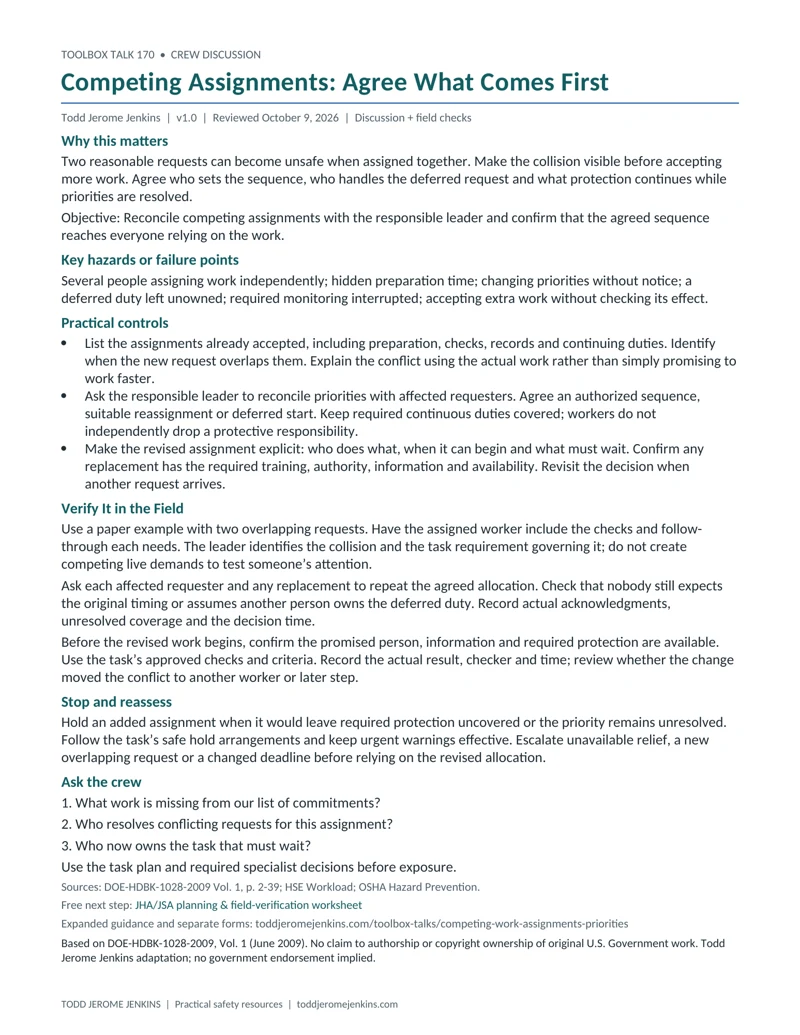
Preview the one-page crew talk
Supporting documents
Included with free Safety & Systems membership.
Supervisor field check
A separate check to verify conditions and controls before work. Includes a one-page PDF and editable Word file.
Attendance sheet
A separate sign-in sheet to record the crew discussion. Includes a one-page PDF and editable Word file.
Need the crew records? Join free to use these supporting documents and the Safety & Systems Academy. No payment details. Email updates are optional.
Get supporting documents — free membershipAlready a member? Use the same link to sign in.
Human Performance weekly series: lesson 47 of 52.
A 5–10 minute crew discussion, plus time to verify the actual controls. The crew talk and Word version are public. Separate supervisor and attendance records are included with free Safety & Systems membership.
Why this matters
Two reasonable requests can become unsafe when assigned together. Make the collision visible before accepting more work. Agree who sets the sequence, who handles the deferred request and what protection continues while priorities are resolved.
Learning objective
Reconcile competing assignments with the responsible leader and confirm that the agreed sequence reaches everyone relying on the work.
Key hazards or failure points
Several people assigning work independently; hidden preparation time; changing priorities without notice; a deferred duty left unowned; required monitoring interrupted; accepting extra work without checking its effect.
Practical controls
- List the assignments already accepted, including preparation, checks, records and continuing duties. Identify when the new request overlaps them. Explain the conflict using the actual work rather than simply promising to work faster.
- Ask the responsible leader to reconcile priorities with affected requesters. Agree an authorized sequence, suitable reassignment or deferred start. Keep required continuous duties covered; workers do not independently drop a protective responsibility.
- Make the revised assignment explicit: who does what, when it can begin and what must wait. Confirm any replacement has the required training, authority, information and availability. Revisit the decision when another request arrives.
Verify It in the Field
- Use a paper example with two overlapping requests. Have the assigned worker include the checks and follow-through each needs. The leader identifies the collision and the task requirement governing it; do not create competing live demands to test someone’s attention.
- Ask each affected requester and any replacement to repeat the agreed allocation. Check that nobody still expects the original timing or assumes another person owns the deferred duty. Record actual acknowledgments, unresolved coverage and the decision time.
- Before the revised work begins, confirm the promised person, information and required protection are available. Use the task’s approved checks and criteria. Record the actual result, checker and time; review whether the change moved the conflict to another worker or later step.
Stop and reassess
Hold an added assignment when it would leave required protection uncovered or the priority remains unresolved. Follow the task’s safe hold arrangements and keep urgent warnings effective. Escalate unavailable relief, a new overlapping request or a changed deadline before relying on the revised allocation.
Crew discussion questions
- What work is missing from our list of commitments?
- Who resolves conflicting requests for this assignment?
- Who now owns the task that must wait?
For each required control, record its acceptance source and criterion, safe verification method, responsible checker, actual result and time. Use VERIFIED, HOLD/NOT VERIFIED, or N/A with a reason. A tick alone is not evidence. Complete all applicable task inspections; do not enter danger or improvise a test to fill out a form.
Leader preparation and practical detail
A request can omit the work surrounding its visible step
Illustrative situation: someone asks for a quick check while the assigned worker is preparing another controlled activity. The request sounds short, but obtaining the correct information, performing the authorized check and recording its result all take attention and time. Have the worker make those obligations visible. The leader decides the sequence with affected requesters. Do not ask the worker to diagnose their own mental capacity or prove overload by allowing something to fail.
A deferral needs an owner
Illustrative situation: one requester agrees to wait, but a second crew still expects the original completion time. Record and communicate the change to everyone depending on it. If another person takes the assignment, confirm relevant competence, authorization and availability, then transfer accurate status. Simply assigning a different name can move the conflict rather than resolve it. Any role that prohibits simultaneous duties remains governed by its actual regulation, permit or procedure.
Use this exercise when the next request arrives
Safety Capacity considers peak demand across people, equipment and controls. Protect the Critical Step addresses incoming interruptions during a specific operation. This lesson practices the conversation at assignment intake: expose current commitments, obtain a priority decision and close the loop with each requester. HSE guidance supports examining tasks, timing and role allocation; it does not supply a universal maximum task count or a staffing ratio. Additional help must make the actual arrangement workable.
Short supervisor field check
- Accepted commitments include checks, records and continuing duties.
- Actual overlap and applicable role restrictions identified.
- Responsible leader reconciles priorities with affected requesters.
- Replacement or deferral has an acknowledged owner and workable timing.
- Revised protection verified without transferring the collision elsewhere.
Confirm the relevant trained/authorized people, unresolved items, interim protection, correction owner and recheck. Record required release authority and rebrief anyone affected. The separate sheet supports these records; it does not replace a specialist inspection, permit or engineering determination.
Attendance and follow-through
Use the separate attendance sheet for participants, roles, discussion concerns, actions and late-arrival rebriefs. Attendance is not proof of competence, functioning controls or authorization to work. Keep completed records private under employer procedures.
Source acknowledgment
This resource draws on the U.S. Department of Energy’s DOE-HDBK-1028-2009, Human Performance Improvement Handbook, Volume 1 (June 2009). Todd Jerome Jenkins makes no claim of authorship or copyright ownership in the original U.S. Government work. New explanations, examples, exercises and layouts are Todd Jerome Jenkins adaptations. No endorsement by DOE or the U.S. Government is implied. Third-party material credited in the handbook remains attributed to its source; this notice does not claim rights in that material.
Source excerpt: Volume 1/VOLUME 1 CHAPTER 2-REDUCING ERROR.pdf; Printed pp. 2-39. The June 2009 handbook supplies concepts; this lesson uses original explanations and exercises.
Technical scope and references
References reviewed October 9, 2026. DOE human-performance tools and OSHA recommended practices support preparation and discussion; they do not establish universal technical acceptance criteria. Apply the current task procedure, manufacturer instructions, permit and required competent or qualified decisions. A successful exercise does not replace required training, technical verification or work authorization.
- DOE-HDBK-1028-2009, Volume 1 — Chapter 2, printed p. 2-39 — June 2009 descriptive source on simultaneous tasks, workload and unclear duties. Original assignment exercise; archived table, rankings and wording not reproduced.
- HSE — Workload — Current UK regulator guidance on task analysis, timing, role allocation and workload changes. Not a U.S. legal requirement or numerical capacity standard.
- OSHA — Hazard Prevention and Control — Recommended practices supporting assigned protection, feasible changes and checks of control implementation.
Connect this discussion to your JHA/JSA
Use the JHA/JSA planning and field-verification worksheet to record the actual task steps, hazards, responsible roles and controls. No task-specific worked example is linked for this topic yet. Return to What Changed Today? when the plan or conditions change.
Related Todd Jerome Jenkins articles: How to Conduct a Job Safety Analysis and What Is Human and Organizational Performance?.
Related crew discussions
Continue the weekly series
- Lesson 46: Unfamiliar Work: Prepare the Question for the Right Expert
- Lesson 48: Two Controls, One Weak Point: Trace the Shared Dependency
Put one check into practice
Use the free JHA/JSA planning and field-verification worksheet to record today’s change, the required protection and the evidence needed before exposure.