Download the free crew talk
The one-page talk, editable Word version, and guidance below are open to everyone. No account required.
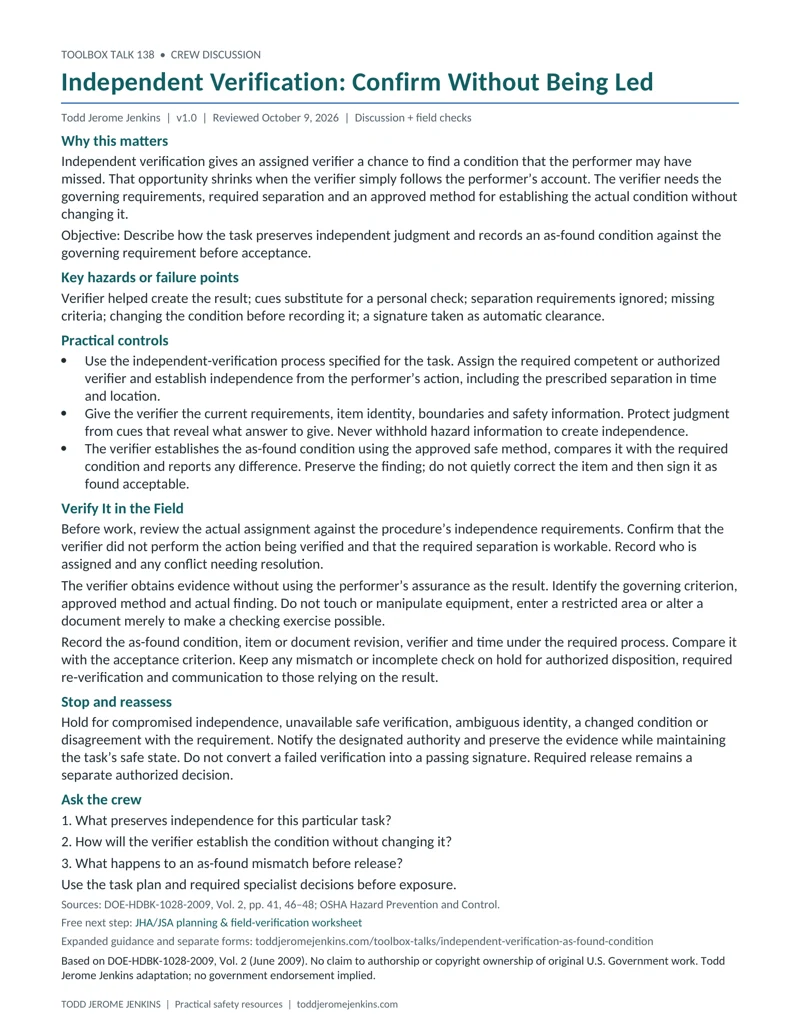
Preview the one-page crew talk
Supporting documents
Included with free Safety & Systems membership.
Supervisor field check
A separate check to verify conditions and controls before work. Includes a one-page PDF and editable Word file.
Attendance sheet
A separate sign-in sheet to record the crew discussion. Includes a one-page PDF and editable Word file.
Need the crew records? Join free to use these supporting documents and the Safety & Systems Academy. No payment details. Email updates are optional.
Get supporting documents — free membershipAlready a member? Use the same link to sign in.
Human Performance weekly series: lesson 15 of 52.
A 5–10 minute crew discussion, plus time to verify the actual controls. The crew talk and Word version are public. Separate supervisor and attendance records are included with free Safety & Systems membership.
Why this matters
Independent verification gives an assigned verifier a chance to find a condition that the performer may have missed. That opportunity shrinks when the verifier simply follows the performer’s account. The verifier needs the governing requirements, required separation and an approved method for establishing the actual condition without changing it.
Learning objective
Describe how the task preserves independent judgment and records an as-found condition against the governing requirement before acceptance.
Key hazards or failure points
Verifier helped create the result; cues substitute for a personal check; separation requirements ignored; missing criteria; changing the condition before recording it; a signature taken as automatic clearance.
Practical controls
- Use the independent-verification process specified for the task. Assign the required competent or authorized verifier and establish independence from the performer’s action, including the prescribed separation in time and location.
- Give the verifier the current requirements, item identity, boundaries and safety information. Protect judgment from cues that reveal what answer to give. Never withhold hazard information to create independence.
- The verifier establishes the as-found condition using the approved safe method, compares it with the required condition and reports any difference. Preserve the finding; do not quietly correct the item and then sign it as found acceptable.
Verify It in the Field
- Before work, review the actual assignment against the procedure’s independence requirements. Confirm that the verifier did not perform the action being verified and that the required separation is workable. Record who is assigned and any conflict needing resolution.
- The verifier obtains evidence without using the performer’s assurance as the result. Identify the governing criterion, approved method and actual finding. Do not touch or manipulate equipment, enter a restricted area or alter a document merely to make a checking exercise possible.
- Record the as-found condition, item or document revision, verifier and time under the required process. Compare it with the acceptance criterion. Keep any mismatch or incomplete check on hold for authorized disposition, required re-verification and communication to those relying on the result.
Stop and reassess
Hold for compromised independence, unavailable safe verification, ambiguous identity, a changed condition or disagreement with the requirement. Notify the designated authority and preserve the evidence while maintaining the task’s safe state. Do not convert a failed verification into a passing signature. Required release remains a separate authorized decision.
Crew discussion questions
- What preserves independence for this particular task?
- How will the verifier establish the condition without changing it?
- What happens to an as-found mismatch before release?
For each required control, record its acceptance source and criterion, safe verification method, responsible checker, actual result and time. Use VERIFIED, HOLD/NOT VERIFIED, or N/A with a reason. A tick alone is not evidence. Complete all applicable task inspections; do not enter danger or improvise a test to fill out a form.
Leader preparation and practical detail
Give the requirement without supplying the answer
The verifier needs to know what item or document to examine, which criteria govern and what hazards and boundaries apply. Those facts support the check. A statement such as it is already correct, just sign here can instead steer the conclusion. Use the task’s prescribed handoff and separation arrangements. Independence concerns the verifier’s relationship to the action and evidence; it is not permission to keep essential safety information secret.
A document example makes the distinction visible
Use a clearly marked training document containing a requirement and a recorded result. Have a verifier who did not produce the result compare it with the stated criterion using the defined method, without watching the preparation or being told which answer to return. Preserve a discovered mismatch and route it for disposition rather than editing it silently. This is an original non-operating exercise, not a qualification or a substitute for an actual technical review.
Do not repair the evidence before reporting it
Illustrative situation: the verifier finds a condition that differs from the required state. Changing it during the check would erase the as-found discrepancy and might introduce another exposure. Follow the approved verification method, report the finding and keep affected reliance held. The responsible authority decides the correction, investigation or additional checks required. If correction is authorized, distinguish the original finding from the subsequent corrected condition and re-verification.
Two different people are only part of the arrangement
Different names do not establish independence if the verifier participated in the action or relied on the performer’s cues. The DOE handbook describes separation in time and distance to support independent judgment; it supplies no universal number of minutes or feet. The governing site process must define an acceptable arrangement and safe method. If the work cannot meet it, escalate for authorized resolution rather than relabeling a concurrent check as independent.
Short supervisor field check
- Procedure specifies verification scope, criteria and required independence.
- Verifier’s role, competence and separation satisfy that process.
- Requirements and hazard information are available without answer coaching.
- Approved method establishes and records the unchanged as-found condition.
- Mismatch disposition, re-verification and required release are controlled.
Confirm the relevant trained/authorized people, unresolved items, interim protection, correction owner and recheck. Record required release authority and rebrief anyone affected. The separate sheet supports these records; it does not replace a specialist inspection, permit or engineering determination.
Attendance and follow-through
Use the separate attendance sheet for participants, roles, discussion concerns, actions and late-arrival rebriefs. Attendance is not proof of competence, functioning controls or authorization to work. Keep completed records private under employer procedures.
Source acknowledgment
This resource draws on the U.S. Department of Energy’s DOE-HDBK-1028-2009, Human Performance Improvement Handbook, Volume 2 (June 2009). Todd Jerome Jenkins makes no claim of authorship or copyright ownership in the original U.S. Government work. New explanations, examples, exercises and layouts are Todd Jerome Jenkins adaptations. No endorsement by DOE or the U.S. Government is implied. Third-party material credited in the handbook remains attributed to its source; this notice does not claim rights in that material.
Source excerpt: Volume 2/VOLUME 2 CHECKING AND VERIFICATION PRACTICES Independent Verification.pdf; Printed pp. 41, 46, 47, 48. The June 2009 handbook supplies concepts; this lesson uses original explanations and exercises.
Technical scope and references
References reviewed October 9, 2026. DOE human-performance tools and OSHA recommended practices support preparation and discussion; they do not establish universal technical acceptance criteria. Apply the current task procedure, manufacturer instructions, permit and required competent or qualified decisions. A successful exercise does not replace required training, technical verification or work authorization.
- DOE-HDBK-1028-2009, Volume 2 — Checking and Verification; Independent Verification — June 2009 guidance, printed pages 41 and 46–48: independence from the performer, prescribed separation, unchanged as-found condition, governing criteria and discrepancy reporting. Historical comparative probability claim, generic hands-on preference and equipment recipes are excluded.
- OSHA — Hazard Prevention and Control — Recommended practices, action items 3 and 6: assigned responsibility and evidence of control effectiveness. Not a generic statutory independent-verification requirement.
Connect this discussion to your JHA/JSA
Use the JHA/JSA planning and field-verification worksheet to record the actual task steps, hazards, responsible roles and controls. No task-specific worked example is linked for this topic yet. Return to What Changed Today? when the plan or conditions change.
Related Todd Jerome Jenkins articles: How to Conduct a Job Safety Analysis and What Is Human and Organizational Performance?.
Related crew discussions
- Concurrent Verification: Two People, One Confirmed Condition
- Self-Checking: Confirm the Item, Action and Result
Continue the weekly series
- Lesson 14: Concurrent Verification: Two People, One Confirmed Condition
- Lesson 16: Questioning in the Field: Notice the Mismatch
Put one check into practice
Use the free JHA/JSA planning and field-verification worksheet to record today’s change, the required protection and the evidence needed before exposure.