Download the free crew talk
The one-page talk, editable Word version, and guidance below are open to everyone. No account required.
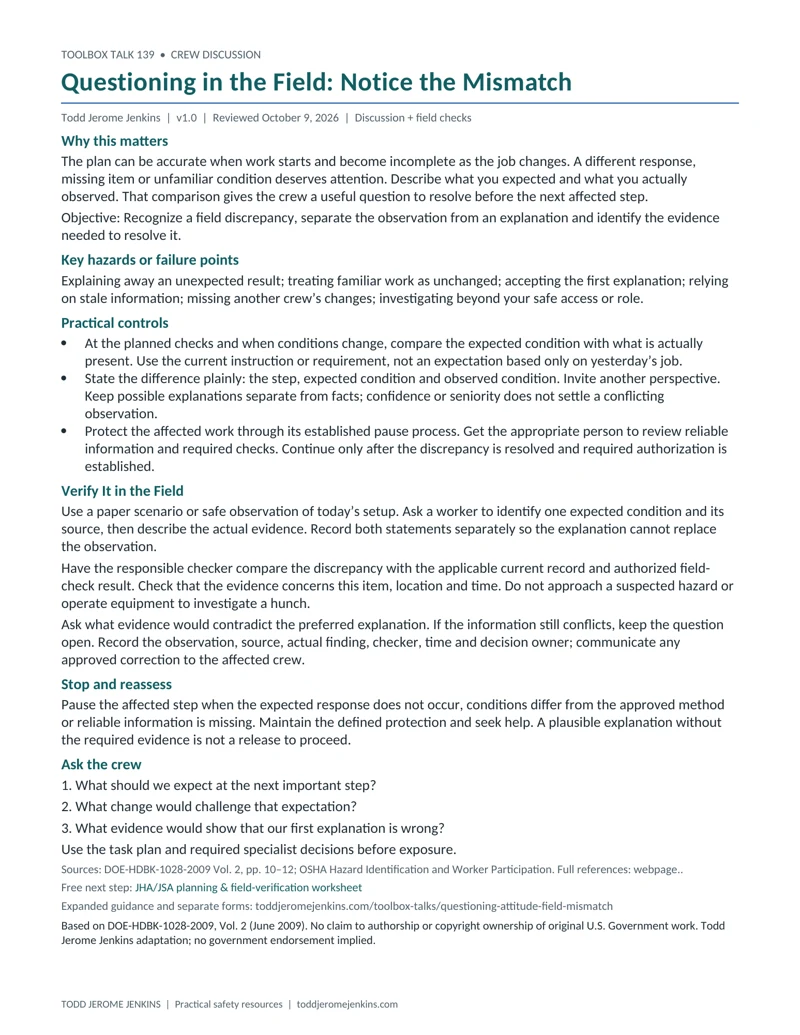
Preview the one-page crew talk
Supporting documents
Included with free Safety & Systems membership.
Supervisor field check
A separate check to verify conditions and controls before work. Includes a one-page PDF and editable Word file.
Attendance sheet
A separate sign-in sheet to record the crew discussion. Includes a one-page PDF and editable Word file.
Need the crew records? Join free to use these supporting documents and the Safety & Systems Academy. No payment details. Email updates are optional.
Get supporting documents — free membershipAlready a member? Use the same link to sign in.
Human Performance weekly series: lesson 16 of 52.
A 5–10 minute crew discussion, plus time to verify the actual controls. The crew talk and Word version are public. Separate supervisor and attendance records are included with free Safety & Systems membership.
Why this matters
The plan can be accurate when work starts and become incomplete as the job changes. A different response, missing item or unfamiliar condition deserves attention. Describe what you expected and what you actually observed. That comparison gives the crew a useful question to resolve before the next affected step.
Learning objective
Recognize a field discrepancy, separate the observation from an explanation and identify the evidence needed to resolve it.
Key hazards or failure points
Explaining away an unexpected result; treating familiar work as unchanged; accepting the first explanation; relying on stale information; missing another crew’s changes; investigating beyond your safe access or role.
Practical controls
- At the planned checks and when conditions change, compare the expected condition with what is actually present. Use the current instruction or requirement, not an expectation based only on yesterday’s job.
- State the difference plainly: the step, expected condition and observed condition. Invite another perspective. Keep possible explanations separate from facts; confidence or seniority does not settle a conflicting observation.
- Protect the affected work through its established pause process. Get the appropriate person to review reliable information and required checks. Continue only after the discrepancy is resolved and required authorization is established.
Verify It in the Field
- Use a paper scenario or safe observation of today’s setup. Ask a worker to identify one expected condition and its source, then describe the actual evidence. Record both statements separately so the explanation cannot replace the observation.
- Have the responsible checker compare the discrepancy with the applicable current record and authorized field-check result. Check that the evidence concerns this item, location and time. Do not approach a suspected hazard or operate equipment to investigate a hunch.
- Ask what evidence would contradict the preferred explanation. If the information still conflicts, keep the question open. Record the observation, source, actual finding, checker, time and decision owner; communicate any approved correction to the affected crew.
Stop and reassess
Pause the affected step when the expected response does not occur, conditions differ from the approved method or reliable information is missing. Maintain the defined protection and seek help. A plausible explanation without the required evidence is not a release to proceed.
Crew discussion questions
- What should we expect at the next important step?
- What change would challenge that expectation?
- What evidence would show that our first explanation is wrong?
For each required control, record its acceptance source and criterion, safe verification method, responsible checker, actual result and time. Use VERIFIED, HOLD/NOT VERIFIED, or N/A with a reason. A tick alone is not evidence. Complete all applicable task inspections; do not enter danger or improvise a test to fill out a form.
Leader preparation and practical detail
Ask about the difference before choosing the explanation
Illustrative situation: a marked route appears usable during planning, but a worker notices delivery materials narrowing the route during execution. “The delivery will leave soon” explains an intention, not the present condition. Ask where the work now differs from the plan and which activity depends on that route. Hold that exposure as required while the responsible person restores the arrangement or obtains an approved alternative. Record the actual correction rather than the promise.
Check whether the evidence belongs to this moment
Illustrative situation: the crew receives a photograph showing a completed safeguard, but the picture predates a later change. The image may be accurate and still fail to establish the current condition. Identify the item, location and time represented, then obtain the prescribed current check from the appropriate role. Do not require workers to climb, reach or enter a restricted area merely to provide a convincing photograph. Evidence must be relevant and collected safely.
Welcome a useful question without turning it into an argument
Illustrative situation: a new crew member reports an unexpected indication that experienced workers have stopped noticing. Ask what was observed and what the instruction says should occur. The worker need not prove a failure before the concern receives attention. This lesson practices noticing and examining a discrepancy; the separate Pause When Unsure lesson supplies the maintained-hold and restart conversation. Technical decisions still belong to the people and processes designated for the actual equipment and work.
Short supervisor field check
- Expected condition tied to the current instruction or applicable requirement.
- Actual observation recorded separately from suggested explanations.
- Relevant contradictory evidence and other worker perspectives considered.
- Required safe check completed by the appropriate person with finding and time.
- Unresolved discrepancy held; decision and approved correction communicated.
Confirm the relevant trained/authorized people, unresolved items, interim protection, correction owner and recheck. Record required release authority and rebrief anyone affected. The separate sheet supports these records; it does not replace a specialist inspection, permit or engineering determination.
Attendance and follow-through
Use the separate attendance sheet for participants, roles, discussion concerns, actions and late-arrival rebriefs. Attendance is not proof of competence, functioning controls or authorization to work. Keep completed records private under employer procedures.
Source acknowledgment
This resource draws on the U.S. Department of Energy’s DOE-HDBK-1028-2009, Human Performance Improvement Handbook, Volume 2 (June 2009). Todd Jerome Jenkins makes no claim of authorship or copyright ownership in the original U.S. Government work. New explanations, examples, exercises and layouts are Todd Jerome Jenkins adaptations. No endorsement by DOE or the U.S. Government is implied. Third-party material credited in the handbook remains attributed to its source; this notice does not claim rights in that material.
Source excerpt: Volume 2/VOLUME 2 QUESTIONING ATTITUDE — AT THE ACTIVITY LEVEL.pdf; Printed pp. 10–12; embedded planning pp. 13–15 excluded. The June 2009 handbook supplies concepts; this lesson uses original explanations and exercises.
Technical scope and references
References reviewed October 9, 2026. DOE human-performance tools and OSHA recommended practices support preparation and discussion; they do not establish universal technical acceptance criteria. Apply the current task procedure, manufacturer instructions, permit and required competent or qualified decisions. A successful exercise does not replace required training, technical verification or work authorization.
- DOE-HDBK-1028-2009, Volume 2 — Questioning Attitude at the Activity Level, printed pp. 10–12 — June 2009 illustrative guidance on recognizing discrepancies and seeking facts. Embedded planning/preparation pages 13–15 excluded from this lesson.
- OSHA Recommended Practices — Hazard Identification and Assessment — Current program guidance on recognizing changed conditions, using relevant information and involving workers; no universal inspection method or acceptance limit supplied.
- OSHA Recommended Practices — Worker Participation — Guidance on receiving concerns, worker input and usable reporting arrangements.
Connect this discussion to your JHA/JSA
Use the JHA/JSA planning and field-verification worksheet to record the actual task steps, hazards, responsible roles and controls. No task-specific worked example is linked for this topic yet. Return to What Changed Today? when the plan or conditions change.
Related Todd Jerome Jenkins articles: How to Conduct a Job Safety Analysis and What Is Human and Organizational Performance?.
Related crew discussions
Continue the weekly series
- Lesson 15: Independent Verification: Confirm Without Being Led
- Lesson 17: Assumptions: Show What Is Known and What Is Not
Put one check into practice
Use the free JHA/JSA planning and field-verification worksheet to record today’s change, the required protection and the evidence needed before exposure.