Download the free crew talk
The one-page talk, editable Word version, and guidance below are open to everyone. No account required.
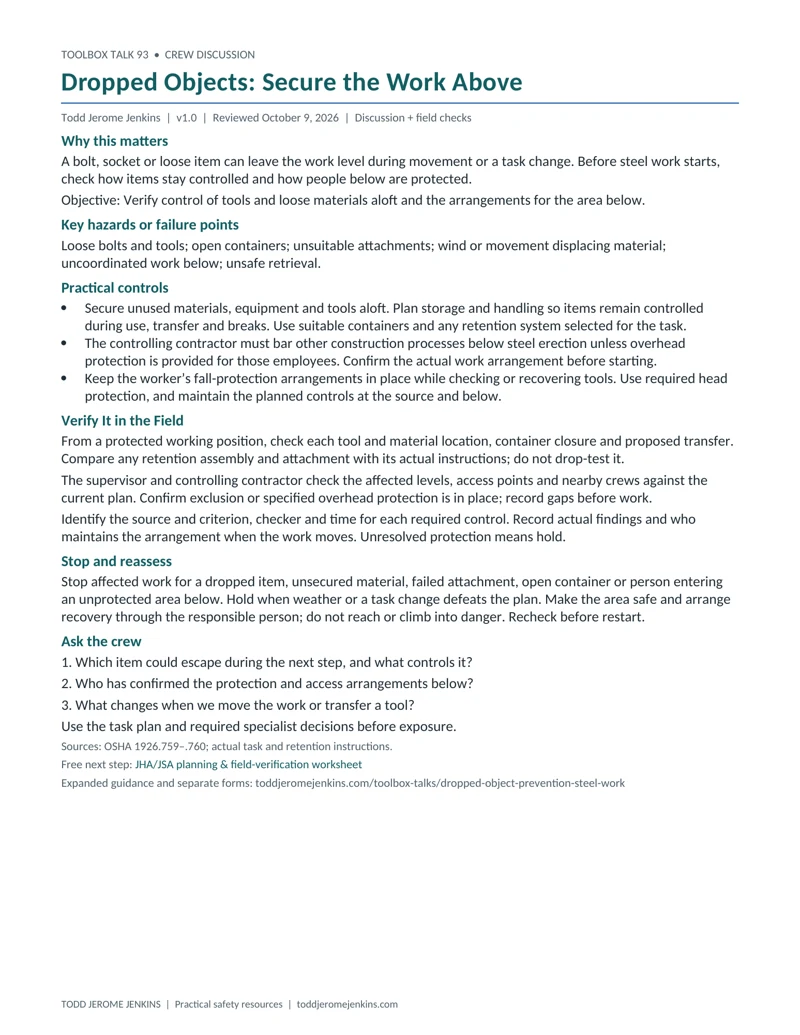
Preview the one-page crew talk
Supporting documents
Included with free Safety & Systems membership.
Supervisor field check
A separate check to verify conditions and controls before work. Includes a one-page PDF and editable Word file.
Attendance sheet
A separate sign-in sheet to record the crew discussion. Includes a one-page PDF and editable Word file.
Need the crew records? Join free to use these supporting documents and the Safety & Systems Academy. No payment details. Email updates are optional.
Get supporting documents — free membershipAlready a member? Use the same link to sign in.
A 5–10 minute crew discussion, plus time to verify the actual controls. The crew talk and Word version are public. Separate supervisor and attendance records are included with free Safety & Systems membership.
Why this matters
A bolt, socket or loose item can leave the work level during movement or a task change. Before steel work starts, check how items stay controlled and how people below are protected.
Learning objective
Verify control of tools and loose materials aloft and the arrangements for the area below.
Key hazards or failure points
Loose bolts and tools; open containers; unsuitable attachments; wind or movement displacing material; uncoordinated work below; unsafe retrieval.
Practical controls
- Secure unused materials, equipment and tools aloft. Plan storage and handling so items remain controlled during use, transfer and breaks. Use suitable containers and any retention system selected for the task.
- The controlling contractor must bar other construction processes below steel erection unless overhead protection is provided for those employees. Confirm the actual work arrangement before starting.
- Keep the worker’s fall-protection arrangements in place while checking or recovering tools. Use required head protection, and maintain the planned controls at the source and below.
Verify It in the Field
- From a protected working position, check each tool and material location, container closure and proposed transfer. Compare any retention assembly and attachment with its actual instructions; do not drop-test it.
- The supervisor and controlling contractor check the affected levels, access points and nearby crews against the current plan. Confirm exclusion or specified overhead protection is in place; record gaps before work.
- Identify the source and criterion, checker and time for each required control. Record actual findings and who maintains the arrangement when the work moves. Unresolved protection means hold.
Stop and reassess
Stop affected work for a dropped item, unsecured material, failed attachment, open container or person entering an unprotected area below. Hold when weather or a task change defeats the plan. Make the area safe and arrange recovery through the responsible person; do not reach or climb into danger. Recheck before restart.
Crew discussion questions
- Which item could escape during the next step, and what controls it?
- Who has confirmed the protection and access arrangements below?
- What changes when we move the work or transfer a tool?
For each required control, record its acceptance source and criterion, safe verification method, responsible checker, actual result and time. Use VERIFIED, HOLD/NOT VERIFIED, or N/A with a reason. A tick alone is not evidence. Complete all applicable task inspections; do not enter danger or improvise a test to fill out a form.
Leader preparation and practical detail
Start with the item and its next movement
Illustrative situation: bolts are stored in a suitable container, but its closure is left open when it is moved. The leader holds the transfer, resolves how the container will remain secure and confirms the route below. Include storage, use, transfer and cleanup in the task review.
Verify the actual retention arrangement
No tether, tool attachment, container or anchor model was provided for this resource. Where a retention system is selected, the responsible person must obtain its instructions and verify compatibility, permitted attachment, condition and limits for the actual item and task. Do not improvise a tether connection to a harness or assume a convenient hole is an approved attachment. No universal capacity or test is supplied here.
Coordinate the levels
OSHA’s steel-erection eTool recommends scheduling work aloft separately from work below. The controlling contractor coordinates the necessary arrangement. Trace affected access and work positions from safe locations; consider whether an item could be deflected or carried beyond the area originally planned. Obtain the required protection design and inspection criteria rather than inventing a radius or treating warning tape as overhead protection.
Keep three protections distinct
1926.759 addresses non-hoisted falling objects. 1926.760 addresses workers falling, including its activity-specific provisions. A worker’s fall system is not automatically a tool-retention system. Hoisted steel follows the separate lift plan and 1926.753 working-under-load rules; a dropped-object boundary does not authorize standing beneath a load. Use the head-protection talk for helmet selection and fit, and the line-of-fire talk for crane and suspended-load coordination.
Short supervisor field check
- Unused tools and materials aloft secured; transfers planned.
- Selected containers/retention parts match actual instructions.
- Controlling contractor confirmed protection of work below.
- Access controls, affected crews and maintenance owner verified.
- Defects resolved; source, result, checker and recheck recorded.
Confirm the relevant trained/authorized people, unresolved items, interim protection, correction owner and recheck. Record required release authority and rebrief anyone affected. The separate sheet supports these records; it does not replace a specialist inspection, permit or engineering determination.
Attendance and follow-through
Use the separate attendance sheet for participants, roles, discussion concerns, actions and late-arrival rebriefs. Attendance is not proof of competence, functioning controls or authorization to work. Keep completed records private under employer procedures.
Technical scope and references
Reviewed October 9, 2026 for construction crew preparation. Apply the actual task, jurisdiction and relevant standard provisions. Manufacturer sources below are reference examples, not approval of your equipment. No site-specific design, permit, exposure assessment, product SDS or current model manual was supplied; obtain the applicable documents before work. This discussion does not replace required training.
- OSHA 1926.759 — Steel erection: secure unused items aloft; controlling-contractor protection of other construction processes below.
- OSHA 1926.760 — Steel-erection worker fall protection; separate from securing tools and materials.
- OSHA Steel Erection eTool: Overhead Hazards — Guidance on coordinating work above and below.
- OSHA 1926.753(a)-(d) — Steel hoisting scope and specific working-under-load conditions.
Connect this discussion to your JHA/JSA
Use the related worked JHA/JSA/AHA example to prepare task steps, hazards and controls. Return to What Changed Today? when the plan or conditions change.
Related Todd Jerome Jenkins article: How to Conduct a Job Safety Analysis.
Related crew discussions
- Head Protection Selection Inspection
- Metal Decking Placement Openings
- Line Of Fire Swing Radius Suspended Loads
Put one check into practice
Use the free JHA/JSA planning and field-verification worksheet to record today’s change, the required protection and the evidence needed before exposure.