Download the free crew talk
The one-page talk, editable Word version, and guidance below are open to everyone. No account required.
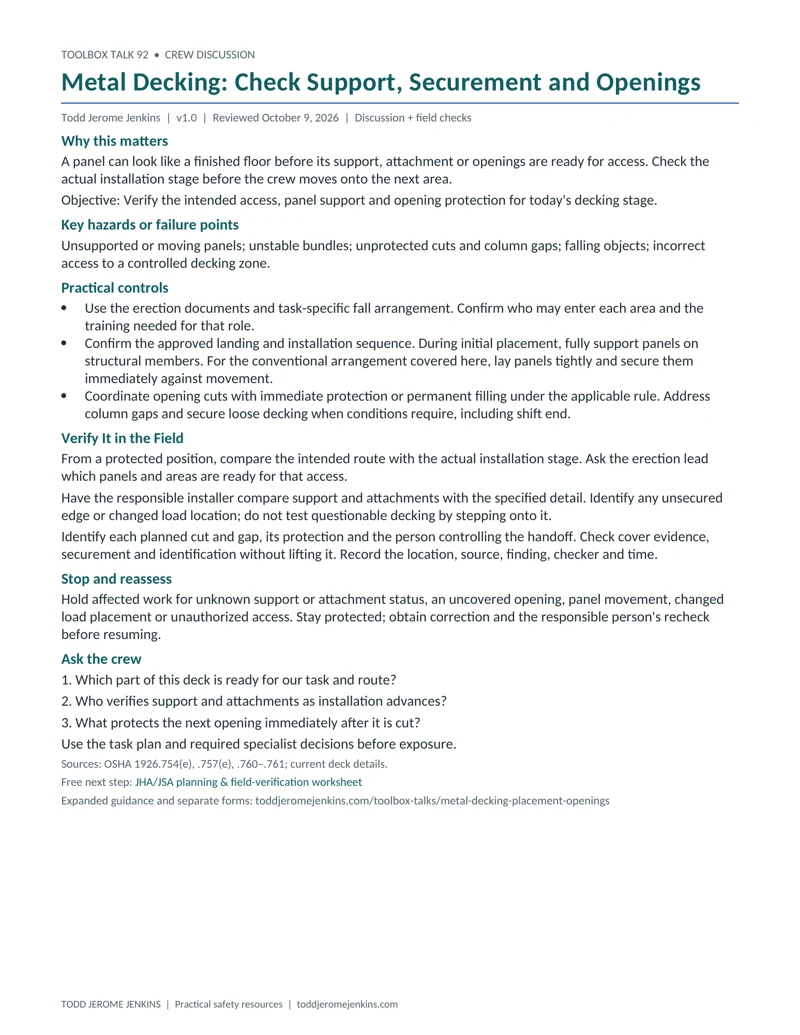
Preview the one-page crew talk
Supporting documents
Included with free Safety & Systems membership.
Supervisor field check
A separate check to verify conditions and controls before work. Includes a one-page PDF and editable Word file.
Attendance sheet
A separate sign-in sheet to record the crew discussion. Includes a one-page PDF and editable Word file.
Need the crew records? Join free to use these supporting documents and the Safety & Systems Academy. No payment details. Email updates are optional.
Get supporting documents — free membershipAlready a member? Use the same link to sign in.
A 5–10 minute crew discussion, plus time to verify the actual controls. The crew talk and Word version are public. Separate supervisor and attendance records are included with free Safety & Systems membership.
Why this matters
A panel can look like a finished floor before its support, attachment or openings are ready for access. Check the actual installation stage before the crew moves onto the next area.
Learning objective
Verify the intended access, panel support and opening protection for today's decking stage.
Key hazards or failure points
Unsupported or moving panels; unstable bundles; unprotected cuts and column gaps; falling objects; incorrect access to a controlled decking zone.
Practical controls
- Use the erection documents and task-specific fall arrangement. Confirm who may enter each area and the training needed for that role.
- Confirm the approved landing and installation sequence. During initial placement, fully support panels on structural members. For the conventional arrangement covered here, lay panels tightly and secure them immediately against movement.
- Coordinate opening cuts with immediate protection or permanent filling under the applicable rule. Address column gaps and secure loose decking when conditions require, including shift end.
Verify It in the Field
- From a protected position, compare the intended route with the actual installation stage. Ask the erection lead which panels and areas are ready for that access.
- Have the responsible installer compare support and attachments with the specified detail. Identify any unsecured edge or changed load location; do not test questionable decking by stepping onto it.
- Identify each planned cut and gap, its protection and the person controlling the handoff. Check cover evidence, securement and identification without lifting it. Record the location, source, finding, checker and time.
Stop and reassess
Hold affected work for unknown support or attachment status, an uncovered opening, panel movement, changed load placement or unauthorized access. Stay protected; obtain correction and the responsible person's recheck before resuming.
Crew discussion questions
- Which part of this deck is ready for our task and route?
- Who verifies support and attachments as installation advances?
- What protects the next opening immediately after it is cut?
For each required control, record its acceptance source and criterion, safe verification method, responsible checker, actual result and time. Use VERIFIED, HOLD/NOT VERIFIED, or N/A with a reason. A tick alone is not evidence. Complete all applicable task inspections; do not enter danger or improvise a test to fill out a form.
Leader preparation and practical detail
Discuss the installation stage
Illustrative situation: a follow-on worker sees continuous decking and starts toward a marked installation area. The lead stops entry and confirms the worker's route and the area's status. Appearance is not a release record. Identify the bay, activity, restrictions and person accepting the next step.
Keep opening work coordinated
Under 1926.754(e), opening covers need verified capacity, securement and warning identification. An installed skylight is not automatically a suitable cover. Do not provide a universal sheet thickness or fastening pattern; obtain the applicable design and acceptance evidence before cutting.
Check bundle loads separately
Deck bundles landed on steel joists are subject to 1926.757(e)(4). Its alternate route requires every stated condition, including a qualified-person determination documented in the site-specific erection plan. A bundle weight alone does not establish permission. Confirm the approved landing location and current bridging/connection status through the erection lead.
A CDZ is a restricted arrangement
A controlled decking zone under 1926.760(c) applies only to qualifying initial decking work and has specific limits, training and access restrictions. It does not authorize general traffic. Final deck attachment and shear-connector installation are prohibited within the CDZ. This briefing does not establish or approve a CDZ; obtain the complete task arrangement before work.
Train for the actual role
Section 1926.761 requires fall-hazard instruction and special CDZ training where used, delivered by qualified persons. Ask workers to explain their permitted route, role and response to a changed opening. Attendance at this short talk is not a substitute for that training.
Use the worked example within its limits
The related Metal Deck Installation JHA uses conventional fall protection and does not authorize a controlled decking zone. A different method needs its own task assessment and applicable controls.
Short supervisor field check
- Current deck area, task and permitted access identified.
- Required support and attachment status verified.
- Bundle landing and joist-load conditions confirmed.
- Cuts, covers and column gaps protected.
- Training, fall arrangement and change handoff confirmed.
Confirm the relevant trained/authorized people, unresolved items, interim protection, correction owner and recheck. Record required release authority and rebrief anyone affected. The separate sheet supports these records; it does not replace a specialist inspection, permit or engineering determination.
Attendance and follow-through
Use the separate attendance sheet for participants, roles, discussion concerns, actions and late-arrival rebriefs. Attendance is not proof of competence, functioning controls or authorization to work. Keep completed records private under employer procedures.
Technical scope and references
Reviewed October 9, 2026 for construction crew preparation. Apply the actual task, jurisdiction and relevant standard provisions. Manufacturer sources below are reference examples, not approval of your equipment. No site-specific design, permit, exposure assessment, product SDS or current model manual was supplied; obtain the applicable documents before work. This discussion does not replace required training.
- OSHA 1926.754(e) — Metal decking — Placement, support, securement, cuts, openings and covers during steel erection.
- OSHA 1926.757(e) — Loads on steel joists — Joist loading and all conditions governing deck-bundle placement.
- OSHA 1926.760 — Steel-erection fall protection — Task-specific protection, controlled decking zones and retained protection.
- OSHA 1926.761 — Training — Fall-hazard and special CDZ training; qualified trainers.
- OSHA 1926.750 — Scope — Apply Subpart R to covered steel-erection activities.
Connect this discussion to your JHA/JSA
Use the related worked JHA/JSA/AHA example to prepare task steps, hazards and controls. Return to What Changed Today? when the plan or conditions change.
Related Todd Jerome Jenkins article: How to Conduct a Job Safety Analysis.
Related crew discussions
Put one check into practice
Use the free JHA/JSA planning and field-verification worksheet to record today’s change, the required protection and the evidence needed before exposure.