Download the talk and separate crew records
Free to download without an account. Each PDF is one page. Use the Word version to adapt the record to your task and approved procedures.
Supervisor field check
Download supervisor field check (PDF, 1 page)Editable supervisor field check (Word)Preview the one-page crew talk
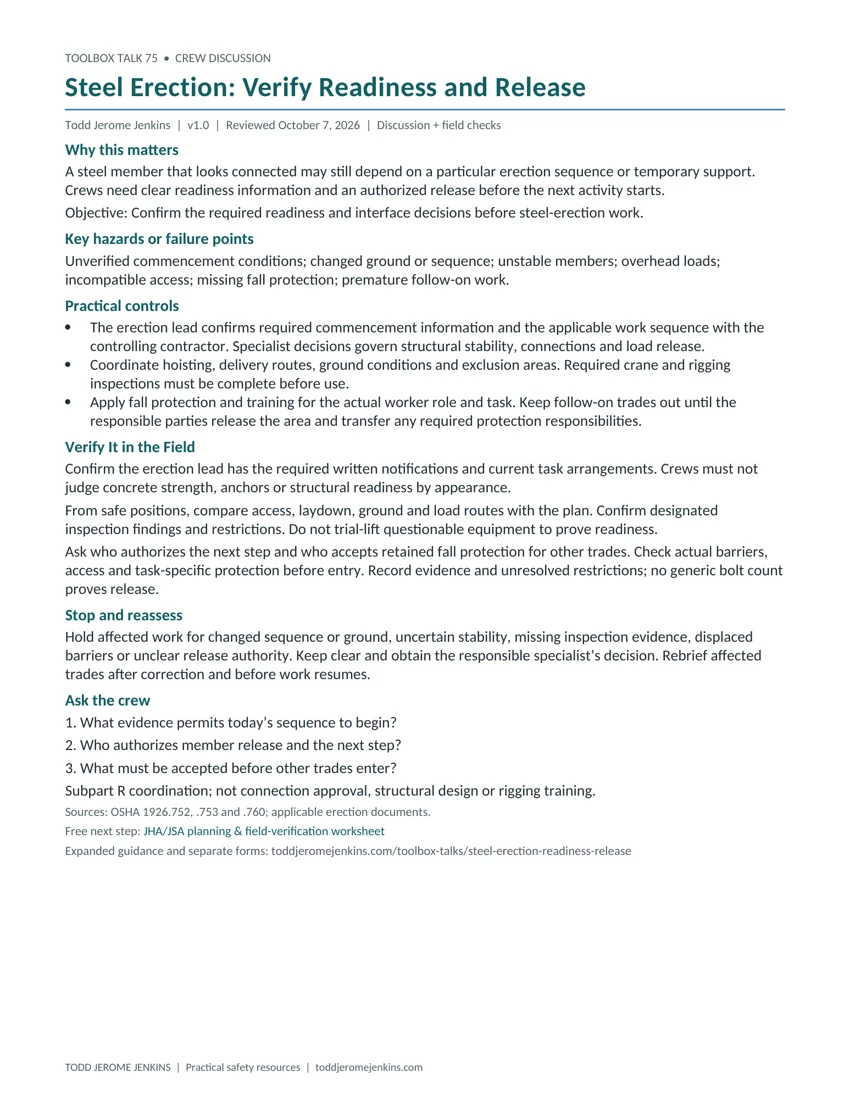
A 5–10 minute crew discussion, plus the time needed for field verification. All six downloads are free without a required signup.
Why this matters
A steel member that looks connected may still depend on a particular erection sequence or temporary support. Crews need clear readiness information and an authorized release before the next activity starts.
Learning objective: Confirm the required readiness and interface decisions before steel-erection work.
Key hazards or failure points
Unverified commencement conditions; changed ground or sequence; unstable members; overhead loads; incompatible access; missing fall protection; premature follow-on work.
Practical controls
- The erection lead confirms required commencement information and the applicable work sequence with the controlling contractor. Specialist decisions govern structural stability, connections and load release.
- Coordinate hoisting, delivery routes, ground conditions and exclusion areas. Required crane and rigging inspections must be complete before use.
- Apply fall protection and training for the actual worker role and task. Keep follow-on trades out until the responsible parties release the area and transfer any required protection responsibilities.
Verify It in the Field
Confirm the erection lead has the required written notifications and current task arrangements. Crews must not judge concrete strength, anchors or structural readiness by appearance.
From safe positions, compare access, laydown, ground and load routes with the plan. Confirm designated inspection findings and restrictions. Do not trial-lift questionable equipment to prove readiness.
Ask who authorizes the next step and who accepts retained fall protection for other trades. Check actual barriers, access and task-specific protection before entry. Record evidence and unresolved restrictions; no generic bolt count proves release.
Use the separate field check to record the acceptance source and criterion, safe method, checker, actual result and time. Mark VERIFIED, HOLD/NOT VERIFIED, or N/A with a reason. A checkmark alone is not evidence that protection works. Complete all required task checks; do not enter danger or improvise a test.
| Control | Safe verification | Evidence |
|---|---|---|
| Commencement readiness | Erection lead confirms required written notifications. | Notification reference, scope and unresolved condition. |
| Ready lift interfaces | Confirm current routes, ground and required inspection evidence. | Actual findings, responsible inspectors and restrictions. |
| Controlled follow-on entry | Confirm area release and applicable protection custody. | Releasing/accepting parties, time and access limits. |
Stop and reassess
Hold affected work for changed sequence or ground, uncertain stability, missing inspection evidence, displaced barriers or unclear release authority. Keep clear and obtain the responsible specialist’s decision. Rebrief affected trades after correction and before work resumes.
Crew discussion questions
- What evidence permits today’s sequence to begin?
- Who authorizes member release and the next step?
- What must be accepted before other trades enter?
A situation to discuss
Illustrative situation: a follow-on crew asks to enter a newly erected area because the crane has moved away. The supervisor holds access until the erection and controlling-contractor representatives confirm area readiness and responsibility for retained protection.
Leader preparation and practical detail
Confirm readiness without guessing strength
Construction 1926.752 sets commencement notification and site-layout requirements, including access and work areas. The crew check should confirm the responsible lead has the required evidence; it is not an invitation to estimate concrete strength or anchor adequacy. Its specific qualified-person erection-plan requirement applies to the stated alternate-method situations, not automatically every steel task. [1]
Coordinate the lift interfaces
Section 1926.753 addresses crane and rigging inspections, planned routes and working beneath suspended loads. General crews must stay outside the required restrictions. Specialized exceptions for particular erection duties do not authorize bystanders to work below a load. Use the erection-specific arrangements and specialist decisions rather than borrow a generic lift example as approval. [2]
Release protection with the area
Section 1926.760 has role- and task-specific fall provisions. Do not borrow a connector or controlled-decking exception for another worker. It also addresses controlling-contractor acceptance of fall protection retained for other trades. Confirm the transfer and usable protection before follow-on access. This talk provides no universal fall height, bolt count or structural release criterion. [3]
Short supervisor field check
- Required commencement notifications confirmed.
- Current sequence and specialist release roles understood.
- Ground, routes and inspection restrictions checked.
- Task-specific fall protection and access verified.
- Follow-on release and protection custody accepted.
Record unresolved items, restrictions, correction owner, recheck result and required restart authorization. Reference permits and specialist inspections rather than treating this form as a replacement. Rebrief workers affected by a change.
Attendance and follow-through
Use the separate attendance sheet for participants, discussion concerns, actions and late-arrival rebriefs. Attendance does not establish competence, verify controls or authorize work. Keep completed records private under the employer’s recordkeeping procedures.
Technical scope and references
Construction steel-erection coordination under Subpart R. Structural stability, connections and release require applicable erection documents and specialist decisions beyond this briefing. It does not replace engineering, connector training, rigging qualification or crane procedures. [1–3]
References reviewed October 7, 2026. Apply the industry, activity and jurisdiction that govern the work. No actual site permit, equipment manual, exposure assessment or engineering determination was supplied for this general discussion.
- OSHA 1926.752 — Site layout and construction sequence — Commencement notifications, site conditions and specified erection-plan triggers.
- OSHA 1926.753 — Hoisting and rigging — Steel-erection inspection, load-route and overhead-exposure provisions.
- OSHA 1926.760 — Fall protection — Task-dependent protection and custody for follow-on trades.
Connect this discussion to your JHA/JSA
Use How to Conduct a Job Safety Analysis to connect task steps, hazards and controls. Revisit Pre-Job JHA/JSA: What Changed Today? when conditions change.
Related crew discussions
- Line of Fire: Swing Radius & Suspended Loads
- Rigging: Before the Load Moves
- Fall Prevention: Verify the Controls
- Competent Person: Know Who Can Correct the Hazard
- Barricades: What Does This Boundary Keep Out?
- Site-Specific Safety Plan: Check the Interfaces Today
Put one check into practice
Use the free JHA/JSA planning and field-verification worksheet to record today’s changes, important controls and the evidence needed before exposure.