Download the free crew talk
The one-page talk, editable Word version, and guidance below are open to everyone. No account required.
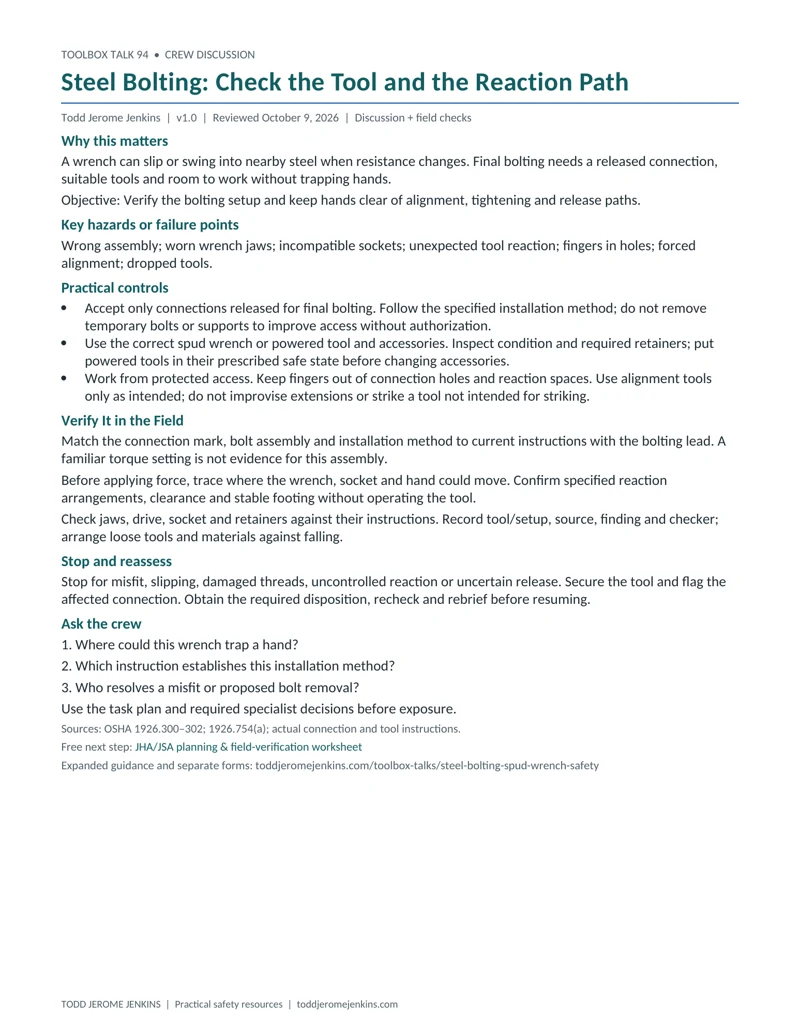
Preview the one-page crew talk
Supporting documents
Included with free Safety & Systems membership.
Supervisor field check
A separate check to verify conditions and controls before work. Includes a one-page PDF and editable Word file.
Attendance sheet
A separate sign-in sheet to record the crew discussion. Includes a one-page PDF and editable Word file.
Need the crew records? Join free to use these supporting documents and the Safety & Systems Academy. No payment details. Email updates are optional.
Get supporting documents — free membershipAlready a member? Use the same link to sign in.
A 5–10 minute crew discussion, plus time to verify the actual controls. The crew talk and Word version are public. Separate supervisor and attendance records are included with free Safety & Systems membership.
Why this matters
A wrench can slip or swing into nearby steel when resistance changes. Final bolting needs a released connection, suitable tools and room to work without trapping hands.
Learning objective
Verify the bolting setup and keep hands clear of alignment, tightening and release paths.
Key hazards or failure points
Wrong assembly; worn wrench jaws; incompatible sockets; unexpected tool reaction; fingers in holes; forced alignment; dropped tools.
Practical controls
- Accept only connections released for final bolting. Follow the specified installation method; do not remove temporary bolts or supports to improve access without authorization.
- Use the correct spud wrench or powered tool and accessories. Inspect condition and required retainers; put powered tools in their prescribed safe state before changing accessories.
- Work from protected access. Keep fingers out of connection holes and reaction spaces. Use alignment tools only as intended; do not improvise extensions or strike a tool not intended for striking.
Verify It in the Field
- Match the connection mark, bolt assembly and installation method to current instructions with the bolting lead. A familiar torque setting is not evidence for this assembly.
- Before applying force, trace where the wrench, socket and hand could move. Confirm specified reaction arrangements, clearance and stable footing without operating the tool.
- Check jaws, drive, socket and retainers against their instructions. Record tool/setup, source, finding and checker; arrange loose tools and materials against falling.
Stop and reassess
Stop for misfit, slipping, damaged threads, uncontrolled reaction or uncertain release. Secure the tool and flag the affected connection. Obtain the required disposition, recheck and rebrief before resuming.
Crew discussion questions
- Where could this wrench trap a hand?
- Which instruction establishes this installation method?
- Who resolves a misfit or proposed bolt removal?
For each required control, record its acceptance source and criterion, safe verification method, responsible checker, actual result and time. Use VERIFIED, HOLD/NOT VERIFIED, or N/A with a reason. A tick alone is not evidence. Complete all applicable task inspections; do not enter danger or improvise a test to fill out a form.
Leader preparation and practical detail
Keep final bolting separate from initial release
This briefing follows the related final-bolting JHA: a stabilized frame, released connections and protected access. It excludes initial connecting under a suspended load and alteration of loaded connections. TBT91 covers the initial connection handoff; TBT10 and41 provide general tool checks.
A spud wrench is not permission to force a connection
Use the actual tool instructions to establish its intended alignment and wrenching functions. Keep fingers out of holes. If the connection will not fit using the approved method, identify the connection and obtain the required erection/design disposition. No model manual was supplied, so this talk does not prescribe striking, leverage or alignment force.
Distinguish condition from installation acceptance
OSHA 1926.301 prohibits unsafe hand tools, including wrench jaws that permit slipping and mushroomed impact-tool heads. Sections 1926.300–302 address safe tool condition, guarding and power-source provisions. These rules do not supply bolt pretension, torque, tightening sequence or installation inspection criteria; obtain those from the project-specified method.
Verify the reaction arrangement before use
Illustrative situation: a replacement powered wrench fits the socket but places its reaction movement against nearby steel. The crew holds that setup and selects a permitted arrangement with adequate clearance. Gloves do not make a trapped-hand position acceptable. Follow the actual tool procedure for isolating energy and changing accessories.
Short supervisor field check
- Connection and method identified.
- Temporary support remains intact.
- Tools and accessories suitable and sound.
- Access, reaction path and hand clearance checked.
- Defects and open connections handed over.
Confirm the relevant trained/authorized people, unresolved items, interim protection, correction owner and recheck. Record required release authority and rebrief anyone affected. The separate sheet supports these records; it does not replace a specialist inspection, permit or engineering determination.
Attendance and follow-through
Use the separate attendance sheet for participants, roles, discussion concerns, actions and late-arrival rebriefs. Attendance is not proof of competence, functioning controls or authorization to work. Keep completed records private under employer procedures.
Technical scope and references
Reviewed October 9, 2026 for construction crew preparation. Apply the actual task, jurisdiction and relevant standard provisions. Manufacturer sources below are reference examples, not approval of your equipment. No site-specific design, permit, exposure assessment, product SDS or current model manual was supplied; obtain the applicable documents before work. This discussion does not replace required training.
- OSHA 1926.301 — Construction hand-tool condition; wrench jaws and impact-tool heads.
- OSHA 1926.300 — Safe tool condition, guards and task-specific PPE.
- OSHA 1926.302 — Power-source-specific tool requirements, including pneumatic retention.
- OSHA 1926.754(a) — Maintain structural stability during erection; no generic bolt installation criterion.
Connect this discussion to your JHA/JSA
Use the related worked JHA/JSA/AHA example to prepare task steps, hazards and controls. Return to What Changed Today? when the plan or conditions change.
Related Todd Jerome Jenkins article: How to Conduct a Job Safety Analysis.
Related crew discussions
- Connecting Structural Steel Safely
- Hand Tools Condition Selection Line Of Fire
- Dropped Object Prevention Steel Work
Put one check into practice
Use the free JHA/JSA planning and field-verification worksheet to record today’s change, the required protection and the evidence needed before exposure.