Download the free crew talk
The one-page talk, editable Word version, and guidance below are open to everyone. No account required.
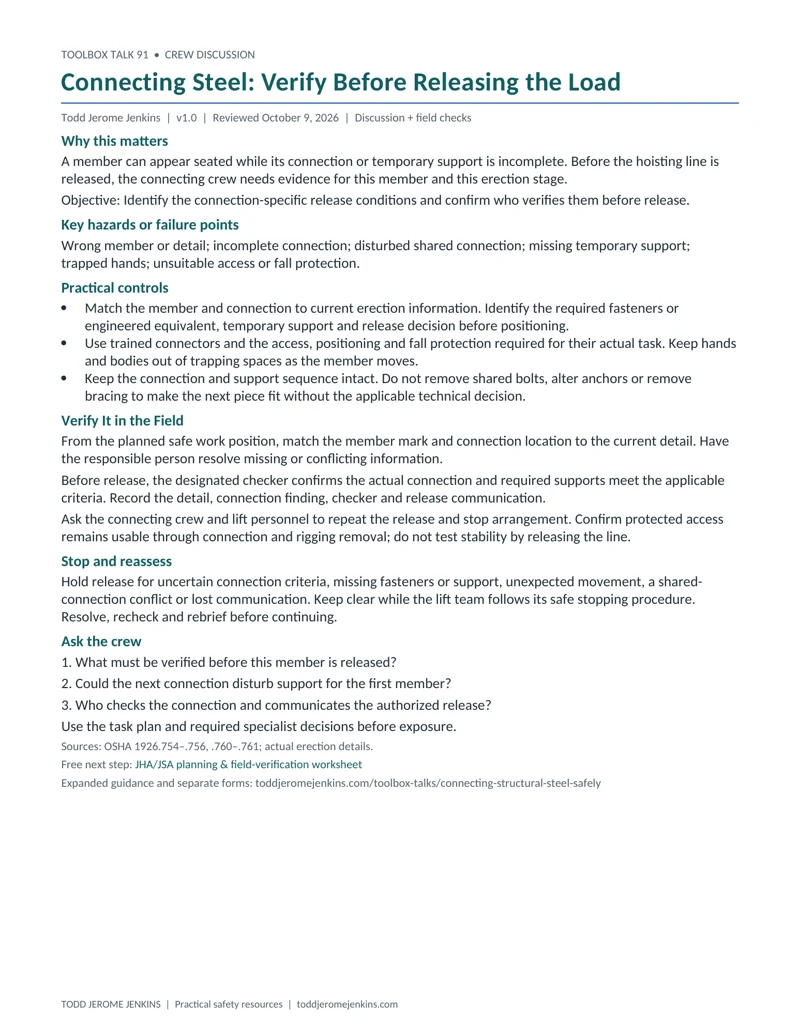
Preview the one-page crew talk
Supporting documents
Included with free Safety & Systems membership.
Supervisor field check
A separate check to verify conditions and controls before work. Includes a one-page PDF and editable Word file.
Attendance sheet
A separate sign-in sheet to record the crew discussion. Includes a one-page PDF and editable Word file.
Need the crew records? Join free to use these supporting documents and the Safety & Systems Academy. No payment details. Email updates are optional.
Get supporting documents — free membershipAlready a member? Use the same link to sign in.
A 5–10 minute crew discussion, plus time to verify the actual controls. The crew talk and Word version are public. Separate supervisor and attendance records are included with free Safety & Systems membership.
Why this matters
A member can appear seated while its connection or temporary support is incomplete. Before the hoisting line is released, the connecting crew needs evidence for this member and this erection stage.
Learning objective
Identify the connection-specific release conditions and confirm who verifies them before release.
Key hazards or failure points
Wrong member or detail; incomplete connection; disturbed shared connection; missing temporary support; trapped hands; unsuitable access or fall protection.
Practical controls
- Match the member and connection to current erection information. Identify the required fasteners or engineered equivalent, temporary support and release decision before positioning.
- Use trained connectors and the access, positioning and fall protection required for their actual task. Keep hands and bodies out of trapping spaces as the member moves.
- Keep the connection and support sequence intact. Do not remove shared bolts, alter anchors or remove bracing to make the next piece fit without the applicable technical decision.
Verify It in the Field
- From the planned safe work position, match the member mark and connection location to the current detail. Have the responsible person resolve missing or conflicting information.
- Before release, the designated checker confirms the actual connection and required supports meet the applicable criteria. Record the detail, connection finding, checker and release communication.
- Ask the connecting crew and lift personnel to repeat the release and stop arrangement. Confirm protected access remains usable through connection and rigging removal; do not test stability by releasing the line.
Stop and reassess
Hold release for uncertain connection criteria, missing fasteners or support, unexpected movement, a shared-connection conflict or lost communication. Keep clear while the lift team follows its safe stopping procedure. Resolve, recheck and rebrief before continuing.
Crew discussion questions
- What must be verified before this member is released?
- Could the next connection disturb support for the first member?
- Who checks the connection and communicates the authorized release?
For each required control, record its acceptance source and criterion, safe verification method, responsible checker, actual result and time. Use VERIFIED, HOLD/NOT VERIFIED, or N/A with a reason. A tick alone is not evidence. Complete all applicable task inspections; do not enter danger or improvise a test to fill out a form.
Leader preparation and practical detail
Focus on the connection handoff
Illustrative situation: a second beam arrives at shared connection holes. The crew pauses before disturbing the first connection and verifies the applicable double-connection arrangement. A nearby bolt is not evidence that the first member will remain supported. Use Steel Erection: Verify Readiness and Release for site commencement and follow-on access; this briefing focuses on the individual connection handoff.
Use the actual member rule
OSHA 1926.756 distinguishes solid-web member placement, cantilevers, diagonal bracing and double connections. Its minimum connection requirements are not interchangeable. A competent person determines whether cantilever stability needs additional bolts. The prescribed equivalent, where allowed, comes from the project structural engineer of record. Identify the exact applicable provision and erection detail; this talk does not replace them with a universal release count.
Protect the first connection
Section 1926.756(c) addresses common-hole double connections and specific requirements for retaining the first connection or using a designed seat or equivalent device. Do not treat temporary support as permission to remove arbitrary fasteners. Have the trained crew establish the compliant sequence before making the connection.
Keep stability and roles explicit
Section 1926.754 requires stability throughout erection. Its plumbing-up provisions require competent-person decisions about necessary equipment and approval for removal. For columns, 1926.755 separately addresses competent-person bracing evaluation and structural-engineer approval of anchor-rod changes. A release to detach rigging does not automatically release temporary bracing or authorize a new construction load.
Check the connector assignment
Sections 1926.760 and 1926.761 contain task-specific fall protection and connector training requirements. Confirm that the assigned work, access and protection match the worker’s training and actual exposure. Do not borrow a connector exception for other workers or treat this discussion as connector training. No fall-height exemption, bolt torque, anchor capacity or engineering procedure is supplied.
Use the related JHA within its scope
The related Structural Steel Initial Beam Connecting JHA addresses initial solid-web beam connections using conventional protected access. It excludes double connections, joists and multiple lifts. Use it only where its scope matches; the double-connection discussion here identifies a separate hazard requiring the applicable procedure.
Short supervisor field check
- Member, location and current connection detail matched.
- Required connection and temporary support verified.
- Assigned connectors and task-specific protection confirmed.
- Checker, stop method and release communication agreed.
- Changes resolved and release evidence recorded.
Confirm the relevant trained/authorized people, unresolved items, interim protection, correction owner and recheck. Record required release authority and rebrief anyone affected. The separate sheet supports these records; it does not replace a specialist inspection, permit or engineering determination.
Attendance and follow-through
Use the separate attendance sheet for participants, roles, discussion concerns, actions and late-arrival rebriefs. Attendance is not proof of competence, functioning controls or authorization to work. Keep completed records private under employer procedures.
Technical scope and references
Reviewed October 9, 2026 for construction crew preparation. Apply the actual task, jurisdiction and relevant standard provisions. Manufacturer sources below are reference examples, not approval of your equipment. No site-specific design, permit, exposure assessment, product SDS or current model manual was supplied; obtain the applicable documents before work. This discussion does not replace required training.
- OSHA 1926.754(a) and (d) — Structural stability and plumbing-up equipment decisions.
- OSHA 1926.755(a)(4) and (b) — Column bracing evaluation and anchor-rod changes; apply column-specific scope.
- OSHA 1926.756 — Member-specific connection and release rules, including cantilevers, diagonal bracing and double connections.
- OSHA 1926.760 — Steel-erection fall protection with task-specific connector provisions.
- OSHA 1926.761 — Qualified training personnel, fall-hazard and connector training.
Connect this discussion to your JHA/JSA
Use the related worked JHA/JSA/AHA example to prepare task steps, hazards and controls. Return to What Changed Today? when the plan or conditions change.
Related Todd Jerome Jenkins article: How to Conduct a Job Safety Analysis.
Related crew discussions
Put one check into practice
Use the free JHA/JSA planning and field-verification worksheet to record today’s change, the required protection and the evidence needed before exposure.