Download the free crew talk
The one-page talk, editable Word version, and guidance below are open to everyone. No account required.
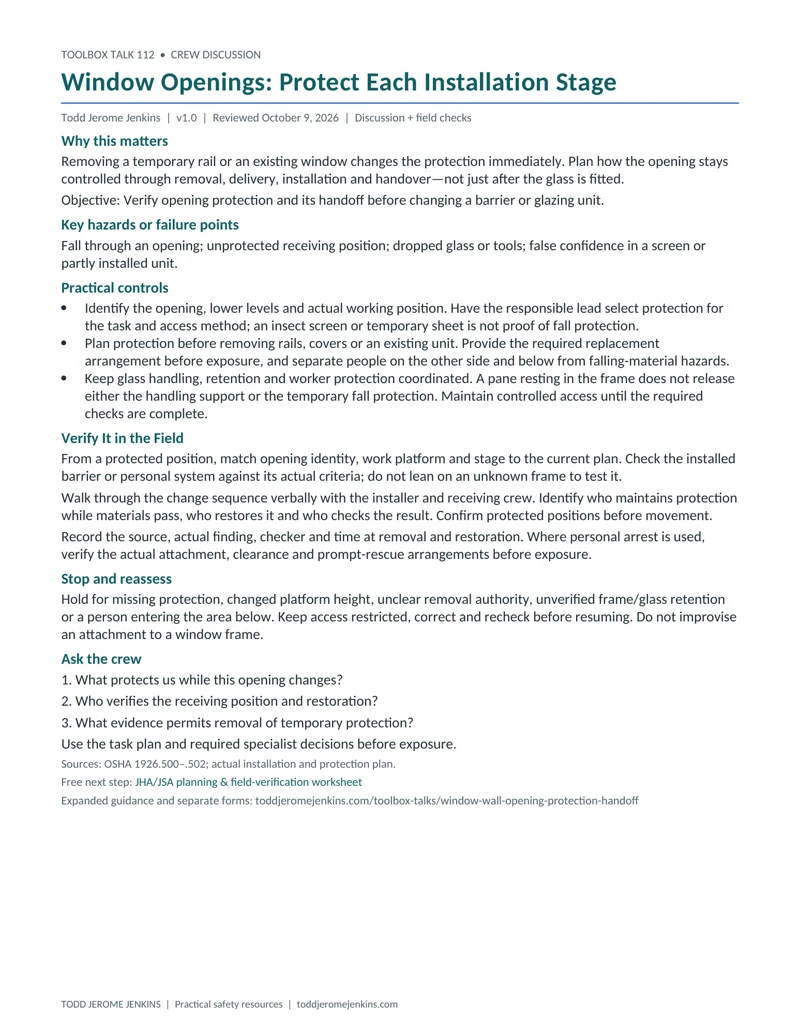
Preview the one-page crew talk
Supporting documents
Included with free Safety & Systems membership.
Supervisor field check
A separate check to verify conditions and controls before work. Includes a one-page PDF and editable Word file.
Attendance sheet
A separate sign-in sheet to record the crew discussion. Includes a one-page PDF and editable Word file.
Need the crew records? Join free to use these supporting documents and the Safety & Systems Academy. No payment details. Email updates are optional.
Get supporting documents — free membershipAlready a member? Use the same link to sign in.
A 5–10 minute crew discussion, plus time to verify the actual controls. The crew talk and Word version are public. Separate supervisor and attendance records are included with free Safety & Systems membership.
Why this matters
Removing a temporary rail or an existing window changes the protection immediately. Plan how the opening stays controlled through removal, delivery, installation and handover—not just after the glass is fitted.
Learning objective
Verify opening protection and its handoff before changing a barrier or glazing unit.
Key hazards or failure points
Fall through an opening; unprotected receiving position; dropped glass or tools; false confidence in a screen or partly installed unit.
Practical controls
- Identify the opening, lower levels and actual working position. Have the responsible lead select protection for the task and access method; an insect screen or temporary sheet is not proof of fall protection.
- Plan protection before removing rails, covers or an existing unit. Provide the required replacement arrangement before exposure, and separate people on the other side and below from falling-material hazards.
- Keep glass handling, retention and worker protection coordinated. A pane resting in the frame does not release either the handling support or the temporary fall protection. Maintain controlled access until the required checks are complete.
Verify It in the Field
- From a protected position, match opening identity, work platform and stage to the current plan. Check the installed barrier or personal system against its actual criteria; do not lean on an unknown frame to test it.
- Walk through the change sequence verbally with the installer and receiving crew. Identify who maintains protection while materials pass, who restores it and who checks the result. Confirm protected positions before movement.
- Record the source, actual finding, checker and time at removal and restoration. Where personal arrest is used, verify the actual attachment, clearance and prompt-rescue arrangements before exposure.
Stop and reassess
Hold for missing protection, changed platform height, unclear removal authority, unverified frame/glass retention or a person entering the area below. Keep access restricted, correct and recheck before resuming. Do not improvise an attachment to a window frame.
Crew discussion questions
- What protects us while this opening changes?
- Who verifies the receiving position and restoration?
- What evidence permits removal of temporary protection?
For each required control, record its acceptance source and criterion, safe verification method, responsible checker, actual result and time. Use VERIFIED, HOLD/NOT VERIFIED, or N/A with a reason. A tick alone is not evidence. Complete all applicable task inspections; do not enter danger or improvise a test to fill out a form.
Leader preparation and practical detail
Assess the actual standing surface
For wall openings within its scope, 1926.501(b)(14) requires guardrails, a safety net or personal arrest when the outside bottom edge is at least six feet above the lower level and the inside bottom edge is less than 39 inches above the walking/working surface. Review the opening definition in 1926.500 and other applicable duties. Raising the work platform can change the exposure; a sill height measured only from the floor may not describe the task.
Separate hoist receiving from ordinary access
An opening used to receive hoisted materials may also engage 1926.501(b)(3). Required protection cannot disappear simply because a rail obstructs delivery. Have the lift/access lead establish the protected receiving method before moving a guardrail section. Do not convert a window into a loading bay without reviewing the resulting task.
Confirm retention without treating glazing as a guard
Illustrative situation: a unit has been placed but its specified retainers are incomplete. The crew keeps handling support and the protected work arrangement until the installation lead confirms the applicable completion evidence. Glass type or appearance does not establish that the entire installed assembly is approved as a worker barrier. Obtain design/system evidence where that function is intended.
Use the related JHA within its boundary
The storefront JHA illustrates both-side separation and retention before handling release at ground level. It expressly excludes elevated glazing and curtain walls, so it cannot approve an upper-story window task. Add the actual access, fall protection, lifting and rescue analysis for that work. Use TBT04 for detailed fall-system verification; this talk focuses on the opening’s change of status.
Apply this briefing to roofing and siding work
Siding around wall openings: coordinate the inside and outside crews
Housewrap, flashing and temporary sheathing can hide an opening or its protection. Before siding work reaches a window or door, the exterior lead and the person controlling the interior area identify the opening, both working positions and every barrier that the task could disturb. A weather barrier does not establish a worker-protection barrier.
Verify before removal: From protected positions, compare the actual opening and standing surfaces with the applicable wall-opening requirements and site plan. Work from a scaffold or aerial lift also needs its own protection review. If trim removal, fastening or panel placement conflicts with a guardrail attachment, arrange the alternative protection and responsible installer before changing it. Do not remove protection first and ask the interior crew to stay back afterward.
Confirm how fasteners, tools and offcuts will remain controlled, including the area inside and below the opening. Coordinate any material pass-through as a separate receiving step. Neither a partly installed window nor temporary infill is accepted as fall protection without the necessary system evidence.
Record: opening ID, interior/exterior work positions, applicable protection and installation references, removal/restoration roles, actual findings, verifier and time. Hold for an unexpected opening, changed platform height, hidden or damaged protection, or an interior crew entering the affected area. Verify restored protection before either crew releases the opening. Do not lean against an unknown panel or frame as an inspection test.
Sources checked October 9, 2026: OSHA 1926.501(b)(14), (c) and 1926.502.
Record the acceptance source, safe check method, assigned verifier, actual result and time. Hold affected work for an unresolved required control; correct, recheck and rebrief before authorized restart.
Short supervisor field check
- Opening and actual work position identified.
- Protection selected and checked for each stage.
- Both sides and area below coordinated.
- Removal, restoration and rescue roles confirmed.
- Retention and protection handover recorded.
Confirm the relevant trained/authorized people, unresolved items, interim protection, correction owner and recheck. Record required release authority and rebrief anyone affected. The separate sheet supports these records; it does not replace a specialist inspection, permit or engineering determination.
Attendance and follow-through
Use the separate attendance sheet for participants, roles, discussion concerns, actions and late-arrival rebriefs. Attendance is not proof of competence, functioning controls or authorization to work. Keep completed records private under employer procedures.
Technical scope and references
Reviewed October 9, 2026 for construction crew preparation. Apply the actual task, jurisdiction and relevant standard provisions. Manufacturer sources below are reference examples, not approval of your equipment. No site-specific design, permit, exposure assessment, product SDS or current model manual was supplied; obtain the applicable documents before work. This discussion does not replace required training.
- OSHA 1926.500 — Subpart M scope and wall-opening definition.
- OSHA 1926.501 — Construction fall duties: wall openings(b)(14), hoist areas(b)(3), holes(b)(4).
- OSHA 1926.502 — System criteria, protection before exposure, guardrails, arrest and covers.
Connect this discussion to your JHA/JSA
Related reference: worked JHA/JSA/AHA example. This ground-level storefront example does not cover elevated glazing. Use its separation and retention concepts within that scope; prepare the actual opening, access and fall-protection analysis for elevated work. Return to What Changed Today? when the plan or conditions change.
Related Todd Jerome Jenkins article: How to Conduct a Job Safety Analysis.
Related crew discussions
Put one check into practice
Use the free JHA/JSA planning and field-verification worksheet to record today’s change, the required protection and the evidence needed before exposure.