Download the free crew talk
The one-page talk, editable Word version, and guidance below are open to everyone. No account required.
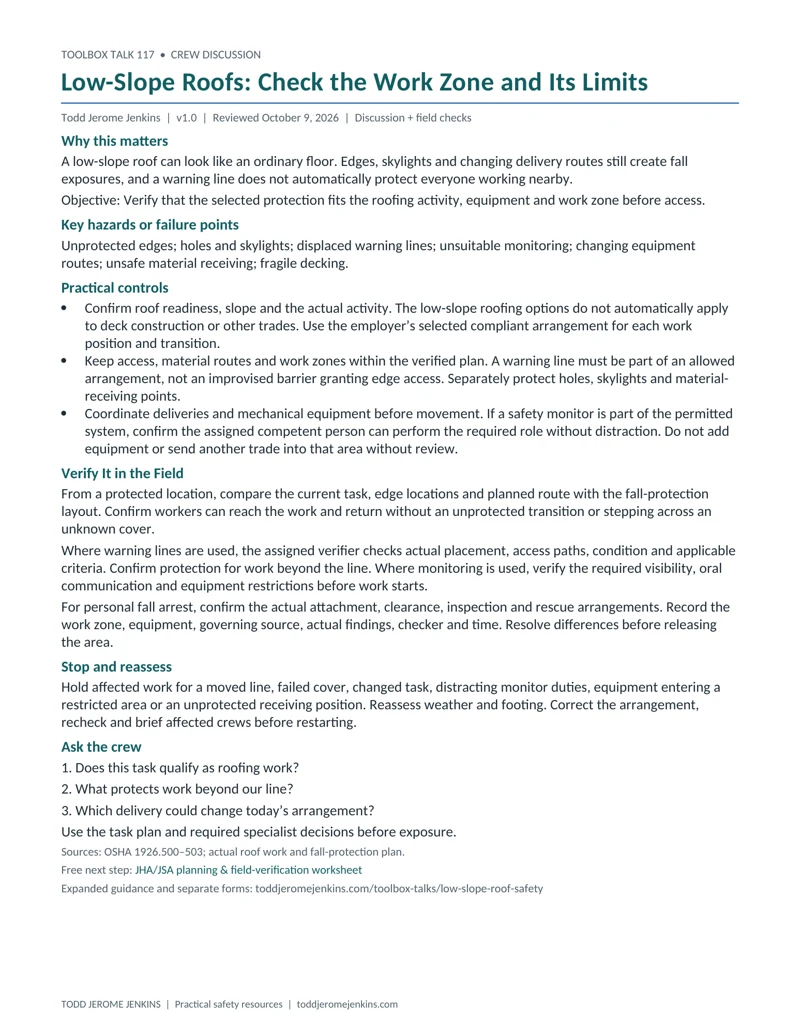
Preview the one-page crew talk
Supporting documents
Included with free Safety & Systems membership.
Supervisor field check
A separate check to verify conditions and controls before work. Includes a one-page PDF and editable Word file.
Attendance sheet
A separate sign-in sheet to record the crew discussion. Includes a one-page PDF and editable Word file.
Need the crew records? Join free to use these supporting documents and the Safety & Systems Academy. No payment details. Email updates are optional.
Get supporting documents — free membershipAlready a member? Use the same link to sign in.
A 5–10 minute crew discussion, plus time to verify the actual controls. The crew talk and Word version are public. Separate supervisor and attendance records are included with free Safety & Systems membership.
Why this matters
A low-slope roof can look like an ordinary floor. Edges, skylights and changing delivery routes still create fall exposures, and a warning line does not automatically protect everyone working nearby.
Learning objective
Verify that the selected protection fits the roofing activity, equipment and work zone before access.
Key hazards or failure points
Unprotected edges; holes and skylights; displaced warning lines; unsuitable monitoring; changing equipment routes; unsafe material receiving; fragile decking.
Practical controls
- Confirm roof readiness, slope and the actual activity. The low-slope roofing options do not automatically apply to deck construction or other trades. Use the employer’s selected compliant arrangement for each work position and transition.
- Keep access, material routes and work zones within the verified plan. A warning line must be part of an allowed arrangement, not an improvised barrier granting edge access. Separately protect holes, skylights and material-receiving points.
- Coordinate deliveries and mechanical equipment before movement. If a safety monitor is part of the permitted system, confirm the assigned competent person can perform the required role without distraction. Do not add equipment or send another trade into that area without review.
Verify It in the Field
- From a protected location, compare the current task, edge locations and planned route with the fall-protection layout. Confirm workers can reach the work and return without an unprotected transition or stepping across an unknown cover.
- Where warning lines are used, the assigned verifier checks actual placement, access paths, condition and applicable criteria. Confirm protection for work beyond the line. Where monitoring is used, verify the required visibility, oral communication and equipment restrictions before work starts.
- For personal fall arrest, confirm the actual attachment, clearance, inspection and rescue arrangements. Record the work zone, equipment, governing source, actual findings, checker and time. Resolve differences before releasing the area.
Stop and reassess
Hold affected work for a moved line, failed cover, changed task, distracting monitor duties, equipment entering a restricted area or an unprotected receiving position. Reassess weather and footing. Correct the arrangement, recheck and brief affected crews before restarting.
Crew discussion questions
- Does this task qualify as roofing work?
- What protects work beyond our line?
- Which delivery could change today’s arrangement?
For each required control, record its acceptance source and criterion, safe verification method, responsible checker, actual result and time. Use VERIFIED, HOLD/NOT VERIFIED, or N/A with a reason. A tick alone is not evidence. Complete all applicable task inspections; do not enter danger or improvise a test to fill out a form.
Leader preparation and practical detail
Low slope is a defined category
OSHA 1926.500 defines low slope as 4 in 12 or less, vertical to horizontal. Roofing work includes handling, applying and removing roofing materials and associated work; it excludes construction of the roof deck. Classify the actual activity before choosing 1926.501(b)(10). A roofer’s job title or the roof’s pitch does not extend its options to every activity.
Select the complete permitted arrangement
Plan conventional protection—guardrails, safety nets or personal fall arrest—as the default for this briefing. For covered roofing work with unprotected edges six feet or more above lower levels, 1926.501(b)(10) permits guardrails, safety nets or personal fall arrest, or its specified combinations of warning lines with those systems or safety monitoring. Warning line alone is not one of the listed combinations. The monitor-only option is limited to roofs 50 feet or less in width, determined under Appendix A, and all applicable monitoring conditions. This talk does not authorize that option or supply a width determination.
Verify the line for the actual equipment
Section 1926.502(f) contains placement and construction criteria. Without mechanical equipment, the minimum edge setback is six feet. With it, the minimum is six feet parallel to its direction of travel and ten feet perpendicular. These numbers are not permission to work unprotected beyond a line. Required access paths and line condition also matter. Use the complete rule and site arrangement rather than measuring only one setback.
Monitoring has operating limits
Under 1926.502(h), the competent monitor must be on the same working surface, see the monitored workers, communicate orally and have no duties that divert attention. Mechanical equipment cannot be used or stored in areas where monitoring protects roofing workers. Section 1926.500’s mechanical-equipment definition includes motor- or human-propelled wheeled roofing equipment, with wheelbarrows and mopcarts excepted. Other trades do not gain entry merely because a monitor is present.
Protect the separate exposures
A perimeter arrangement does not resolve skylights, roof holes or hoist-area duties. Check these separately under 1926.501 and the relevant system criteria. The EPDM JHA adds membrane handling and product-specific controls; it is not a warning-line design. Link TBT113 for skylights and TBT04 for personal-system verification, clearance and rescue. No actual roof layout or fall-system design was supplied.
Short supervisor field check
- Roof, task and applicable protection identified.
- Work-zone boundaries and access verified.
- Holes and receiving areas separately protected.
- Any monitoring and equipment restrictions met.
- Changes, rescue and restart authority understood.
Confirm the relevant trained/authorized people, unresolved items, interim protection, correction owner and recheck. Record required release authority and rebrief anyone affected. The separate sheet supports these records; it does not replace a specialist inspection, permit or engineering determination.
Attendance and follow-through
Use the separate attendance sheet for participants, roles, discussion concerns, actions and late-arrival rebriefs. Attendance is not proof of competence, functioning controls or authorization to work. Keep completed records private under employer procedures.
Technical scope and references
Reviewed October 9, 2026 for construction crew preparation. Apply the actual task, jurisdiction and relevant standard provisions. Manufacturer sources below are reference examples, not approval of your equipment. No site-specific design, permit, exposure assessment, product SDS or current model manual was supplied; obtain the applicable documents before work. This discussion does not replace required training.
- OSHA 1926.500 — Construction scope and definitions of low-slope roof, steep roof, roofing work and mechanical equipment.
- OSHA 1926.501 — Fall duties, including low-slope roofing (b)(10), steep roofs (b)(11), holes and hoist areas.
- OSHA 1926.502 — Selected system criteria, warning lines, monitors, PFAS and rescue.
- OSHA 1926.503 — Construction fall-hazard training, certification and retraining.
Connect this discussion to your JHA/JSA
Use the related worked JHA/JSA/AHA example to prepare task steps, hazards and controls. Return to What Changed Today? when the plan or conditions change.
Related Todd Jerome Jenkins article: How to Conduct a Job Safety Analysis.
Related crew discussions
Put one check into practice
Use the free JHA/JSA planning and field-verification worksheet to record today’s change, the required protection and the evidence needed before exposure.