Download the free toolbox talk
The one-page talk, editable Word version, and guidance below are open to everyone. No account required.
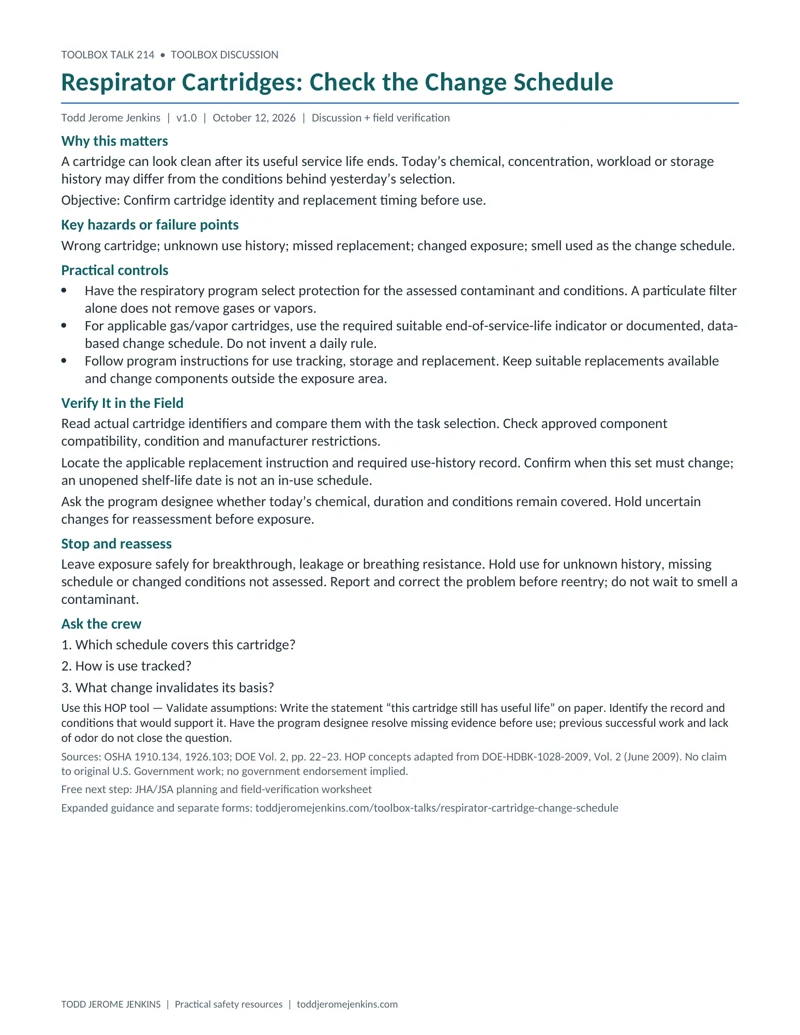
One-page toolbox talk
Download one-page toolbox talk (PDF, 1 page)Editable one-page toolbox talk (Word)Preview the one-page toolbox talk
Supporting documents
Included with free Safety & Systems membership.
Supervisor field check
A separate check to verify conditions and controls before work. Includes a one-page PDF and editable Word file.
Attendance sheet
A separate sign-in sheet to record the crew discussion. Includes a one-page PDF and editable Word file.
Need the crew records? Join free to use these supporting documents and the Safety & Systems Academy. No payment details. Email updates are optional.
Get supporting documents — free membershipAlready a member? Use the same link to sign in.
Hazard-based toolbox talk 39 of 52, with a practical HOP exercise.
Plan a 5–10 minute toolbox discussion, plus time to verify the actual controls. The one-page toolbox talk and editable Word version are public. Separate supervisor and attendance records are included with free Safety & Systems membership.
Why this matters
A cartridge can look clean after its useful service life ends. Today’s chemical, concentration, workload or storage history may differ from the conditions behind yesterday’s selection.
Learning objective
Confirm cartridge identity and replacement timing before use.
Key hazards or failure points
Wrong cartridge; unknown use history; missed replacement; changed exposure; smell used as the change schedule.
Practical controls
- Have the respiratory program select protection for the assessed contaminant and conditions. A particulate filter alone does not remove gases or vapors.
- For applicable gas/vapor cartridges, use the required suitable end-of-service-life indicator or documented, data-based change schedule. Do not invent a daily rule.
- Follow program instructions for use tracking, storage and replacement. Keep suitable replacements available and change components outside the exposure area.
Verify It in the Field
- Read actual cartridge identifiers and compare them with the task selection. Check approved component compatibility, condition and manufacturer restrictions.
- Locate the applicable replacement instruction and required use-history record. Confirm when this set must change; an unopened shelf-life date is not an in-use schedule.
- Ask the program designee whether today’s chemical, duration and conditions remain covered. Hold uncertain changes for reassessment before exposure.
Stop and reassess
Leave exposure safely for breakthrough, leakage or breathing resistance. Hold use for unknown history, missing schedule or changed conditions not assessed. Report and correct the problem before reentry; do not wait to smell a contaminant.
Crew discussion questions
- Which schedule covers this cartridge?
- How is use tracked?
- What change invalidates its basis?
For each required control, record its acceptance source and criterion, safe verification method, responsible verifier, actual result and time. Mark VERIFIED, HOLD/NOT VERIFIED, or N/A with a reason. Complete all required inspections; never enter danger or improvise a test to fill out a form.
Use this HOP tool
Validate assumptions
Write the statement “this cartridge still has useful life” on paper. Identify the record and conditions that would support it. Have the program designee resolve missing evidence before use; previous successful work and lack of odor do not close the question.
This exercise supports hazard identification or control verification. It does not replace safeguards, required training, specialist decisions or work authorization.
Leader preparation and practical detail
Make the change instruction usable
Illustrative situation: reusable cartridges return from storage without the history required by the program. A clean appearance cannot fill that gap. The program designee decides the correct disposition; the worker does not guess at remaining service life. Record the actual replacement instruction, tracking method and place to obtain fresh approved components so the next shift inherits usable information.
The schedule belongs to the exposure conditions
OSHA’s change-schedule eTool explains that contaminant mixture, concentration, work rate, temperature, humidity and storage can affect service life. The program’s objective basis must cover the actual use. A schedule copied from another chemical or work area may not. Manufacturer information and specialist evaluation supply the technical basis; this talk provides no service-life calculation or generic number of hours.
Separate filters, cartridges and failure response
Gas/vapor cartridge schedules and particulate-filter replacement are different decisions. Follow the selected equipment’s instructions and program requirements for each component. The required suitable NIOSH-certified end-of-service-life indicator is an alternative where applicable; visual cleanliness and odor are not substitutes. Air-purifying equipment supplies no oxygen. An unknown or potentially IDLH atmosphere requires appropriate specialist assessment and protection rather than a new cartridge.
Short supervisor field check
- Task selection confirmed
- Cartridge identifiers matched
- Schedule or indicator verified
- Use history and storage known
- Safe replacement available
Use the separate sheet to document evidence, unresolved restrictions, correction owner, recheck and required release authority. Rebrief affected workers. This record does not replace specialist inspections, permits or engineering determinations.
Attendance and follow-through
Use the separate attendance record for participants, roles, questions, actions and late-arrival rebriefs. Attendance does not prove competence, functioning controls or authorization. Keep completed records private under employer procedures.
Source acknowledgment
HOP concepts are adapted from DOE-HDBK-1028-2009, Human Performance Improvement Handbook, Volume 2 (June 2009). Todd Jerome Jenkins makes no claim to authorship or copyright ownership of original U.S. Government work. The explanations and exercises are original adaptations; no endorsement by DOE or the U.S. Government is implied. Third-party material credited in the handbook retains its separate ownership.
HOP source: Volume 2/VOLUME 2 VALIDATE ASSUMPTIONS.pdf; Printed pp. 22–23. The handbook supplies concepts; task-specific technical references are listed below.
Technical scope and references
Technical sources inspected October 12, 2026; resource edition October 12, 2026. Apply current jurisdictional requirements, the actual task procedure, manufacturer instructions, permits and required competent or qualified decisions. This resource supplies no equipment-specific acceptance criteria.
- OSHA 29 CFR 1910.134 — Gas/vapor protection and objective cartridge change schedule or suitable ESLI; safe failure response.
- OSHA 29 CFR 1926.103 — Applies identical respiratory requirements to construction.
- OSHA Respiratory Protection eTool — Change Schedules — Guidance on objective basis, service-life variables and limits of odor reliance.
- DOE-HDBK-1028-2009 Volume 2 — Validate assumptions — Printed pp. 22–23; historical HOP guidance adapted into an original exercise.
Connect this discussion to your JHA/JSA
Use the JHA/JSA planning and field-verification worksheet to connect this discussion to the actual task, controls and responsible people.
Related Todd Jerome Jenkins articles: How to Conduct a Job Safety Analysis and What Is Human and Organizational Performance?.
Related toolbox talks
- Respiratory Hazards: Know What You’re Breathing
- Respirator Seal Problems: Resolve the Leak Before Exposure
- Assumptions: Show What Is Known and What Is Not
Continue the hazard series
- Respirator Seal Problems: Resolve the Leak Before Exposure
- Multiple-Trade Noise: Coordinate Before the Tools Start
Put one verification into practice
Record today’s change and evidence using the free JHA/JSA planning and field-verification worksheet.