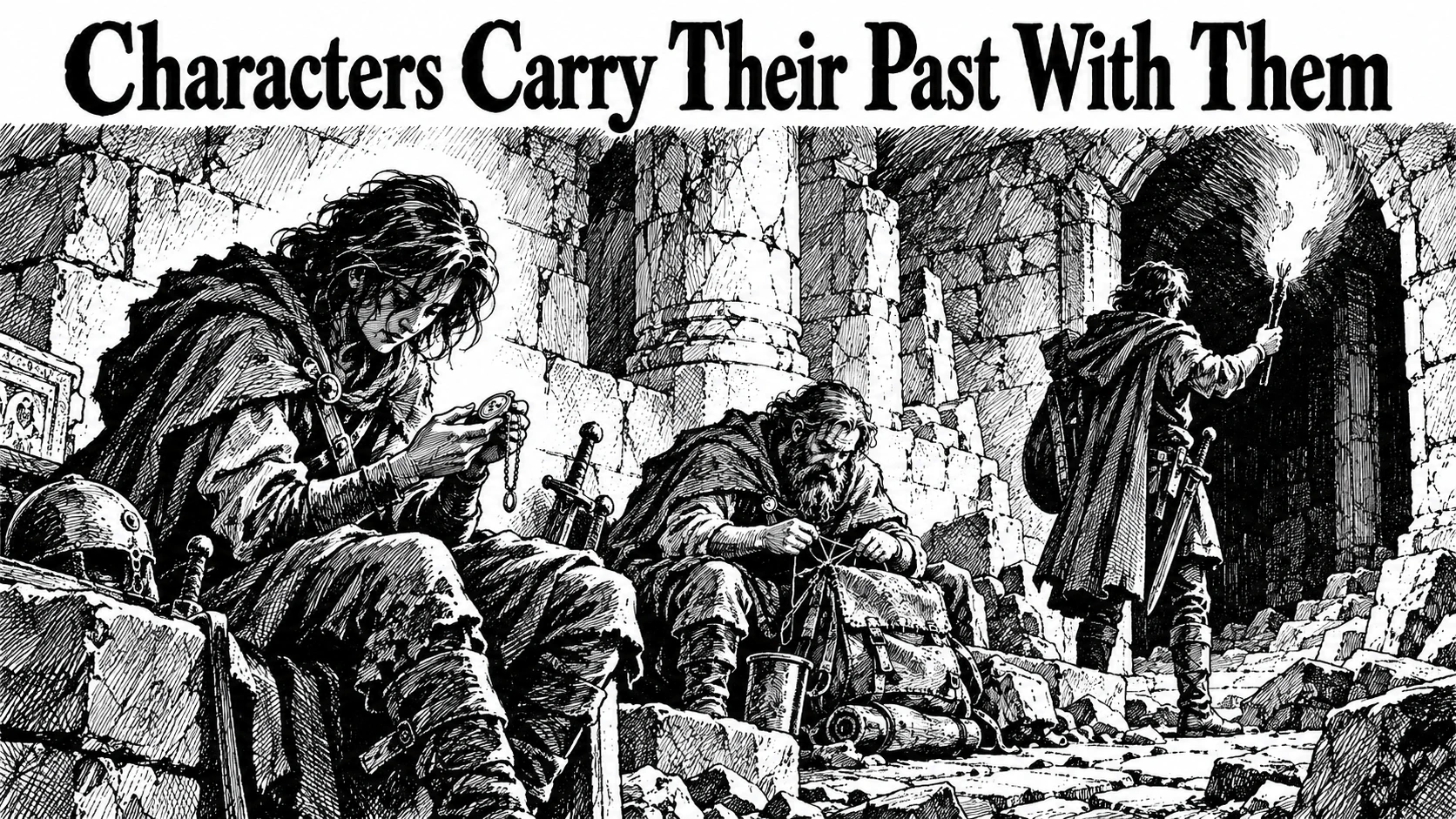
A Past Gives You Something to Play
A backstory can contain a great deal of information without giving the player much to use.
Names of ancestors.
Dates of wars.
A list of places the character has visited.
Those details may help establish the world. But at the table, I want to know what changes because the character lived through them.
Suppose someone once worked on a river ferry.
What might that experience give them?
Perhaps they watch the current before agreeing to a crossing.
They know how passengers behave when they are frightened.
They recognize the difference between a useful rope and one that only looks sound.
These are imagined examples, not automatic rules benefits.
They give the player ways to notice things, ask questions, and contribute to a scene.
The past becomes useful when it provides a starting point for action.
Begin With an Ordinary Life
A character's history does not have to begin with a catastrophe.
People learn things while doing ordinary work.
A kitchen teaches timing, attention, and how to continue when three people need something at once.
A market stall teaches bargaining and the cost of wasting stock.
A family farm teaches seasons, repairs, and what happens when a task is put off.
Those experiences can remain relevant when the character becomes an adventurer.
Someone who once repaired tools may notice that a door has been forced recently.
Someone who served meals may recognize that a supposedly deserted house was occupied this morning.
The character does not have to turn every observation into a speech about their childhood.
They can simply see something another person might miss.
Let a Skill Carry a Memory
In Welcome to Kharadorn, I introduced Jinx through the developing novel's opening.
Her background includes her father's tailoring business.
That gives her something beyond a role in an adventuring company. Reading a customer and keeping a conversation moving were useful before she stepped onto the road.
The interesting connection is what she brings into the present.
A way of listening.
A practical concern about payment.
Attention to the difference between an attractive promise and an arrangement that will actually work.
For your own character, ask the same kind of question.
What did they do often enough to become good at it?
What did that work teach them about other people?
Which habit remains after the work itself has ended?
A small answer can give you more to portray than a long account of a battle nobody at the table has experienced.
Give Them Someone to Think About
Relationships make history easier to bring into play.
Someone taught the character.
Someone disagreed with them.
Someone still expects them to return.
That person does not have to be an enemy, a missing relative, or a future hostage.
Perhaps the character writes to an older sister whenever they reach a town.
Perhaps a former employer would welcome them back, but they are not ready to admit they might need the work.
Perhaps they remember a friend's advice and argue with it even when the friend is nowhere nearby.
A relationship gives a decision another point of reference.
What would this person think?
What have I promised them?
What am I prepared to tell them afterward?
The answer can matter without becoming the main quest.
Show the Past in a Small Choice
Imagine a traveler who grew up in a household where food was uncertain.
At an inn, they order enough for tomorrow and wrap part of the meal before eating.
Another traveler asks why.
Now there is an opening.
The character might answer honestly.
They might make a joke.
They might say it is simply sensible to carry food.
Any of those responses tells us something.
The past does not need to arrive as a full explanation. A small choice lets another person notice it and decide whether to ask more.
This is one way characters can discover each other while the adventure continues.
A Habit Is a Starting Point
History can explain a response without requiring the character to repeat it forever.
Someone who was deceived may approach a generous offer cautiously.
That gives you a starting position in the conversation.
It does not decide whether they must reject the offer.
What evidence would change their mind?
Who could help them assess it?
What happens if they take the risk and it works?
Those questions leave room for growth.
At the table, a character's history should help you make choices while leaving the other players room to make theirs.
A suspicious character can ask difficult questions and still cooperate.
An independent character can learn to accept help.
A frightened character can choose to continue.
The new decision becomes part of their history too.
Share What the Game Master Can Use
A backstory becomes easier to work with when it includes a few clear connections.
Give the Game Master a person, a place, an unfinished obligation, or an unanswered question.
Then discuss what kinds of developments you would enjoy.
Perhaps you want an old friendship to return.
Perhaps you would enjoy revisiting a place the character left.
Perhaps a family detail exists only to help you portray them, and you want it to remain in the background.
That distinction is useful.
You can offer material without giving every personal detail the same purpose.
A shared understanding helps the Game Master connect history to play in ways the player actually wants to explore.
Keep Track of What Happens Next
Preparation gives the character a beginning.
Play adds events nobody could have written in advance.
The companion who held the rope.
The promise made after a failed plan.
The town where someone remembered their name.
The argument they wish they had handled differently.
Write down a few of those moments.
What happened?
Who was involved?
What changed for the character?
A sentence may be enough.
Six sessions later, that record can explain why they trust one companion with a difficult task or hesitate before making a familiar mistake.
The campaign is creating a shared past.
Let it become available to the next decision.
Try Four Short Prompts
If a character's history feels difficult to use, begin here:
Work: What did they do before adventuring, and what habit did it leave?
Relationship: Who still matters to them, and why?
Memory: What experience influences a decision they may face?
Possibility: What might cause them to reconsider an old belief?
You do not need a complete biography to answer those questions.
You need enough to begin portraying a person.
As with Give the NPC a Life, a few useful details can provide structure while leaving room for discovery.
Then put the character into the world.
See what they notice.
See who they trust.
See what they choose when the present asks something their history has not prepared them to answer.
The past gives them somewhere to begin. What they do next gives them somewhere to go.
END OF